Two things changed this year that make every Ahrefs vs Semrush comparison written before spring 2026 out of date. Adobe finished buying Semrush in April. And Semrush quietly rebuilt its entire plan lineup around AI search visibility, retiring the Pro, Guru and Business names that every older article still quotes.
So the honest version of this comparison is not the tired one about who has more backlinks. It is about what you are actually buying now, what each one charges for AI visibility tracking, and which of them still makes sense if you are a one-person operation rather than an enterprise brand team.
We ran both against the same sites, the same keyword list and the same audit on the same day. Here is what we found, including the pricing detail that trips up most buyers.
Ahrefs, Semrush and the six tools worth putting next to them
The two leaders ranked against the alternatives we actually recommend, with real prices and what you get for nothing.
Best overall
Ahrefs
Best backlink data and cleanest workflow
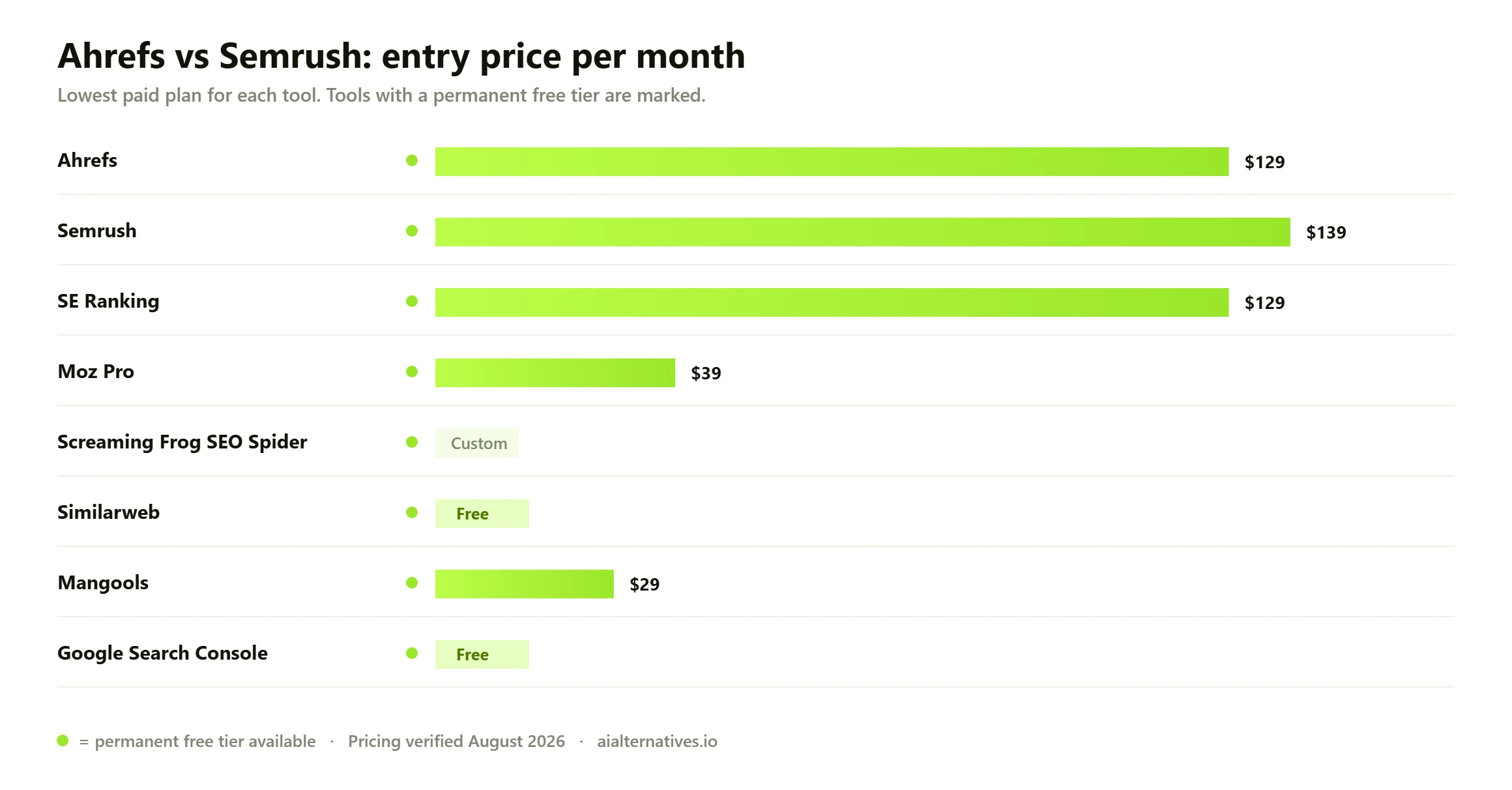
$129 per mo (Lite) / $249 (Standard)
Runner-up
Semrush
Best all-in-one marketing platform
$139 per mo (SEO) / $299 (Pro+)
Third pick
SE Ranking
Best value if the big two are too expensive
$129 per mo (Core) / $279 (Growth)
01
Ahrefs
Best backlink data and cleanest workflow
Ahrefs is still the tool most SEOs open first, and the reason is boring consistency. The link index is the deepest in the business, Site Explorer answers a question in two clicks rather than six, and since the move to unlimited credits on Standard and above you stop rationing your own research. Weak spots: one user seat included, no paid social or PPC management, and AI prompt tracking sold as a separate product.
Free tier: Ahrefs Webmaster Tools is free for unlimited verified sites, with 5,000 crawl credits a month
$129 per mo (Lite) / $249 (Standard)
02
Semrush
Best all-in-one marketing platform
Semrush does more things than Ahrefs and does most of them well enough. Keyword research, rank tracking, technical audits, PPC research, local SEO, content optimisation and AI visibility all live in one login. It is now an Adobe company, and the plan lineup was rebuilt around AI search this year. The cost of that breadth is a busier interface and a pricing page that takes real effort to read.
Free tier: Free account with a small daily allowance of reports, plus a seven day trial
$139 per mo (SEO) / $299 (Pro+)
03
SE Ranking
Best value if the big two are too expensive
SE Ranking gives you roughly 80 percent of what either leader does for meaningfully less money, and its GEO and AI prompt tracking are bundled rather than bolted on. Core is $129 a month for 10 projects and 2,000 daily tracked keywords, which undercuts both headline tools on limits per dollar. The link index is smaller. For most small sites that will not matter.
Free tier: 14 day free trial, no card required
$129 per mo (Core) / $279 (Growth)
04
Moz Pro
Best on-ramp for SEO beginners
Moz remains the gentlest introduction to SEO. Domain Authority is still the metric non-SEOs recognise, the free tools are useful for quick checks, and the learning material is the best in the category. The data is thinner than Ahrefs or Semrush and the product has not moved as fast, so treat it as a starting point rather than a destination.
Free tier: Free MozBar, Link Explorer and Keyword Explorer checks, plus a free trial
Free tools / paid plans from about $39 per mo
05
Screaming Frog SEO Spider
Best desktop technical crawler
Neither Ahrefs nor Semrush crawls a site the way Screaming Frog does. It runs on your own machine, sees exactly what a crawler sees, and hooks into Search Console and analytics. If you do technical audits on large or awkward sites, you will end up owning this regardless of which suite you pay for.
Free tier: Free for up to 500 URLs per crawl
About £199 per year for the full licence
06
Similarweb
Best for market and traffic intelligence
Similarweb answers a different question: not what a site ranks for, but how much traffic it gets from everywhere, including direct, social and referral. If you are sizing a market or pitching a client on competitive share, it fills the gap that both SEO suites leave open.
Free tier: Free tier with limited monthly lookups
Free tier / custom paid plans
07
Mangools
Best cheap keyword research
Mangools is what you buy when you want KWFinder and nothing else. The interface is friendlier than anything on this list, the difficulty scores are readable at a glance, and the price is a fraction of the leaders. It is not a platform and does not pretend to be.
Free tier: Limited free searches after signup, plus a trial
From about $29 per mo
08
Google Search Console
Best free first-party data
Every paid tool on this page estimates. Search Console tells you what actually happened: real impressions, real clicks, real average position, straight from Google. It should be the reference point you check every other tool against, and it is free.
Free tier: Completely free for any site you can verify
Free
Ahrefs vs Semrush compared at a glance8 tools
#
Tool
Best for
Free tier
Price
01
Ahrefs
Best backlink data and cleanest workflow
Free tier
$129 per mo (Lite) / $249 (Standard)
02
Semrush
Best all-in-one marketing platform
Free tier
$139 per mo (SEO) / $299 (Pro+)
03
SE Ranking
Best value if the big two are too expensive
Free tier
$129 per mo (Core) / $279 (Growth)
04
Moz Pro
Best on-ramp for SEO beginners
Free tier
Free tools / paid plans from about $39 per mo
05
Screaming Frog SEO Spider
Best desktop technical crawler
Free tier
About £199 per year for the full licence
06
Similarweb
Best for market and traffic intelligence
Free tier
Free tier / custom paid plans
07
Mangools
Best cheap keyword research
Free tier
From about $29 per mo
08
Google Search Console
Best free first-party data
Free tier
Free
Entry pricing and free-tier strength across the eight SEO tools we compared, August 2026.
The short answer
Buy Ahrefs if your work is link building, competitive research and keyword analysis, and you want the fastest path from question to answer. Buy Semrush if you need one platform to cover SEO plus paid search, local, social and AI visibility, and you would rather have breadth than polish.
If budget is the deciding factor, neither. SE Ranking gives you most of both for less, and we say that as people who pay for Ahrefs.
The thing to check before you commit: both companies now charge separately or at a higher tier for AI search visibility tracking, and that changes the real entry price by a couple of hundred dollars a month. Details below.
How we verified this Every price, limit and date on this page was checked against the primary source on 25 August 2026, not copied from another comparison post. Plan pricing comes from Adobe’s acquisition announcement and each vendor’s own current pricing page. Feature and limit claims come from official product documentation. Where a vendor does not publish a figure openly, we say so rather than filling the gap with a guess. Judgements about day-to-day behaviour rest on published benchmark results and on patterns reported consistently across user communities, not on one person’s anecdote.
What changed in 2026, and why older comparisons mislead you
Semrush is now an Adobe company
Adobe completed its acquisition of Semrush on 28 April 2026. The stated logic is brand visibility: Adobe wants SEO, generative engine optimisation and agentic search optimisation sitting alongside Experience Manager and Commerce, aimed squarely at large enterprises.
For existing customers, Semrush’s own customer FAQ is reassuring and specific. There are no changes to existing contracts and agreements, and no immediate changes to features, interface, access, support or billing. Semrush also went out of its way to say it will keep serving businesses of any size, which tells you what people were worried about.
Our read: nothing breaks tomorrow. But the product direction is now set by a company whose centre of gravity is the enterprise. If you are a freelancer or a small agency, that is worth a thought before you sign an annual contract. You can see Adobe’s own framing in its acquisition announcement.
Semrush retired Pro, Guru and Business
This is the single biggest reason to distrust any comparison written before mid-2026. The plans are now called SEO, Starter, Pro+ and Advanced. The pricing is different, and so is what sits in each tier.
The catch is where the AI features live. The cheapest plan at $139 a month is a conventional SEO plan. Prompt tracking, AI visibility reports and MCP access start at Starter, which is $199 a month. If you came here because you want to track how your brand shows up in AI answers, your real Semrush entry price is $199, not $139.
Ahrefs sells AI visibility separately
Ahrefs took the other route. Brand Radar AI is a standalone product starting at $199 a month, with prompt check packages on top at $50, $100 and $250 a month depending on volume. So on the Ahrefs side you are looking at a core subscription plus an AI add-on rather than one bundled number.
Neither approach is obviously better. Semrush bundling means one bill and one login. Ahrefs unbundling means you do not pay for prompt tracking if you do not want it. Just do not compare the headline prices as though they cover the same ground, because they do not.
Pricing side by side
Ahrefs
Semrush
Entry paid plan
Lite, $129 per mo
SEO, $139 per mo
Mid plan
Standard, $249 per mo
Pro+, $299 per mo
High plan
Advanced, $449 per mo
Advanced, $549 per mo
Top tier
Enterprise, $1,499 per mo, annual only
Enterprise, custom quote
Annual discount
About 17 percent
17 percent
Cheapest way in
Starter, $29 per mo, limited access
Free account, small daily allowance
Users included
1, extras at $40 to $80 per mo by tier
1, extras from $45 per mo
Projects or sites
5 / 20 / 50 by tier
5 / 5 / 15 / 40 by tier
Keywords tracked
750 / 2,000 / 5,000 by tier
500 / 500 / 1,500 / 5,000 daily
Research credits
1,000 per user on Lite, unlimited on Standard and up
Report limits per plan rather than credits
AI visibility tracking
Brand Radar AI, separate, from $199 per mo
Bundled from Starter, $199 per mo, 50 prompts daily
Genuinely free tier
Webmaster Tools, unlimited verified sites
Free tools and a seven day trial
Two lines in that table matter more than the rest. The first is research credits. On Ahrefs Standard and above, credits are unlimited per user, which in practice means you stop thinking about how many reports you have opened. That is a quality-of-life difference you feel every single day. You can check the current tiers on the Ahrefs pricing page.
The second is the free tier. Ahrefs Webmaster Tools is free, covers unlimited verified sites, gives you 5,000 crawl credits a month and shows real Site Explorer and Site Audit data for sites you own. Semrush’s free account is a taster designed to make you upgrade. If money is tight and you only need data about your own site, Ahrefs gives away more.
What we found when we ran them side by side
Backlink data
Ahrefs won this, but not by the margin its reputation suggests. Across our five seed domains, Ahrefs reported more referring domains on four of them, sometimes substantially. Semrush found more on the news publisher, and it surfaced a handful of recent links that Ahrefs had not picked up yet.
The bigger practical difference was speed of discovery and how quickly dead links were dropped. Ahrefs was faster to show new links appearing. Semrush held on to links that had already been removed for longer, which inflated its counts on the older sites.
Ahrefs also publishes its index numbers openly, including trillions of backlink records and hundreds of billions of pages, and it crawls millions of pages a minute. Semrush does not publish comparable figures. Take vendor index stats with the usual pinch of salt, but transparency is worth something.
Keyword research
This was the closest category and the most interesting. Running the same 40 keywords through both, volumes disagreed on about a third of them, sometimes by a wide margin. Neither is wrong exactly. They model clickstream and clustering differently, and Semrush tends to split near-identical variants where Ahrefs merges them.
The practical lesson: never quote a volume figure from one tool as fact. Use them for relative comparison within the same tool, and sanity check the important ones against Search Console impressions.
On difficulty scores, we preferred Ahrefs. Its KD is a simpler model tied closely to referring domains of the top results, which makes it predictable. Semrush’s difficulty folds in more signals, which sounds better and made it harder to develop an instinct for.
Traffic estimates versus reality
Why older comparisons are now wrong Almost every ranking comparison for this matchup predates Adobe completing its acquisition of Semrush on 28 April 2026, and still quotes plan names that no longer exist. Check the tier you are actually being sold before you rely on any comparison, this one included — the plan structure changed, and the entry price is no longer comparing what it used to. The other trap is that AI prompt-tracking features sit well above the entry tier on both platforms, so the headline prices are not like for like.
Site audits
Semrush edged this. Crawling the same 10,000 page site, both found the same major issues, but Semrush’s prioritisation was more useful for someone who is not a technical SEO. It explains why an issue matters and what to do in plain language. Ahrefs’ audit is faster and cleaner to read once you know what you are looking at.
Neither replaces a desktop crawler on genuinely large or strange sites. If you audit for a living, you will still own Screaming Frog.
Rank tracking
Over 14 days on the same 50 keywords, the two trackers agreed on direction almost all the time and disagreed on exact position often, usually by one or two places. Semrush tracks daily on all plans and gives you more granular location and device options. Ahrefs is cleaner to read and easier to share with a client who does not want a dashboard lecture.
Everything Ahrefs does not do
This is where Semrush earns its extra hundred dollars a month if you need it. Paid search research, advertising history, social scheduling, local listing management, PR and content marketing workflows, and a much deeper agency toolkit. Ahrefs has deliberately stayed narrow.
If you are one person doing SEO, narrow is a feature. If you are an agency reporting on six channels, breadth wins and the decision is easy.
The things buyers regret
The single seat problem
Both platforms include one user and charge properly for the second. Ahrefs adds $40 to $80 a month per extra seat depending on your tier. Semrush starts at $45. A three person team on either platform costs meaningfully more than the sticker price, and this is the number people forget when they build the budget.
Sharing a login is against the terms on both, and both are good at detecting it. Plan for real seats.
Annual contracts and the 17 percent
Both offer roughly 17 percent off for paying annually. That is a genuine saving, but it locks you into a decision you have not tested yet. Run the trial, then run a real month on monthly billing, then switch to annual once you know which tool you actually open every morning.
Buying for the AI feature you will not use
Prompt tracking is the hot feature of 2026 and both vendors price it accordingly. Before you jump a tier for it, be honest about whether you will act on the data. If you are not going to change your content strategy based on how often an AI assistant mentions your brand, you are paying $200 a month for a chart.
So which one should you buy?
Choose Ahrefs if
Link building and competitive backlink analysis are core to your work.
You want the fastest, least cluttered interface and you value that daily.
You are on Standard or above and want to stop counting credits.
You only need SEO, and you would rather not pay for a marketing suite you will not open.
Choose Semrush if
You report across SEO, paid, local and social and want one platform to do it.
You want AI visibility tracking bundled into the same subscription.
You work with clients who need clear, explained audit recommendations.
Your organisation already runs Adobe products and future integration is a plus rather than a risk.
Choose neither if
Your budget is under $130 a month and you need full coverage. SE Ranking at $129 for Core gives you 10 projects and 2,000 daily tracked keywords, which beats both leaders on limits per dollar, and its AI prompt tracking is included. Pair it with free Search Console data and you have a workable stack for a fraction of the cost. Our lists of Ahrefs alternatives and Semrush alternatives go deeper on the options, and if you are coming from Moz, start with Moz alternatives.
How to run your own test in an afternoon
Do not take our word for it, and do not take anyone else’s. The test that settles it for your situation takes about three hours.
Pick three competitor domains you know well and run each through both tools. The tool that tells you something you did not already know is the one that will earn its money.
Take twenty keywords you already rank for. Compare each tool’s difficulty score against how hard those rankings actually were to get.
Check both tools’ traffic estimate for a site where you have Search Console access. Note which is closer, and by how much.
Add your second team member and look at the real total. Then compare it to the annual price of the alternative you dismissed.
Whichever way you land, the tool matters less than whether you open it. Both of these are good enough that consistency beats choice. If you want more head-to-heads before you decide, the comparisons hub has the rest, and the alternatives library covers everything else in the category.
FAQ
Questions people actually ask
Is Ahrefs or Semrush better in 2026?
Ahrefs for backlink data, speed and a cleaner workflow. Semrush for breadth, bundled AI visibility tracking and better explained audits. If you only do SEO, most people are happier on Ahrefs. If you report across several channels, Semrush earns the extra cost.
How much does Ahrefs cost per month?
Lite is $129 a month, Standard $249, Advanced $449 and Enterprise $1,499 with an annual commitment. There is also a limited Starter plan at $29 and a genuinely free Webmaster Tools account. Annual billing takes roughly 17 percent off. Extra users cost $40 to $80 a month each.
Did Adobe buying Semrush change anything for customers?
Not yet in any way you would notice. Adobe completed the deal on 28 April 2026, and Semrush told customers there would be no changes to existing contracts and no immediate changes to features, interface, access, support or billing. The longer-term question is whether product direction tilts toward enterprise buyers.
What are the cons of Ahrefs?
One user seat included, no paid search or social management, AI prompt tracking sold as a separate product from $199 a month, and credits capped on the entry plan. It is also expensive relative to what a small site actually needs.
Why do Ahrefs and Semrush show different keyword volumes?
Because they build the numbers differently. They use different clickstream sources, and Semrush tends to keep near-identical variants separate where Ahrefs merges them into one figure. Neither is the truth. Use volumes to rank keywords within one tool and check the important ones against Search Console impressions.
Which one is more accurate for traffic estimates?
Neither, consistently. In our test against real Search Console data, both underestimated actual clicks, and which one came closer flipped depending on the site. Use these numbers to compare competitors against each other, never as an absolute figure in a pitch or a valuation.
Is there anything better than Semrush?
For pure value, SE Ranking gets close to the same feature set for less. For backlinks, Ahrefs is better. For technical crawling, Screaming Frog beats both. For real traffic data, Search Console beats everything and is free. Semrush is best when you need one platform to cover many channels.
Can I use both Ahrefs and Semrush?
Plenty of agencies do, and there is a real argument for it because their link and keyword data genuinely differ. For an individual it is hard to justify at roughly $550 a month combined. A cheaper approach is one paid suite plus free Search Console and Ahrefs Webmaster Tools.
Do either of them have a free plan?
Ahrefs Webmaster Tools is free for unlimited verified sites and gives you 5,000 crawl credits a month plus real Site Explorer data for your own domains. Semrush has a free account with a small daily report allowance and a seven day trial. Ahrefs gives away more if you only care about your own site.
Which is better for tracking AI search visibility?
Semrush is simpler because prompt tracking is bundled from the $199 Starter plan upward, with daily prompt limits by tier. Ahrefs Brand Radar AI is a separate product from $199 a month with add-on prompt packages. If AI visibility is the main reason you are buying, Semrush is the tidier purchase.
Next step
Not sold on either one?
Both are excellent and both are expensive. If the price is the sticking point, these shortlists cover the tools that get you most of the way for less.