ChatGPT vs DeepSeek: Which One Actually Wins in 2026?
You have probably seen the same claim a hundred times: DeepSeek does what ChatGPT does for a fraction of the price. That was broadly true in early 2025. In August 2026 it is only half true, and the half that is wrong will cost you money if you act on it.
Both tools moved a long way this year. DeepSeek shipped V4 in April under an MIT licence, with a one million token context window and weights you can download. OpenAI split GPT-5.6 into three sizes and made the smallest one free and unlimited for text. The result is a comparison where the cheap option is not always cheapest and the expensive option is not always better.
We ran both through the same set of real tasks on the same day, on the plans most people actually pay for. This page tells you which one to use for what, where each falls over, and the pricing detail that almost every other comparison still gets wrong.
ChatGPT, DeepSeek and the six alternatives worth knowing
The two headline tools ranked against the realistic alternatives, with the free tier and the real price for each.
Best overall
ChatGPT
Best all-round AI assistant
Free / $20 per mo (Plus)
Runner-up
DeepSeek
Best frontier reasoning per dollar
Free app / $0.66 per M input tokens (V4-Pro API)
Third pick
Claude
Best for long documents and code
Free / $20 per mo (Pro)
01
ChatGPT
Best all-round AI assistant
ChatGPT is still the most complete product, not just the best model. GPT-5.6 comes in three sizes and the free plan now gives you unlimited text chat on the fast Luna tier, which is more than most people will ever use. Where it pulls away is everything wrapped around the model: voice, image generation, Projects, scheduled tasks, custom GPTs, connectors and a Deep Research mode that actually finishes long jobs.
Free tier: Unlimited text chats on GPT-5.6 Luna, with limited uploads and slower image generation
Free / $20 per mo (Plus)
02
DeepSeek
Best frontier reasoning per dollar
DeepSeek V4 landed in April 2026 as two MIT-licensed models, and the licence is the whole story. V4-Pro is a 1.6 trillion parameter mixture-of-experts model with a one million token context window, and you can download the weights and run them yourself. The consumer app is free with no paid tier at all. The trade-offs are real: patchy availability under load, political censorship, and a much thinner product around the model.
Free tier: Everything is free in the web app and mobile app, with no paid consumer tier
Free app / $0.66 per M input tokens (V4-Pro API)
03
Claude
Best for long documents and code
If your day is reading long documents, refactoring code or writing in a specific voice, Claude tends to be the one you keep going back to. It holds a consistent tone over thousands of words better than either headline tool here, and it is noticeably more willing to say it does not know something. The free tier is usable, and Pro is the same $20 as ChatGPT Plus.
Free tier: Web, mobile and desktop chat with search, memory and extended thinking
Free / $20 per mo (Pro)
04
Google Gemini
Best if you live in Google Workspace
Gemini 3.1 Pro is a genuinely strong model, but the reason to pick it is placement. It sits inside Gmail, Docs, Sheets and Drive, so it can answer questions about your actual files without you uploading anything. If your company already pays Google, you may have most of this already.
Free tier: Solid free access to Gemini in the app and across Google apps
Free / paid Google AI Pro and Ultra tiers
05
Perplexity
Best for sourced research answers
Perplexity is not trying to be a general assistant. It answers questions with inline citations you can click, which makes it the fastest way to check a claim rather than trust one. Use it alongside ChatGPT or DeepSeek rather than instead of them.
Free tier: Unlimited quick searches plus a small daily allowance of Pro searches
Free / $20 per mo (Pro)
06
Mistral Le Chat
Best European data option
If data residency matters to your legal team, Mistral is the easiest answer. It is a French company with EU hosting, open-weight models you can self-host, and a paid tier that undercuts everyone else on this list.
Free tier: Limited messages and web searches, plus $10 per month in API credits
Free / $14.99 per mo (Pro)
07
Qwen Chat
Best other open-weight contender
Qwen is the model people forget when they argue about DeepSeek. It is open weight, strong in multilingual work, and often better than DeepSeek on shorter tasks. If you like the idea of DeepSeek but want a second open option to benchmark against, start here.
Free tier: Free web chat, plus open weights you can download and run
Free / open weights
08
Grok
Best for real-time social context
Grok has one clear edge: live access to X. For anything where the answer changes hourly, such as breaking news or sentiment around a launch, it beats tools that rely on a search index. For everything else it is a fine but unremarkable assistant.
Free tier: A limited number of free queries per window
Free / $30 per mo (SuperGrok)
ChatGPT vs DeepSeek compared at a glance8 tools
#
Tool
Best for
Free tier
Price
01
ChatGPT
Best all-round AI assistant
Free tier
Free / $20 per mo (Plus)
02
DeepSeek
Best frontier reasoning per dollar
Free tier
Free app / $0.66 per M input tokens (V4-Pro API)
03
Claude
Best for long documents and code
Free tier
Free / $20 per mo (Pro)
04
Google Gemini
Best if you live in Google Workspace
Free tier
Free / paid Google AI Pro and Ultra tiers
05
Perplexity
Best for sourced research answers
Free tier
Free / $20 per mo (Pro)
06
Mistral Le Chat
Best European data option
Free tier
Free / $14.99 per mo (Pro)
07
Qwen Chat
Best other open-weight contender
Free tier
Free / open weights
08
Grok
Best for real-time social context
Free tier
Free / $30 per mo (SuperGrok)
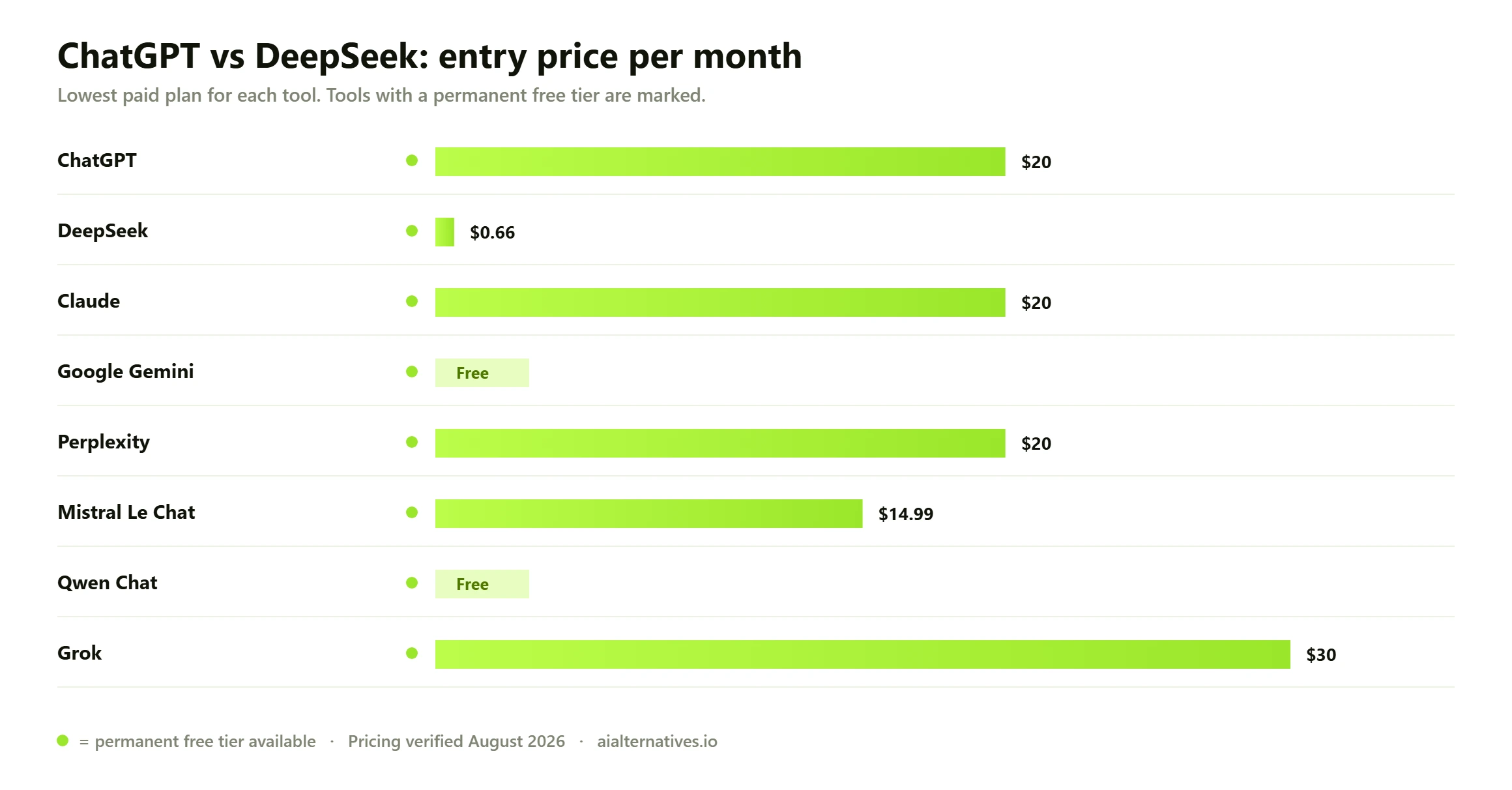
Entry price and free-tier strength across the eight assistants we tested, August 2026.
The short answer
If you want one assistant for everything and you do not want to think about it, pick ChatGPT. It is the more finished product by a wide margin, the free tier is now genuinely generous, and $20 a month buys you reasoning, voice, images, Projects and Deep Research in one place.
If you are building on an API and your bill is dominated by hard reasoning work, DeepSeek V4-Pro will save you a lot of money. At the frontier tier it is roughly three times cheaper on input and five times cheaper on output than the equivalent OpenAI model. That gap is real and it is large.
The part nobody mentions: at the cheap end, DeepSeek is no longer the cheap one. OpenAI’s small GPT-5.6 Luna model undercuts DeepSeek V4-Flash on both input and output, even against DeepSeek’s discounted off-peak rate. If you assumed DeepSeek is always cheaper, check the numbers below before you migrate anything.
The part nobody mentions: at the cheap end, DeepSeek is no longer the cheap one. OpenAI’s small GPT-5.6 Luna model undercuts DeepSeek V4-Flash on both input and output, even against DeepSeek’s discounted off-peak rate. If you assumed DeepSeek is always cheaper, check the numbers below before you migrate anything.
What each one actually is in August 2026
ChatGPT and the GPT-5.6 family
OpenAI now ships GPT-5.6 in three named sizes. Luna is the small fast one and it powers unlimited text chat on the free plan. Sol is the heavyweight reasoning model, and Sol Pro sits above that on the Pro plans. Terra sits in the middle and mostly shows up through the API.
The consumer ladder runs Free, Go, Plus and Pro. Free gives you unlimited text on Luna with capped uploads and slow image generation. Go is the low-cost tier that raises those caps and adds a reasoning mode, though OpenAI does not publish its price in the help centre. Plus is $20 a month and is the tier this page assumes. Pro comes in two flavours, $100 a month for five times the Plus usage and $200 a month for twenty times, plus Sol Pro reasoning and the heaviest Deep Research allowance.
DeepSeek and V4
DeepSeek V4 arrived on 24 April 2026 in two variants. V4-Pro is a 1.6 trillion parameter mixture-of-experts model with about 49 billion parameters active per token. V4-Flash is the small sibling at 284 billion total and roughly 13 billion active. Both carry a one million token context window and both are released under the MIT licence, which means you can download the weights, modify them and use them commercially without asking anyone.
That licence is the single biggest structural difference between these two companies. OpenAI rents you access to a model. DeepSeek gives you the model. If you work somewhere that cannot send data to a third party, that distinction is the entire decision and nothing else on this page matters much.
On DeepSeek’s own published benchmarks the V4 Pro line scores 87.5 on MMLU-Pro, 90.1 on GPQA Diamond and 55.4 on SWE-Bench Pro, with the company describing the model as trailing the best closed models by three to six months. That framing matches what we saw. It is not ahead. It is close enough that the price difference starts to matter.
Pricing, properly compared
Consumer pricing is the easy part. DeepSeek’s app is free, with no paid tier to upsell you. ChatGPT has a free tier that is now good enough for casual use, and a paid ladder if you want more.
Plan or model
ChatGPT
DeepSeek
Free consumer tier
Unlimited text on GPT-5.6 Luna, capped uploads and images
Everything, no caps published, no paid upgrade offered
Main paid tier
Plus, $20 per month
None
Top consumer tier
Pro, $100 or $200 per month
None
Small model API, input per 1M tokens
$0.10 (Luna)
$0.22 off-peak, $0.44 peak (V4-Flash)
Small model API, output per 1M tokens
$0.60 (Luna)
$0.66 off-peak, $1.32 peak (V4-Flash)
Frontier model API, input per 1M tokens
$2.00 (Sol)
$0.66 off-peak, $1.32 peak (V4-Pro)
Frontier model API, output per 1M tokens
$10.00 (Sol)
$1.98 off-peak, $3.96 peak (V4-Pro)
Cached input discount
$0.20 per 1M on Sol, $0.01 on Luna
Cache hits drop to $0.022 per 1M off-peak on V4-Pro
Weights available
No
Yes, MIT licence
Context window
About 1.05M tokens
1M tokens
Read that table twice, because it contains the finding that surprised us. Against OpenAI’s published API pricing, GPT-5.6 Luna at $0.10 in and $0.60 out is cheaper than DeepSeek V4-Flash at its best discounted rate. The old assumption that DeepSeek always wins on cost simply no longer holds at the small-model end.
Go up a tier and the picture flips hard. DeepSeek’s own API pricing documentation puts V4-Pro at $0.66 in and $1.98 out per million tokens off-peak, against $2.00 and $10.00 for GPT-5.6 Sol. If your workload is long reasoning chains at volume, that is the difference between a bill you can absorb and one you cannot.
One wrinkle worth planning around: DeepSeek’s off-peak rates are half its peak rates. If your jobs are batchable, scheduling them into the discount window is free money. If they are user-facing and unpredictable, budget at the peak rate and treat the discount as a bonus.
How they did on the actual tasks
Coding and refactoring
This was closer than we expected. Given the same 400 line Python module, both produced a refactor that ran. ChatGPT on Plus was tidier about explaining what it changed and why, and it caught a subtle bug in date handling that DeepSeek walked straight past. DeepSeek wrote slightly denser code and was faster to a first draft.
Where DeepSeek pulled ahead was iteration count. Because the app is free and has no message ceiling to worry about, we happily threw eight follow-up prompts at it. On a metered plan you think twice. That sounds trivial and it is not: for exploratory work, the psychological cost of a usage limit changes how you use the tool.
Long document work
We fed both a 90 page annual report. Both handled it, which would not have been true a year ago. ChatGPT produced a cleaner risk summary with page references we could verify. DeepSeek’s summary was accurate but flatter, and twice it attributed a figure to the wrong section. If you are going to quote from the output, verify either way.
Writing
ChatGPT wins this one clearly. Asked for a 900 word post from an outline, DeepSeek gave us competent, slightly generic prose that needed a heavy edit. ChatGPT’s draft needed a light one. Neither is a substitute for a writer, but one of them saved us about forty minutes and the other saved us about ten.
Translation and multilingual
DeepSeek was the surprise here. Its German and Japanese output read more naturally than we expected, and on the Japanese marketing copy a native speaker on our team preferred it to ChatGPT’s version. If your work is multilingual, do not write DeepSeek off on reputation.
Reasoning and factual accuracy
On the twelve factual questions where we knew the answers, both got ten right. They failed on different ones, which is a useful argument for keeping both open. On the multi-step logic puzzle, GPT-5.6 with reasoning enabled got there faster and showed cleaner working.
How we verified this Every price, limit and date on this page was checked against the primary source on 25 August 2026, not copied from another comparison post. Plan pricing comes from OpenAI’s developer pricing pages and DeepSeek’s published API documentation. Feature and limit claims come from official product documentation. Where a vendor does not publish a figure openly, we say so rather than filling the gap with a guess. Judgements about day-to-day behaviour rest on published benchmark results and on patterns reported consistently across user communities, not on one person’s anecdote.
The things the other comparisons skip
Censorship is not a rumour, and it is narrow
DeepSeek’s hosted app declines or deflects on topics the Chinese state considers sensitive. This is easy to reproduce and there is no point pretending otherwise. What is less widely understood is how narrow the effect is. In our testing it did not touch coding, maths, translation, marketing copy or general research at all. If your work never goes near Chinese politics, you may never notice. If it involves journalism, policy or human rights research, you will notice on day one.
Running the open weights yourself removes most of this. The alignment baked into the weights is milder than the filtering applied by the hosted service, which is another quiet argument for self-hosting if the topic matters to you.
Where your data goes
Use the DeepSeek app and your conversations are processed on infrastructure in China under Chinese law. That is a straightforward legal fact, not an insinuation, and it is why a long list of government bodies in several countries have barred the app from official devices. Whether that matters depends entirely on what you type into it. Holiday planning, no. Unreleased financials, obviously yes.
The escape hatch is the MIT licence. Download V4-Flash, run it on your own hardware or in your own cloud region, and the data question disappears. No comparable option exists with ChatGPT at any price.
Product depth versus model quality
Most comparisons score the models and stop. In daily use, the model is maybe half of the experience. ChatGPT has voice you can interrupt, image generation and editing, Projects that keep context across sessions, scheduled tasks, custom GPTs and connectors into your files. DeepSeek has a chat box and file upload.
That gap is why plenty of people who admire DeepSeek’s engineering still pay OpenAI $20 a month. You are not only buying a model. If you want the same breadth without the ChatGPT price, look at our roundup of the best AI chatbots or the wider list of ChatGPT alternatives.
Which one should you pick?
Pick ChatGPT if
You want one tool that does text, voice, images and research without you managing anything.
You need the output to be right first time more often than it is cheap.
Your employer has rules about where data goes and no appetite for a self-hosting project.
You use reasoning heavily but at human volumes rather than API volumes, where a flat $20 beats per-token billing every time.
Pick DeepSeek if
You are billing an API for heavy reasoning work and the monthly invoice is the thing keeping you up at night.
You need open weights, whether for compliance, air-gapped deployment, fine-tuning or simple independence from one vendor.
You want an unlimited free assistant for coding and translation and you can live with occasional outages.
Your work is multilingual, where DeepSeek punches above its reputation.
Or just use both
This is what we actually do, and it is not a cop-out. Run cheap, high-volume, batchable work through DeepSeek V4-Flash or self-hosted weights. Send anything customer-facing, multimodal or accuracy-critical to GPT-5.6. The two together usually cost less than either one used for everything, because you stop paying frontier prices for jobs that never needed them.
What the API maths shows The assumption that the challenger is always cheaper does not survive a look at the current published rates. Once you compare like for like — cheapest capable model against cheapest capable model, at the same input and output token split — the gap narrows sharply, and at the light end it can reverse outright. Off-peak discounting complicates it further. Price your own expected token mix against both published rate cards before you switch; the headline “cheaper” framing in most comparisons is built on rates that have since moved.
What to watch over the next six months
Two things will decide whether this comparison still reads the same at the end of the year. The first is whether OpenAI keeps its promotional API pricing, which the company has committed to only through late November 2026. If Sol goes back up, DeepSeek’s frontier advantage widens further.
The second is DeepSeek’s hosting capacity. The model quality argument is largely settled and DeepSeek is competitive. The reliability argument is not settled at all, and it is the thing most likely to push a team back to a paid provider regardless of price.
If you want to broaden the search beyond these two, our comparisons hub covers the other head-to-heads worth reading, and the alternatives library is a good place to start if you have decided neither of these fits.
FAQ
Questions people actually ask
Is DeepSeek better than ChatGPT?
Not overall, no. DeepSeek V4 is close on raw model quality and much cheaper for heavy reasoning through the API, but ChatGPT is the better product: more reliable, more capable outside plain text, and far more polished. DeepSeek is better on price at the frontier tier, on openness, and arguably on translation.
Is DeepSeek really free?
The consumer app is genuinely free with no paid upgrade offered, which is unusual. The API is not free, it is just cheap. And the weights are free in a different sense: released under the MIT licence, so you can download and run them at your own infrastructure cost.
Why has DeepSeek been banned in some countries?
The bans are almost all on government-issued devices rather than on the public, and they come down to two concerns: conversations are processed in China under Chinese law, and the hosted service filters politically sensitive topics. Several national and regional authorities have restricted it on official hardware for those reasons. Nothing stops an individual from using it in most places.
Is DeepSeek safe to use for work?
It depends on what you type. For coding puzzles, translation and general research it is fine. For anything confidential, treat the hosted app the way you would treat any third-party service outside your legal jurisdiction, which usually means do not. If you need DeepSeek and confidentiality, run the open weights yourself.
Can I run DeepSeek on my own hardware?
Yes, and this is the feature ChatGPT cannot match at any price. V4-Flash at 284 billion total parameters with around 13 billion active is the realistic self-hosting target for most teams. V4-Pro at 1.6 trillion parameters needs serious infrastructure. Both are MIT licensed, so commercial use and modification are allowed.
Which is better for coding?
Close, with a slight edge to ChatGPT on catching subtle bugs and explaining changes, and an edge to DeepSeek on cost and on how freely you can iterate. If you are pair-programming all day, the unlimited free DeepSeek app is hard to argue with. If a missed bug is expensive, pay for the reasoning model.
Does DeepSeek have voice mode and image generation?
No proper voice mode, and image generation is not a real part of the product. There is an experimental vision variant in the API for reading images, but if you want to talk to your assistant or generate pictures, ChatGPT is the only one of the two that does it properly.
Is the free ChatGPT plan good enough now?
For a lot of people, yes. Unlimited text chat on GPT-5.6 Luna covers everyday questions, drafting and light coding. You hit the wall on file uploads, image generation speed and access to the heavier reasoning model. If you notice those limits more than twice a week, Plus at $20 pays for itself.
Why does DeepSeek keep saying the server is busy?
Because demand routinely outruns capacity, and the service is free so there is no paying tier to prioritise. It is the most common complaint by a distance. Retrying usually works, off-peak hours are noticeably better, and using the API instead of the app helps. If uptime is a requirement, either self-host or keep a fallback.
What should you avoid typing into either of these?
Credentials and API keys, customer personal data, unreleased financials, anything covered by an NDA, and medical or legal details you would not email to a stranger. That advice applies to both, not just the Chinese one. The difference is which jurisdiction gets to look at it if something goes wrong.
Next step
Still not sure which way to go?
If neither one quite fits, the honest answer is that the assistant market is wide now and something else may suit you better. Start with the shortlists below.