The 10 Best Midjourney Alternatives in 2026 (Free and Paid)
Midjourney got better this year, not worse — V8.2 has been the default since 24 July 2026. So if you are looking to leave, it is almost certainly for one of four specific reasons: there is no free trial, you are metered on GPU hours, you cannot run it on your own machine, and three studios are suing it.
This guide covers ten alternatives: an open-weight frontier model you can download, a local stack, the one that gets text right, the one your legal team will accept, two free tiers that genuinely work, and the rest. Every price came off the vendor own page in August 2026.
Most guides ranking for this term are still arguing against Midjourney V6. We are not — and where Midjourney still wins, we will tell you.
Ranked on output quality, what they cost you to actually use, and whether you can run them yourself.
Best overall
FLUX (Black Forest Labs)
The frontier model you can own
Free weights / API pay-as-you-go
Runner-up
Stable Diffusion + ComfyUI
Total control, nothing per image
Free (you supply the GPU)
Third pick
Ideogram
The one that gets text right
Free / from $15 per mo (annual)
01
FLUX (Black Forest Labs)
The frontier model you can own
FLUX.2 [dev] is the strongest open-weight image model available, and FLUX 3 added joint image, video and audio in July 2026. Text rendering beats Midjourney outright.
Free tier: FLUX.2 [dev] and [klein] weights are Apache 2.0 — free to run yourself.
Free weights / API pay-as-you-go
02
Stable Diffusion + ComfyUI
Total control, nothing per image
LoRAs, ControlNet, inpainting and node graphs. Nothing else lets you fix the exact thing that went wrong instead of rerolling and hoping. The interface is a workshop, not an app.
Free tier: Free and fully local. The real cost is VRAM.
Free (you supply the GPU)
03
Ideogram
The one that gets text right
The job Midjourney has never done reliably. If you make posters, packaging, thumbnails or anything with words on it, this will save you more time than any quality difference here.
Free tier: Free account with weekly slow credits.
Free / from $15 per mo (annual)
04
Adobe Firefly
The one your legal team accepts
Trained on licensed content, ships Content Credentials, and Adobe offers IP indemnification on qualifying plans. For client or brand work, that is the entire argument.
Free tier: Free daily generations across image, video and audio.
Free / from $9.99 per mo
05
Google Gemini
The best free tier you can get
Image generation and editing are included free, and the Nano Banana models are strong on edits and likeness. You will notice it is weaker on painterly, illustrative work.
Free tier: Image generation and editing included on the free tier.
You describe the change instead of rewriting a prompt. The easy pick if you already pay OpenAI and would rather not learn prompt craft. Slower, and less distinctive-looking.
Free tier: Limited, slower image generation on the free plan.
The nearest product to a Midjourney-shaped tool with a real free tier: presets, private generations, and you can train your own models on paid plans.
Free tier: 150 fast tokens a day, every day.
Free / from $12 per mo (annual)
08
Krea
Watching it change as you steer
A live canvas where the image updates while you adjust, plus upscaling and LoRA training. Cheapest paid entry on this list by some distance.
Free tier: 100 units a day on the free plan.
Free / from $5.25 per mo
09
Recraft
Vectors and brand consistency
The only tool here that gives you real SVG, plus brand style sets you can reuse across a whole campaign. Not a general art generator, and not trying to be.
Free tier: Limited free credits; the allowance changes often.
From $10 per mo (annual)
10
NightCafe
Volume for nothing
Unlimited base Stable Diffusion creations at no cost, plus daily credits for better models. Quality sits behind everything above it, but the price is hard to argue with.
Free tier: Unlimited base Stable Diffusion creations plus 5 credits a day.
Free / paid PRO tiers
Midjourney alternatives compared at a glance10 tools
#
Tool
Best for
Free tier
Price
01
FLUX (Black Forest Labs)
The frontier model you can own
Free tier
Free weights / API pay-as-you-go
02
Stable Diffusion + ComfyUI
Total control, nothing per image
Free tier
Free (you supply the GPU)
03
Ideogram
The one that gets text right
Free tier
Free / from $15 per mo (annual)
04
Adobe Firefly
The one your legal team accepts
Free tier
Free / from $9.99 per mo
05
Google Gemini
The best free tier you can get
Free tier
Free / from $4.99 per mo
06
ChatGPT
Fixing images by talking
Free tier
Free / $20 per mo (Plus)
07
Leonardo AI
Closest thing to the same workflow
Free tier
Free / from $12 per mo (annual)
08
Krea
Watching it change as you steer
Free tier
Free / from $5.25 per mo
09
Recraft
Vectors and brand consistency
Free tier
From $10 per mo (annual)
10
NightCafe
Volume for nothing
Free tier
Free / paid PRO tiers
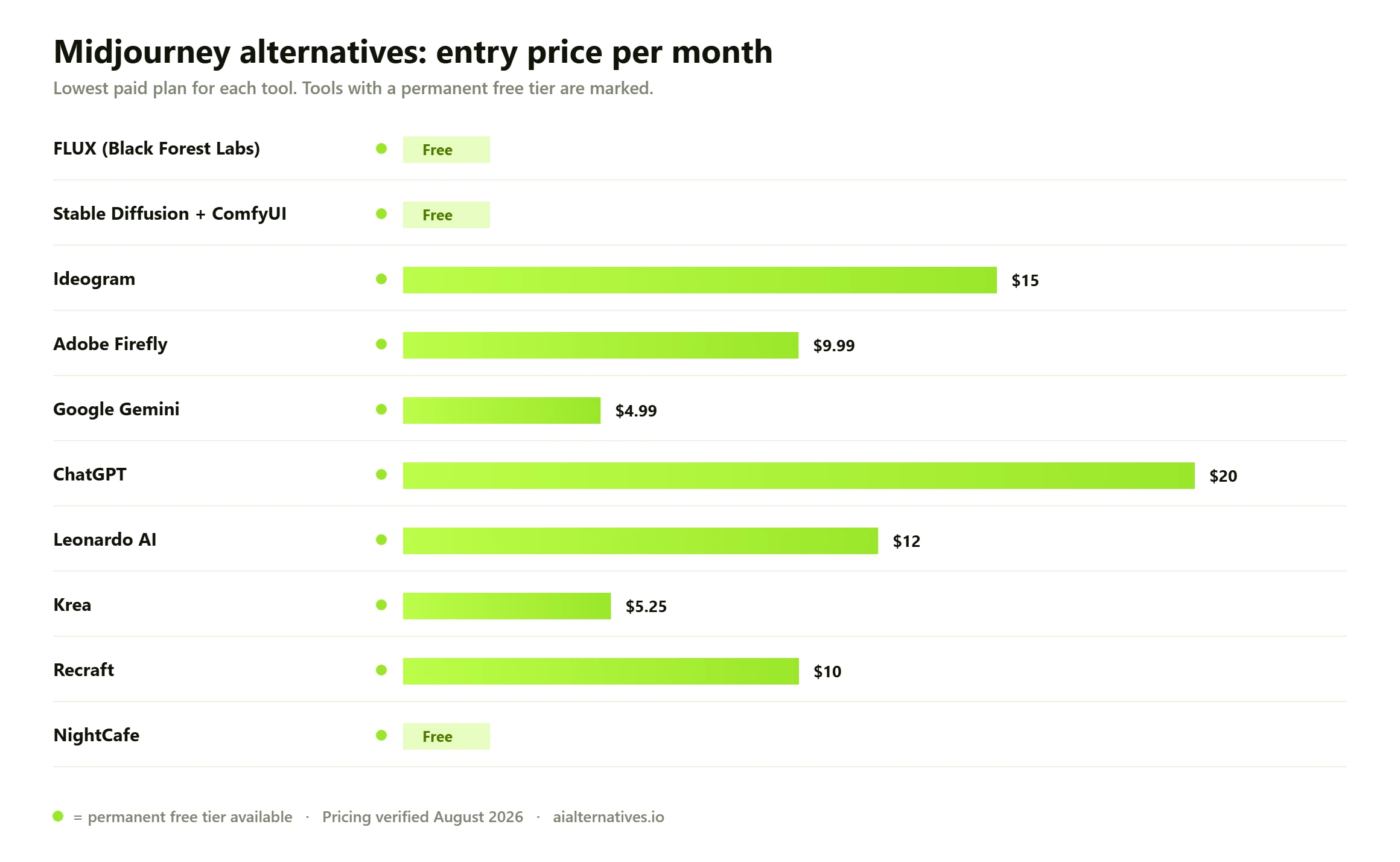
Entry monthly price across every Midjourney alternative we tested. Green dot marks a permanent free tier. Pricing verified August 2026.
Why you might be looking
Worth saying up front: Midjourney has not got worse. V8.2 became the default on 24 July 2026, after V8.0 in March and V8.1 in April, and the V8 notes claim generation is around five times faster with 2K rendering built in. If you read somewhere that it is Discord-only, that has not been true since V7.
So the honest reasons to leave are narrower than most guides suggest — but if one of these four is yours, it is a real reason.
There is no free trial, with one odd exception
Everyone writes that Midjourney has no free tier. Midjourney own documentation is more precise, and the detail is useful to you: there is no free trial on Discord or midjourney.com, but a limited one does exist inside the niji-journey app on iOS and Android. That is the only free way in, and it leans anime.
Everything else on this list has either a free tier or free weights. That single difference is what brings most people here.
You are buying GPU hours, not images
Here is what your money actually buys, from Midjourney own plan page in August 2026: Basic $10 a month or $96 a year, Standard $30 or $288, Pro $60 or $576, Mega $120 or $1,152.
Ignore the sticker and look at fast GPU time. Basic gives you 3.3 hours a month and no Relax mode, which means when your fast hours are gone, you stop generating. Standard is the first plan with unlimited Relax, and it is three times the price. If you generate seriously, your real entry price is $30, not $10 — and knowing that up front changes which alternatives are actually cheaper.
The legal question the roundups skip
Three studios are suing. Disney, NBCUniversal and DreamWorks filed in June 2025; Warner Bros. Discovery followed in September 2025. As of April 2026 both were in discovery with no ruling on the merits, so nothing has been decided.
Separately — and this applies to every tool here, not just Midjourney — the US Copyright Office concluded in January 2025 that text prompts alone do not make you the author. If you are producing work for a client, that matters more than which tool makes the prettiest picture, and it is why the indemnity section below is worth reading.
You cannot run it yourself
No weights, no local mode, no offline work, no private pipeline. If your images are commercially sensitive, or you want zero cost per image at volume, Midjourney structurally cannot help you. FLUX and Stable Diffusion can.
Midjourney alternatives compared at a glance
Prices read from each vendor own page in August 2026. Free tier here means a recurring allowance, not a one-time trial credit — a distinction that matters more than it sounds.
Tool
Best for
Starting price
Free tier
FLUX
Open-weight frontier quality
Free weights / API usage
Yes — Apache 2.0 weights
Stable Diffusion + ComfyUI
Total control, local
Free
Yes, fully local
Ideogram
Text in images
$15 per mo
Yes (weekly slow credits)
Adobe Firefly
Commercial indemnity
$9.99 per mo
Yes (daily generations)
Google Gemini
Best free image tier
$4.99 per mo
Yes, image gen included
ChatGPT
Conversational editing
$20 per mo
Limited, slower
Leonardo AI
Midjourney-like workflow
$12 per mo
Yes (150 tokens a day)
Krea
Real-time iteration
$5.25 per mo
Yes (100 units a day)
Recraft
Vector and brand assets
$10 per mo
Limited
NightCafe
Free volume
Paid PRO tiers
Yes, unlimited base SD
Midjourney
Aesthetics out of the box
$8 per mo (annual)
niji-journey app only
The ones worth your time, reviewed
1. FLUX — the one that changed the answer
If the guide you are reading was written before 2026, Flux is either missing or described as a promising newcomer. That framing is two model generations out of date.
FLUX.2 shipped in November 2025 with a 32-billion-parameter [dev] variant under Apache 2.0 — Black Forest Labs calls it the most powerful open-weight image generation and editing model available. It takes up to ten reference images and edits at 4 megapixels. FLUX 3 followed on 23 July 2026, learning jointly from images, video and audio, with an open-weight Dev variant again.
What that means for you: you can download a model that competes at the frontier, run it on your own hardware, fine-tune it, and never pay per image again. Midjourney offers none of that at any price. Where Midjourney still wins is the default look — FLUX needs more prompt work to reach the same polish, and you should expect that.
2. Stable Diffusion with ComfyUI — for when close is not good enough
Stability 2026 releases have been about audio and brand tooling rather than a new flagship image model, which is precisely why FLUX has taken over as the default open-weights answer. The ecosystem, though, is still unmatched.
ComfyUI with SDXL or SD 3.5 gives you LoRAs, ControlNet, regional prompting, inpainting and a node graph you can save and rerun. Think about how you work today: when a Midjourney generation comes out 90% right, you reroll and hope. In ComfyUI you fix the other 10%. That is the whole trade — a harder interface in exchange for getting the same result twice.
3. Ideogram — for anything with words on it
Typography is Midjourney most persistent weakness and Ideogram entire reason to exist. If your work is posters, packaging, ad creative, thumbnails or logos, this will save you more time than any quality difference elsewhere on this page.
Pricing from ideogram.ai in August 2026: Plus $15 a month billed annually, Pro $42, Team $20 per user with a two-seat minimum. A free account gets weekly slow credits — enough to test with, not enough to work with.
4. Adobe Firefly — the only answer to the legal question
Firefly is trained on content Adobe says it has rights to, applies Content Credentials to what it generates, and offers IP indemnification to customers on qualifying plans. Read that qualification carefully before you rely on it — indemnity is tied to specific agreements, not to simply having a Firefly login.
Plans from Adobe own page in August 2026: Standard $9.99, Pro $19.99, Pro Plus $49.99, Premium $199.99, with free daily generations across image, video and audio on the free tier. If you are putting AI work in front of a client legal team, this is the only entry here that survives the meeting.
5. Google Gemini and ChatGPT — the ones you may already pay for
Check your subscriptions before you buy anything new. Google free tier includes image generation and editing outright, with paid tiers at $4.99, $19.99 and $99.99. ChatGPT gives you limited, slower image generation free and the full thing on Plus at $20.
Neither matches Midjourney aesthetics. Both beat it on iteration, because you say make the sign green and move it left instead of rewriting a prompt and rolling the dice again. For product shots, diagrams, edits to an existing image and quick social assets, that conversational loop is worth more than beauty.
Free Midjourney alternatives that are genuinely free
Free is one of the most searched things about this topic, so here is the precise answer, ranked by how far you can get before hitting a wall.
Stable Diffusion or FLUX.2 [dev] locally — unlimited, private, no watermark, nothing per image. You need a GPU. The only genuinely unlimited option here.
Google Gemini — image generation and editing on the free tier, no card, and the best quality you will get for nothing.
NightCafe — unlimited base Stable Diffusion creations plus five daily credits for the better models.
Leonardo AI — 150 fast tokens a day, refreshed daily, in a proper interface.
Krea — 100 units a day, and the real-time canvas makes each one go further.
Ideogram — weekly slow credits, and the only free way to get reliable text in an image.
What none of them gives you is Midjourney default aesthetic. The free tiers get you 80% of the way for nothing. That last 20% is what the $8 to $30 a month is actually buying.
Running it yourself: what local generation really costs
Local generation is free per image, not free. The cost just moves to hardware.
Your binding constraint is VRAM. Full-size open-weight models want a serious card; distilled variants such as FLUX.2 [klein] are built for consumer hardware and now ship pre-installed on some laptops. Expect a working setup to mean a modern GPU, an evening installing ComfyUI and checkpoints, and a learning curve measured in weeks rather than hours.
The maths flips fast at volume, though. Midjourney Standard is $288 a year for unlimited Relax generations. If you generate all day every day, a GPU pays for itself inside two years and then keeps working. If you make twenty images a month, do not buy a GPU — you will not get your money back.
Commercial use, copyright and indemnity
Three separate questions get tangled together here, and untangling them tells you which tool you need.
Are you allowed to use it commercially? Under each vendor terms, generally yes on paid plans. Check the free tiers — several restrict commercial use.
Do you own it? Probably not in the copyright sense. Prompts alone do not establish authorship. Your own editing and arrangement can add protectable elements; typing a prompt cannot.
Who pays if someone sues? Only Adobe offers IP indemnification, and only on qualifying plans. Everyone else leaves that risk sitting with you.
If your work is a client deliverable, a brand campaign or anything regulated, that third question outranks image quality every time. It is the single strongest reason to choose Firefly over a better-looking generator.
How to choose
You want the Midjourney look for less — Leonardo or Krea. Neither matches it exactly; both get close for a third of the price.
You need words in the image — Ideogram, every time.
You need legal cover — Adobe Firefly on a qualifying plan.
You want frontier quality without a subscription — FLUX.2 [dev] weights, local or via API.
You want to fix images rather than reroll them — Stable Diffusion with ComfyUI.
You have no budget — Google free tier first, NightCafe when you need volume.
You need SVG or brand consistency — Recraft.
You already pay for ChatGPT or Google AI — use what you have before adding another subscription.
Is switching worth it?
Stay on Midjourney if you are on Standard or above, the house style is doing real work for you, and your output is illustration or concept art where aesthetics decide everything. V8.2 is genuinely good and nothing here reproduces it exactly.
Switch if any of this is you: you have hit Basic 3.3 fast GPU hours and will not pay triple, you need legible text, you need indemnified output for client work, you want to run models on your own hardware, or you would rather own something than rent it.
The cheapest experiment costs nothing and takes an hour. Run the same five prompts through Google free tier, Leonardo and a local FLUX build before you cancel anything — you will know quickly whether the gap is one you can live with. Our best AI image generators guide ranks the whole category, and the design tool alternatives hub covers the editors you will want afterwards.
Questions
Midjourney alternatives FAQs
The questions you are actually asking on Google and Quora — answered with what we verified this month.
Nothing beats it on every axis, so pick your axis. FLUX for open-weight quality and text. Ideogram for typography. Adobe Firefly for indemnified commercial use. Google Gemini for a free tier that works. Stable Diffusion with ComfyUI for control. On raw out-of-the-box aesthetics, Midjourney V8.2 is still the one to beat.
02 Is there a free AI art generator like Midjourney?
Several. Google free tier includes image generation and editing. NightCafe gives you unlimited base Stable Diffusion plus five credits a day. Krea gives 100 units a day, Leonardo 150 tokens. And if you have a GPU, Stable Diffusion and FLUX.2 [dev] run free on your own machine forever.
03 Is there a free version of Midjourney?
Not on Discord or midjourney.com. Midjourney own documentation says there is no free trial on either, and the only limited trial runs in the niji-journey mobile app on iOS and Android. Paid entry is $10 a month, or $8 billed annually.
04 What is the best AI image generator right now?
As of August 2026: Midjourney V8.2 for aesthetics out of the box, FLUX 3 for open multimodal capability, Ideogram for anything with words in it, and Adobe Firefly if commercial safety matters to you more than having the prettiest result.
05 What is the cheapest Midjourney alternative?
Free first: Google free tier, NightCafe, Krea 100 daily units and Leonardo 150 daily tokens all cost nothing. Cheapest paid is Krea at $5.25 a month against Midjourney $10. And once you own a GPU, Stable Diffusion and FLUX cost nothing per image at all.
06 Can I use AI-generated images commercially?
Usually yes under each vendor terms, but owning it is a different question. The US Copyright Office concluded in January 2025 that prompts alone do not make you the author, so purely prompt-generated work may not be protectable. Adobe Firefly is the only tool here offering IP indemnification, and only on qualifying plans.
07 Is Midjourney being sued, and does that affect me?
Yes. Disney, NBCUniversal and DreamWorks sued in June 2025, Warner Bros. Discovery followed in September. Both were still in discovery with no ruling as of April 2026. The practical risk sits with generating recognisable copyrighted characters, not with using the tool for your own work.
08 Do I need a powerful GPU to run Stable Diffusion or FLUX locally?
Yes, and that is the hidden cost of free. Full-size models want serious VRAM. Distilled variants such as FLUX.2 [klein] are built for smaller hardware and now ship on consumer laptops. Price a modern GPU into the decision before you count local generation as free.
Updated monthly · No paid placements
Still deciding?
See the head-to-head tests, or browse every image and design tool alternative we publish.