The 9 Best Semrush Alternatives in 2026 (Free and Paid)
If you’re here, chances are the Semrush invoice stopped making sense. Entry pricing sits at $139.95 per month, and the newer Semrush One bundles start at $199. Semrush is no longer a cheap habit — and you’re not alone in noticing.
Then Adobe bought the company. The $1.9 billion deal was announced in November 2025 and closed on 28 April 2026. Nothing broke overnight. But if you’re a solo SEO or a small agency, you probably started shopping anyway. Plenty did.
This guide walks you through 9 options, ranked. Some are cheaper. Some are free. We checked every price on the official pricing pages in August 2026, and we’re blunt about what the free tools can’t do for you.
The closest thing you’ll find to a like-for-like swap on data quality, and the Starter plan at $29 undercuts every Semrush tier. Watch the credit limits — they bite fast if you run big exports.
Free tier: Ahrefs Webmaster Tools: free Site Explorer and Site Audit for sites you verify
$29 to $449 per mo
02
SE Ranking
Full-stack Semrush replacement
Gives you rank tracking, audits, keyword research and local SEO in one place, with a gentler interface than Semrush. The Core plan tracks 2,000 keywords daily.
Free tier: No free plan. 14-day trial, no card required
$103.20 to $279 per mo
03
Mangools
Solo SEOs on a budget
KWFinder is still the friendliest keyword tool you’ll use, and the annual Basic plan is roughly a fifth of Semrush. The backlink index is its weak spot.
Free tier: Free account plus free mini tools (SERP checker, SERP simulator)
$29.90 to $129 per mo
04
Ubersuggest
Cheapest paid keyword research
Personal costs you $29 a month for keywords, basic audits and rank tracking. Data depth is thinner than Semrush, so treat the volumes as directional.
Free tier: A few free searches per day without paying
$29 to $99 per mo
05
Moz Pro
Beginners and link metrics
Domain Authority is still the metric your clients recognise, and Starter at $39 annually is genuinely affordable. Just know the crawl and keyword limits are tight on lower tiers.
Free tier: Free MozBar, Link Explorer and limited Keyword Explorer queries
$39 to $299 per mo
06
Google Search Console + Keyword Planner
The honest free stack
Search Console gives you real impressions, clicks and positions — data no paid tool can match for your own site. It tells you nothing about competitors.
Free tier: Entirely free, forever
Free
07
Serpstat
Budget agency toolkit
You get keyword, backlink and audit modules in one platform at a fraction of Business-tier pricing. Pricing shifts by tier and region, so confirm it before you commit.
Free tier: Trial access only; the free allowance is very limited
From about $50 per mo
08
Screaming Frog SEO Spider
Technical crawls and audits
A desktop crawler that beats Semrush’s Site Audit on depth and control. It won’t help you with keywords, backlinks or rank tracking.
Free tier: Free version crawls up to 500 URLs
Free / £199 per yr (about $245)
09
Similarweb
Competitor traffic estimates
Better than Semrush at whole-market traffic and channel mix, including apps. Treat it as a market intelligence tool, not your SEO workbench.
Free tier: Free traffic checker, keyword tool and rankings
From $125 per mo
Semrush alternatives compared at a glance9 tools
#
Tool
Best for
Free tier
Price
01
Ahrefs
Deepest backlink and keyword data
Free tier
$29 to $449 per mo
02
SE Ranking
Full-stack Semrush replacement
Trial only
$103.20 to $279 per mo
03
Mangools
Solo SEOs on a budget
Free tier
$29.90 to $129 per mo
04
Ubersuggest
Cheapest paid keyword research
Free tier
$29 to $99 per mo
05
Moz Pro
Beginners and link metrics
Free tier
$39 to $299 per mo
06
Google Search Console + Keyword Planner
The honest free stack
Free tier
Free
07
Serpstat
Budget agency toolkit
Free tier
From about $50 per mo
08
Screaming Frog SEO Spider
Technical crawls and audits
Free tier
Free / £199 per yr (about $245)
09
Similarweb
Competitor traffic estimates
Free tier
From $125 per mo
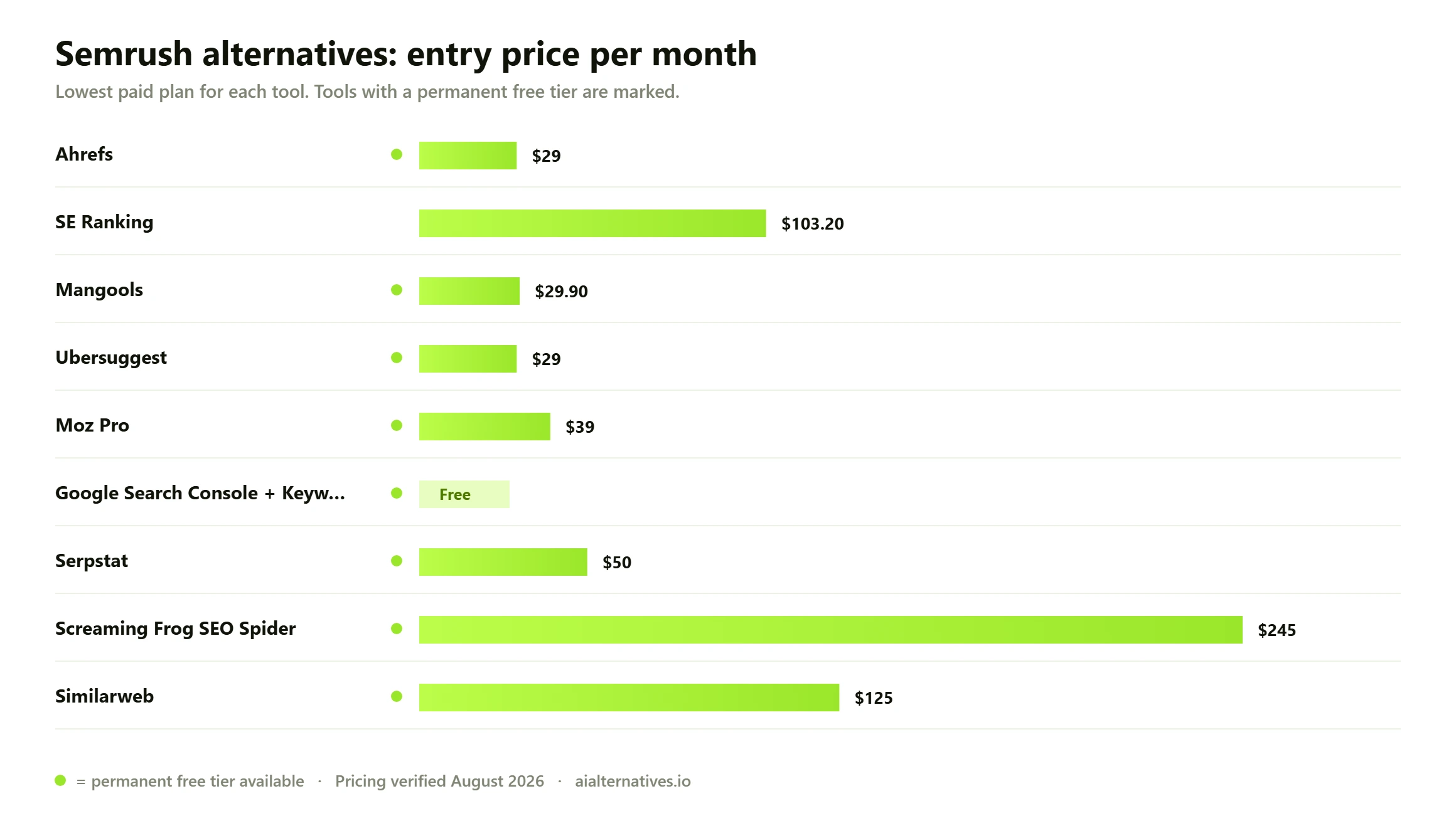
Entry monthly price across every Semrush alternative we tested. Green dot marks a permanent free tier. Pricing verified August 2026.
Why people are leaving Semrush
Three things probably pushed you out the door in 2025 and 2026: price, ownership and limits.
The price
The legacy SEO Classic ladder runs $139.95 (Pro), $249.95 (Guru) and $499.95 (Business) per month. The newer Semrush One bundles sit at $199, $299 and $549 monthly. Annual billing trims roughly 17%, but $117.33 a month is still a real line item for a freelancer. Extra user seats are billed on top of the plan, which catches small teams out. You can check the current tiers on Semrush’s official pricing page.
The Adobe acquisition
Adobe announced it would buy Semrush on 19 November 2025 for about $1.9 billion in cash, at $12.00 per share. Adobe confirmed the deal closed on 28 April 2026. Semrush’s customer FAQ, published the same day, says there are “no immediate changes” to features, billing or support.
That’s reassuring in the short term. The worry is longer term. Adobe’s stated focus is enterprise customer experience — SEO, generative engine optimisation and agentic search. If you’re an agency or a solo operator, you can reasonably wonder whether your $139-a-month self-serve plan stays a priority inside Adobe Experience Cloud.
The limits
Semrush’s free plan is thin on purpose: you get one demo project and 10 reports per day across the main tools. The trial is seven days. Beyond that, reviewers on G2 consistently rate Semrush lower than SE Ranking on usability (8.3 versus 9.2) and ease of setup. The recurring complaint isn’t that Semrush is bad. It’s that you probably use maybe 20% of it and pay for all of it.
Semrush alternatives compared at a glance
Every price below was verified on the vendor’s own pricing page in August 2026. Where a tool bills annually, we show the effective monthly rate.
Tool
Best for
Starting price
Free plan
Ahrefs
Deepest backlink and keyword data
$29 per mo
Yes — Webmaster Tools for verified sites
SE Ranking
Full-stack Semrush replacement
$103.20 per mo (annual)
No — 14-day trial, no card
Mangools
Solo SEOs on a budget
$29.90 per mo (annual)
Free account and free mini tools
Ubersuggest
Cheapest paid keyword research
$29 per mo
Yes — a few searches per day
Moz Pro
Beginners and link metrics
$39 per mo (annual)
Yes — free MozBar and Link Explorer
Search Console + Keyword Planner
The honest free stack
Free
Yes — fully free
Serpstat
Budget agency toolkit
From about $50 per mo
Very limited
Screaming Frog
Technical crawls and audits
Free / £199 per yr
Yes — 500 URL crawl limit
Similarweb
Competitor traffic estimates
From $125 per mo
Yes — free web checkers
The best paid Semrush alternatives
1. Ahrefs — best data, cheapest entry point
Ahrefs does backlinks better than anyone, and its keyword database holds up against Semrush’s. What changes the maths for you is the Starter plan at $29 a month — competitor keyword and backlink lookups for less than a quarter of Semrush Pro. Lite is $129, Standard $249, Advanced $449.
What it lacks: PPC and advertising research is weaker, there’s no equivalent to Semrush’s content marketing suite, and credit limits on exports will frustrate you if you export heavily. Pick it if link analysis and keyword accuracy are what you actually pay for. Disclosure: we use Ahrefs data on this site, so weigh that accordingly.
2. SE Ranking — the closest all-in-one swap
If you want one login that does everything Semrush did, this is it. Core is $129 monthly or $103.20 on annual billing, with 10 projects, 2,000 daily tracked keywords and 250K pages of audit per month. Growth is $279 monthly. The 14-day trial needs no card.
What it lacks: the backlink index is smaller than Ahrefs or Semrush, and the savings versus Semrush are modest rather than dramatic. Pick it if you’re an agency that wants rank tracking, audits, local SEO and white-label reports in one bill.
3. Mangools — best cheap Semrush alternative for solo SEOs
Mangools hands you five small tools done well: KWFinder, SERPChecker, SERPWatcher, LinkMiner and SiteProfiler. Basic is $49 monthly or $29.90 on annual. Premium is $69 / $44.90. Agency is $129 / $89.90.
What it lacks: no proper site audit crawler, a shallower link index, and no PPC data. Pick it if you’re a freelancer or blogger who mainly needs keyword research and rank tracking without a $1,600 annual commitment.
4. Ubersuggest — the $29 starting point
Ubersuggest gives you keyword ideas, basic site audits and rank tracking for $29 (Personal), $59 (Business) or $99 (Enterprise) a month, with a seven-day trial. The free version lets you run a small number of searches per day.
What it lacks: volume and difficulty figures are noticeably rougher than Semrush’s, and the backlink data is limited. Pick it if you’re starting out and want directional answers cheaply. Don’t build client deliverables on it.
5. Moz Pro — the beginner-friendly option
Moz Pro runs $49 monthly / $39 annually (Starter), $99 / $79 (Standard), $179 / $143 (Medium) and $299 / $239 (Large). Domain Authority remains the metric your non-SEO stakeholders actually understand, which makes your reporting easier.
What it lacks: crawl budgets and keyword query limits on cheaper tiers run out fast, and the trial only covers Standard and Medium. Pick it if you’re new to SEO or need clean, explainable metrics for your clients.
Free alternatives to Semrush (and what they can’t do)
Let’s be straight: no free Semrush alternatives replace Semrush. Free tools cover roughly two jobs out of five. They’re excellent at your own site’s performance and technical health. They’re weak to useless at competitor intelligence, which is the thing you’re actually paying Semrush for.
Here’s what a genuinely free stack looks like, and where it stops.
The Google stack — free, and better than paid data for your own site
Google Search Console gives you real impressions, clicks, average position and query data straight from Google. No estimation model beats it for your own domain. Add Google Keyword Planner for volume ideas, Google Trends for seasonality and Bing Webmaster Tools for a second data set.
Where it stops: Keyword Planner shows broad ranges rather than precise volumes unless you’re running ad spend. There is no competitor analysis, no backlink index, no rank tracking of rivals and no historical archive beyond 16 months.
Ahrefs Webmaster Tools — free backlinks for sites you own
Verify your domain and you get free, limited access to Site Explorer and Site Audit. That covers your backlink profile and technical issues at zero cost. You can’t point it at a competitor, which is the whole catch.
Screaming Frog free — 500 URLs of real crawling
The free desktop version crawls up to 500 URLs — enough for most small sites, likely yours included. Broken links, redirect chains, duplicate titles, thin metadata: it finds all of it for you. The paid licence is £199 a year (about $245). It does nothing for keywords or backlinks.
Semrush’s own free plan
Worth knowing before you pay: Semrush’s free tier gives you one demo project and 10 reports per day across the main tools. It’s a sampler, not a workflow. But if you only run occasional lookups, it may be all you need.
The honest verdict on free: run Search Console plus Screaming Frog plus Ahrefs Webmaster Tools and you’ll cover technical SEO and your own performance properly. For competitor keywords, gap analysis and link prospecting, budget $29 to $50 a month for one paid tool. That’s still 70% cheaper than Semrush.
How to choose
Match the tool to your job, not to the feature list.
Freelancer or blogger, under $50 a month: Mangools annual ($29.90) or Ahrefs Starter ($29). Add free Search Console.
Small agency replacing Semrush entirely: SE Ranking Core at $103.20 annually. It’s the only pick that covers rank tracking, audits, local SEO and client reporting in one seat.
Link building is your main job: Ahrefs. Nothing else comes close on referring domain data.
Technical SEO and site migrations: Screaming Frog, free up to 500 URLs, then £199 a year.
Competitive and market research, not SEO: Similarweb from $125 a month.
Zero budget: Search Console + Keyword Planner + Ahrefs Webmaster Tools + Screaming Frog free. Accept that competitor data is off the table.
One rule that saves money: count the Semrush features you opened last month. If it’s fewer than four, you’re overpaying, and a $30 tool will do.
Is switching worth it?
For most solo operators and small teams — probably you — yes. Moving from Semrush Pro at $139.95 to Mangools Basic at $29.90 annually saves you about $1,320 a year. You lose PPC research, the content toolkit and some database depth. If you weren’t using them, that’s not a loss.
Stay on Semrush if any of these are true. You need one platform for SEO, PPC, content and social in a single audit trail. Your clients or your boss expect Semrush-branded reports. You depend on its advertising research or its Position Tracking history, which doesn’t transfer. Or you run multi-market campaigns across many databases at once.
Also worth weighing before you decide: the Adobe deal cuts both ways. Adobe says investment and the product roadmap will expand. That could mean a stronger Semrush in 2027. It could also mean an enterprise pivot that leaves $139-a-month customers like you behind. Nobody outside Adobe knows yet.
The pragmatic move is not all-or-nothing. Export your Semrush keyword lists and Position Tracking history before you cancel — that data doesn’t follow you. Then run your cheaper pick alongside Search Console for a month. If you don’t miss anything, cancel. If you do, you’ve lost one month’s fee finding out.
Questions
Semrush alternatives FAQs
The questions people actually ask on Google, Reddit and Quora — answered with what we verified this month.
Google Search Console, paired with Keyword Planner and Google Trends. It’s free forever and gives you real click and impression data that no paid tool can match for your own site. Add Ahrefs Webmaster Tools for free backlink data on domains you verify, and Screaming Frog’s free version for crawls up to 500 URLs. The gap is competitor research — free tools won’t give you that.
02 How much does Semrush cost in 2026?
More than you’d like. The legacy SEO Classic plans run $139.95 (Pro), $249.95 (Guru) and $499.95 (Business) per month. The newer Semrush One bundles are $199 (Starter), $299 (Pro+) and $549 (Advanced) monthly, and annual billing saves you up to 17%. There’s also a free plan limited to one demo project and 10 reports per day, plus a seven-day trial if you want to test before paying.
03 Did Adobe buy Semrush, and what changes for users?
Yes. Adobe announced the acquisition on 19 November 2025 at roughly $1.9 billion, or $12.00 per share, and completed it on 28 April 2026. For you, nothing changes yet: Semrush’s customer FAQ from that date states there are no immediate changes to features, interface, access, support or billing. Longer-term pricing and packaging under Adobe Experience Cloud have not been announced, so keep an eye on your renewal terms.
04 Is Ahrefs cheaper than Semrush?
At the entry level, yes. Ahrefs Starter is $29 a month versus Semrush’s $139.95 floor, and Ahrefs Lite at $129 undercuts Semrush Pro slightly. Higher up they converge: Ahrefs Standard is $249 and Advanced is $449. One thing to check before you switch: Ahrefs has stricter credit limits on exports, so if you’re a heavy user you can end up paying more in practice.
05 Are cheaper Semrush alternatives accurate enough for client work?
SE Ranking, Ahrefs, Mangools and Moz Pro are all reliable enough for your professional deliverables. Ubersuggest’s volume and difficulty figures are rougher — fine for direction, risky for client reports. Whatever you pick, calibrate it against Search Console data for your own sites, since that’s the only ground truth you have.
06 Can I export my data before cancelling Semrush?
Yes, and you should do it before your subscription lapses. Export your keyword lists, Position Tracking history and Site Audit reports to CSV while your account is active. Historical rank tracking data does not transfer to other tools, so if you need year-over-year comparisons, archive it first.
Updated monthly · No paid placements
Still comparing?
See how the top picks square off head to head, or browse every alternative guide we publish.