The 8 Best VMware Alternatives in 2026 (Enterprise and Homelab)
Your renewal quote came back three times higher. You’re not imagining it.
Since Broadcom took over, VMware alternatives have gone from a hobbyist debate to a line item your board asks about. Perpetual licences are gone. Bundles replaced à la carte SKUs. Core minimums and three-year prepaid terms did the rest. If you’re searching for alternatives to VMware, you’re probably not unhappy with vSphere itself. You’re unhappy with the invoice.
This guide walks you through 8 replacements for vSphere, ESXi and Horizon. Every price was checked against official vendor pages in August 2026. We’re precise about hypervisor type, live migration, HA and storage, because those are the things that break during your migration — and we split the enterprise advice from the homelab advice, since you’re not solving the same problem in both cases.
Ranked by testing, current pricing and free-tier value. Details on every pick below the list.
Best overall
Proxmox VE
Most VMware refugees, mid-size estates
Free / from €120 per socket per yr
Runner-up
Nutanix AHV
Enterprise HCI at scale
Quote-based (no public list price)
Third pick
Microsoft Hyper-V / Azure Local
Windows-heavy shops
From $1,176 per 16 cores (Server Standard)
01
Proxmox VE
Most VMware refugees, mid-size estates
You get KVM plus LXC with clustering, live migration, HA and built-in Ceph in one web UI. Version 9.0 finally added snapshots on thick-provisioned LVM over iSCSI/FC SANs, which removes the last big blocker if you’re running existing arrays.
Free tier: Fully free and open source (AGPLv3); the subscription only buys the stable repo and support
Free / from €120 per socket per yr
02
Nutanix AHV
Enterprise HCI at scale
It’s the closest thing to a like-for-like enterprise swap: KVM-based hypervisor, distributed AOS storage, and Acropolis Dynamic Scheduling as a genuine DRS equivalent. One vendor owns the whole stack, which is exactly why you’ll pay for it like VMware used to cost.
Free tier: Community Edition is free for labs, up to 4 nodes
Quote-based (no public list price)
03
Microsoft Hyper-V / Azure Local
Windows-heavy shops
You get a mature type-1 hypervisor with Live Migration, Failover Clustering and Storage Spaces Direct. If your estate is already Windows Server Datacenter, the hypervisor is effectively a sunk cost for you.
Free tier: Hyper-V role is included with any Windows Server licence you already own
From $1,176 per 16 cores (Server Standard)
04
XCP-ng / Vates VMS
Teams who want vSphere ergonomics
It’s a Xen-based type-1 hypervisor with Xen Orchestra as your vCenter equivalent, plus XOSTOR for hyperconverged storage. You’re priced per host rather than per core, which is the single biggest reason people shortlist it after a Broadcom quote.
Free tier: Free and feature-unlimited; the Xen Orchestra appliance build is the paid part
Free / from $1,000 per host per yr
05
Red Hat OpenShift Virtualization
VM and container consolidation
You run VMs as pods via KubeVirt on the same control plane as your containers. Powerful if you’re already an OpenShift shop, heavy and unfamiliar if you’re not — your live migration depends on getting ReadWriteMany storage right.
Free tier: No free commercial tier; OKD with upstream KubeVirt is free
From about $9,880 per node per yr (list)
06
Scale Computing Platform
Edge sites and small clusters
HyperCore is a KVM-based appliance stack with its own SCRIBE block storage and automatic self-healing. You get no separate management server to babysit, which is why retail, manufacturing and healthcare edge deployments keep picking it.
Free tier: None; evaluations run through sales
Quote-based (appliance plus subscription)
07
Oracle Linux Virtualization Manager
Oracle database workloads
It’s oVirt-derived KVM management with live migration and HA. Its real selling point for you is licence policy: Oracle recognises it for hard partitioning, which can cut what you owe on Oracle DB cores.
Free tier: Software is a free download; support subscription buys errata and help
Free / support from $1,399 per CPU pair per yr
08
OpenStack
Service providers, sovereign cloud
It’s not a hypervisor — it’s an IaaS control plane that usually drives KVM underneath, with Nova live migration and multi-tenancy built in. Worth it for you above roughly 500 nodes or when you’re reselling capacity.
Free tier: Fully free and open source; you pay in engineering time
Free (self-run); vendor distros vary
VMware alternatives compared at a glance8 tools
#
Tool
Best for
Free tier
Price
01
Proxmox VE
Most VMware refugees, mid-size estates
Free tier
Free / from €120 per socket per yr
02
Nutanix AHV
Enterprise HCI at scale
Free tier
Quote-based (no public list price)
03
Microsoft Hyper-V / Azure Local
Windows-heavy shops
Free tier
From $1,176 per 16 cores (Server Standard)
04
XCP-ng / Vates VMS
Teams who want vSphere ergonomics
Free tier
Free / from $1,000 per host per yr
05
Red Hat OpenShift Virtualization
VM and container consolidation
Trial only
From about $9,880 per node per yr (list)
06
Scale Computing Platform
Edge sites and small clusters
Free tier
Quote-based (appliance plus subscription)
07
Oracle Linux Virtualization Manager
Oracle database workloads
Free tier
Free / support from $1,399 per CPU pair per yr
08
OpenStack
Service providers, sovereign cloud
Free tier
Free (self-run); vendor distros vary
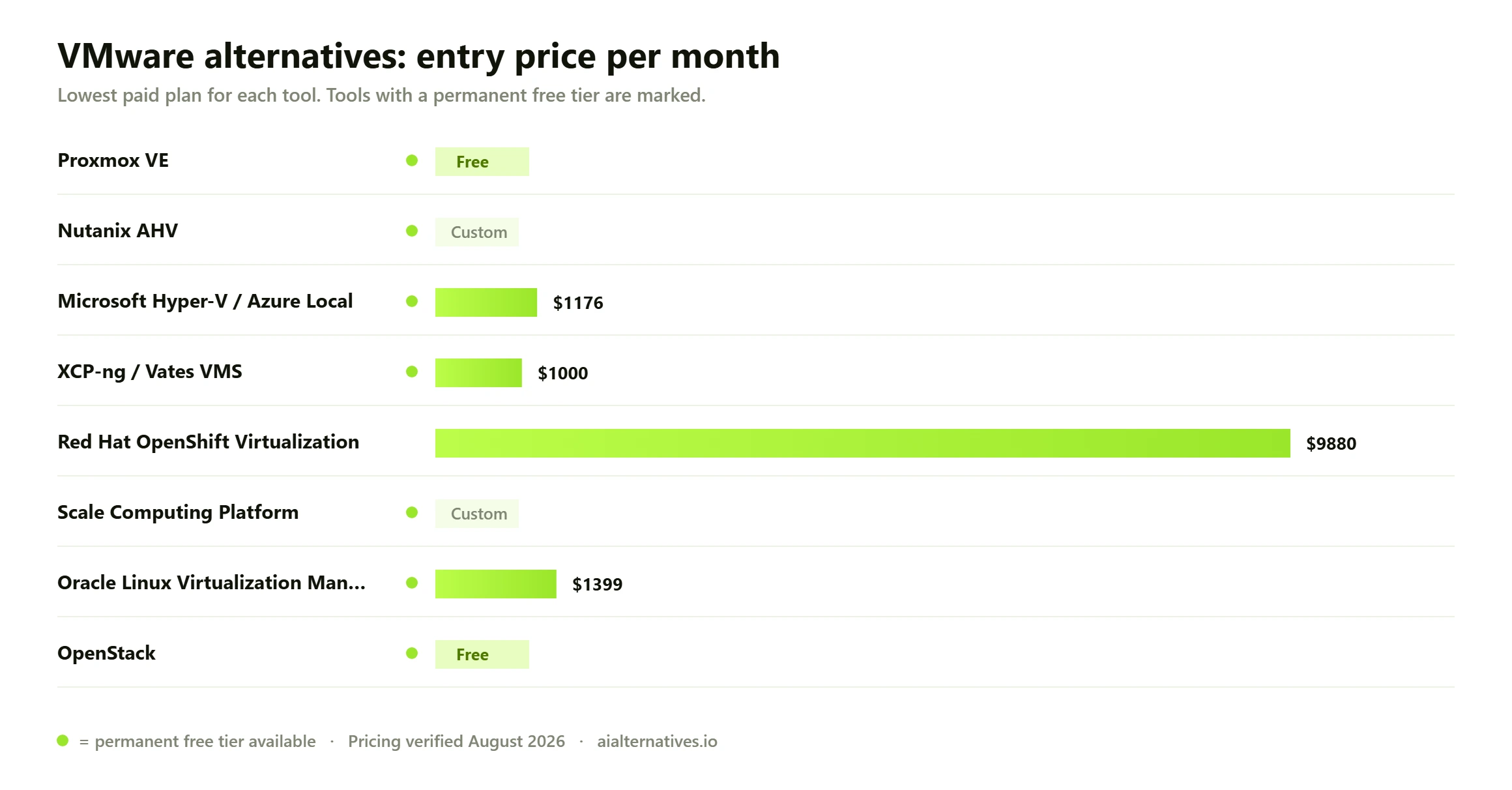
Entry monthly price across every VMware alternative we tested. Green dot marks a permanent free tier. Pricing verified August 2026.
Why people are leaving VMware
This isn’t a vague dissatisfaction story for you. It’s a licensing story with dates attached.
Broadcom closed its $69 billion VMware acquisition on 22 November 2023. On 11 December 2023, VMware ended perpetual licensing entirely. Everything moved to subscription. The à la carte catalogue collapsed into bundles — VMware Cloud Foundation (VCF) and vSphere Foundation (VVF) — with vSphere Standard and Essentials left for small estates.
Then came the floors. Licensing is per physical core with a 16-core-per-CPU minimum, so a pair of 8-core sockets bills as 32. In April 2025 Broadcom pushed a 72-core minimum per order, which would have punished small clusters worst. It was walked back after backlash. Three-year prepaid terms became the default.
The numbers customers actually report
In an October 2024 court filing, AT&T said Broadcom had proposed a 1,050% increase. In May 2025, the European Cloud Competition Observatory reported member price hikes of 800% to 1,500% to the European Commission. A CloudBolt survey published 18 February 2026 found 86% of North American enterprises are actively shrinking their VMware footprint and 59% saw increases above 25% — yet only 4% have fully left.
The channel shrank too
Broadcom wound down the VMware Cloud Service Provider programme. Non-renewing partner contracts lapsed on 26 January 2026, with open deals told to close by 31 March 2026. Roughly 19 VCSPs remain in the US. On 19 March 2026, CISPE filed an EU competition complaint against Broadcom and asked regulators for interim measures.
In fairness: Broadcom quietly restored a free ESXi build (8.0 Update 3e) in April 2025, and vSphere Foundation 9.0 shipped on 17 June 2025 with a genuinely better operations stack. The technology is fine. The commercial terms are what’s driving the exodus.
The best VMware alternatives compared
Tool
Best for
Starting price
Free plan
Proxmox VE
Most VMware refugees, mid-size estates
Free / from €120 per socket per yr
Yes — fully free, AGPLv3
Nutanix AHV
Enterprise HCI at scale
Quote-based
Community Edition, 4 nodes
Microsoft Hyper-V / Azure Local
Windows-heavy shops
From $1,176 per 16 cores
Role included with Windows Server
XCP-ng / Vates VMS
Teams who want vSphere ergonomics
Free / from $1,000 per host per yr
Yes — no feature limits
Red Hat OpenShift Virtualization
VM and container consolidation
From ~$9,880 per node per yr
No — OKD/KubeVirt upstream only
Scale Computing Platform
Edge sites and small clusters
Quote-based
No
Oracle Linux Virtualization Manager
Oracle database workloads
Free / support from $1,399 per CPU pair
Yes — software is free
OpenStack
Service providers, sovereign cloud
Free (self-run)
Yes — fully open source
Prices verified against vendor pricing pages in August 2026. Nutanix and Scale Computing publish no list price; assume a quote process.
Top VMware alternatives reviewed
1. Proxmox VE — the default answer
Proxmox VE is KVM and LXC wrapped in a clustered web UI, with corosync-based HA, watchdog fencing and live migration included. Your storage is flexible: ZFS local, Ceph for hyperconverged, or plain LVM over your existing iSCSI/FC array.
Version 9.0 landed on 5 August 2025 on Debian 13, and it mattered. Snapshots now work on thick-provisioned shared LVM, so if you’re a SAN customer you stopped being a second-class citizen. HA affinity rules and SDN fabrics arrived in the same release.
What you won’t get: DRS-style automatic load balancing, and vendor backup integration is thinner than VMware’s. Pick it if you have competent Linux people and want your cost curve to stop climbing. Free forever; support from €120 per socket per year, €550 for the Standard tier most businesses buy.
2. Nutanix AHV — the enterprise swap
AHV is a KVM-derived type-1 hypervisor bundled with Nutanix AOS distributed storage. You get live migration, self-healing, and Acropolis Dynamic Scheduling, which is a real DRS equivalent rather than a manual affinity rule. Prism Central handles your multi-cluster management.
What you won’t get: transparent pricing, and it strongly prefers you buy the whole stack. That’s the trade. Pick it if you need a single vendor throat to choke and your CFO will accept enterprise pricing — just not Broadcom’s.
3. Microsoft Hyper-V and Azure Local — the one you already own
Hyper-V is a type-1 hypervisor with Live Migration, Failover Clustering for HA, and Storage Spaces Direct in Datacenter edition. Windows Server 2025 Standard lists at $1,176 per 16 cores; Datacenter at $6,771, which also grants you unlimited Windows guest VMs.
Azure Local is the Arc-managed successor to Azure Stack HCI, billed at roughly $10 per physical core per month for hyperconverged nodes, more with an external SAN. Pick it if your workloads are mostly Windows and you’re already paying for Datacenter. Skip it if you’re a Linux shop — the tooling will fight you.
4. XCP-ng and Vates VMS — the per-host escape hatch
XCP-ng is the open-source continuation of Citrix Hypervisor, built on Xen. It’s a genuine type-1 hypervisor with live migration, storage motion and HA, managed through Xen Orchestra — the closest analogue to vCenter you’ll find in the open-source world. XOSTOR adds hyperconverged storage.
The commercial hook is licensing shape: Vates charges $1,000 per host per year for Pro support, $1,800 for Enterprise with 24/7 and one-hour critical response. Nothing scales with core count. Pick it if you run dense, high-core hosts and per-core pricing is what killed your budget.
5. Red Hat OpenShift Virtualization — for platform teams
Built on KubeVirt, this runs your VMs as pods alongside containers on one control plane. Live migration works, but only with ReadWriteMany storage — usually OpenShift Data Foundation or a suitable CSI driver. Get that wrong and your migrations fail in production.
List pricing sits around $9,880 per bare-metal node per year for the Virtualization Engine premium subscription (1-2 sockets, up to 128 cores). Pick it if you’re already running OpenShift and want to retire a second stack. Skip it if Kubernetes isn’t already in your team’s muscle memory.
6. Scale Computing Platform — for the edge
HyperCore is a KVM-based appliance OS with its own SCRIBE storage layer and automatic failure recovery. There’s no separate management VM for you to protect, no vCenter equivalent to lose. Two- and three-node clusters are your sweet spot.
What you won’t get: breadth. It’s not trying to run your 400-node datacentre. Pick it if you manage dozens of remote sites with no local IT staff. Pricing is quote-based and bundles hardware.
Also worth shortlisting
Oracle Linux Virtualization Manager — free oVirt-based KVM management. Recognised by Oracle for hard partitioning, which can meaningfully cut your Oracle Database licensing on the same tin. Support from $1,399 per CPU pair per year.
OpenStack — the right answer if you’re a service provider, under a sovereign-cloud mandate, or running an estate above roughly 500 nodes. Free software, expensive people.
VMware Horizon alternatives for VDI
Horizon isn’t Broadcom’s anymore. Broadcom sold the End-User Computing business to KKR, and it relaunched as Omnissa on 1 July 2024, taking Horizon and Workspace ONE with it. So if your VDI renewal spiked, it’s a different vendor doing it to you.
Omnissa raised prices too: from 4 May 2026, new and expansion Horizon licences went up 7% when bundled with vSphere Foundation, and 16-21% without it. Renewals were left alone.
Citrix — your mature swap. Best protocol performance over bad networks, strongest brokering and app-layering. Also the most expensive, and Citrix has had its own licensing turbulence.
Azure Virtual Desktop — the AVD service itself carries no per-user fee if your users already hold Microsoft 365 E3/E5, Windows Enterprise E3/E5 or Business Premium. You pay for Azure compute and storage, which is where your budget actually goes.
Omnissa Horizon — staying put is legitimate. If your golden images, App Volumes and DEM configs are deep, a lateral move will cost you more than the increase.
One caution: don’t move your hypervisor and your VDI broker in the same quarter. Horizon on Proxmox or XCP-ng isn’t a supported combination, so a hypervisor migration usually forces a VDI decision on you too.
How to choose
Enterprise (50+ hosts, change control, audits)
Start with your storage. If you have a big FC or iSCSI SAN with years left on it, Proxmox VE 9 or XCP-ng preserve that investment. If your array is due for refresh anyway, Nutanix AHV or Azure Local let you collapse compute and storage together.
Then check your support model honestly. If your organisation requires a named vendor with 24/7 SLAs and professional services, that’s Nutanix, Scale Computing, Red Hat or Vates Enterprise — not community Proxmox. And check your backup vendor’s support matrix before you commit, not after.
Homelab and small business
Proxmox VE, no subscription, non-enterprise repo. It’s free, the community is enormous, and it runs on consumer hardware that ESXi refuses to touch — Realtek NICs being the classic example. XCP-ng is your pick if you want to learn something closer to enterprise Xen tooling.
If you only need one host and a few VMs, VMware ESXi alternatives may be overkill for you: Broadcom restored the free ESXi 8.0 U3e build in April 2025. No vCenter, no support, no clustering — but it’s still free.
By workload
Windows-dominant estate → Hyper-V or Azure Local
Oracle Database on-prem → Oracle Linux Virtualization Manager
Usually yes, but slower than the vendor slide decks suggest. Real migrations run 18-24 months for a large estate, and the CloudBolt data explains why only 4% have finished: complexity (25%), unexpected costs (23%) and technical blockers (21%) are the top three obstacles you’ll hit.
Budget for the parts nobody quotes you. Retraining. Backup and DR re-tooling. Rewriting PowerCLI automation. Re-certifying compliance workloads. On a mid-size estate those routinely equal one to two years of the licence saving.
When you should stay
Stay if you’re under two years from a hardware refresh — migrate to new tin instead of twice. Stay if your renewal increase is under about 30% and your team has no Linux depth. Stay if you’re running NSX microsegmentation or heavy vSAN stretched clusters, because the feature-parity gap there is still real.
When you should move now
Move if your quote jumped 3x or more, if you’re a service provider caught by the VCSP wind-down, or if you’re carrying dense high-core hosts where the 16-core-per-CPU floor and bundling multiply against you. Move if you have a hardware refresh coming inside 12 months — that’s your cheapest possible cutover window.
Whatever you decide, run an accurate core and socket inventory before you take the meeting. Broadcom resumed formal audits in mid-2025, and walking into a renewal without your own numbers is how you end up with the worst quotes.
Questions
VMware alternatives FAQs
The questions people actually ask on Google, Reddit and Quora — answered with what we verified this month.
For most organisations it’s Proxmox VE — free, KVM-based, with clustering, live migration, HA and Ceph built in, and no per-core licensing. If you need a single enterprise vendor with a DRS equivalent and 24/7 support, Nutanix AHV is your closest like-for-like swap. If you’re a Windows-heavy shop, look at Hyper-V first, since you likely already own the licence.
02 Is Proxmox actually enterprise-ready?
Yes, with caveats. It has HA with fencing, live migration, cluster-aware storage and a paid support tier up to €1,100 per socket per year with two-hour response. Version 9.0 closed the last major gap by adding snapshots on thick-provisioned shared LVM over SANs. What you still won’t get is automatic DRS-style load balancing or the depth of third-party ecosystem integrations VMware has.
03 Can I still use VMware ESXi for free?
Yes. Broadcom restored a free ESXi build — version 8.0 Update 3e — in April 2025 after removing it in 2024. It’s a single standalone host with no support, no vCenter and no clustering, so it’s fine for your labs and edge boxes but not for production. Anything beyond that needs a paid vSphere Foundation or VCF subscription.
04 Why did VMware prices increase so much under Broadcom?
Three changes stacked. Perpetual licences ended in December 2023, forcing everyone onto subscriptions. The catalogue collapsed into VCF and VVF bundles, so you buy capabilities you may not use. And licensing moved to physical cores with a 16-core-per-CPU minimum plus three-year prepaid terms. AT&T’s 2024 court filing cited a proposed 1,050% increase; European providers reported 800-1,500% to the Commission in May 2025.
05 What are the best VMware Horizon alternatives?
Citrix for the richest feature set and best remote protocol performance, Azure Virtual Desktop if your users already hold Microsoft 365 E3/E5 or Windows Enterprise licences that include the AVD entitlement. Note that Horizon is no longer VMware — KKR bought the EUC business and relaunched it as Omnissa on 1 July 2024. Omnissa raised new and expansion licence prices 7-21% from 4 May 2026.
06 How long does migrating off VMware take?
Plan 18-24 months for a large estate, and a few weekends if yours is small. VM conversion itself is usually the easy part for you — tools exist for every major target. The time goes into backup and DR re-platforming, rewriting PowerCLI automation, retraining staff and re-validating compliance workloads. Only 4% of enterprises surveyed in February 2026 had completed the move.
Updated monthly · No paid placements
Still comparing?
See how the top picks square off head to head, or browse every alternative guide we publish.