The Best Twitter Alternatives in 2026, Ranked and Priced
If you’re on X, you’ve probably noticed: you keep paying more for less. Premium+ costs $40 a month now. In March 2026, X Pro vanished behind that tier with no warning. If you’re hunting for twitter alternatives, you’re not alone.
Here’s the good news: almost every serious option you’ll find is free. Here’s the bad news: none of them replaced Twitter for you. The audience just split up instead.
We cover 7 alternatives to Twitter below, so you can pick the right one for you. Every price was verified in August 2026. You get real 2026 user numbers, not 2024 hype.
Ranked by testing, current pricing and free-tier value. Details on every pick below the list.
Best overall
Bluesky
Closest feel to old Twitter
Free
Runner-up
Threads
Largest reachable audience
Free
Third pick
Mastodon
Ad-free, community-run posting
Free
01
Bluesky
Closest feel to old Twitter
Chronological by default, with custom feeds you can swap in and out to suit you. Registered accounts passed 46 million in August 2026, though monthly actives sit near 10.4 million.
Free tier: Entirely free. No paid tier exists as of August 2026.
Free
02
Threads
Largest reachable audience
Meta announced 500 million monthly users on June 16, 2026. Signup rides on your Instagram account, so your following can appear overnight.
Free tier: Free and ad-supported. No subscription of any kind.
Free
03
Mastodon
Ad-free, community-run posting
No ads and no ranking algorithm deciding what you see. Roughly 750,000 to 1 million people post monthly across thousands of independent servers.
Free tier: Free forever. Servers run on donations you can optionally chip into.
Free
04
Substack Notes
Writers building paid audiences
A short-post feed bolted onto a newsletter business. If you write, you’ll likely find it drives more subscriber growth than any other channel.
Free tier: Posting and reading Notes costs nothing. Fees apply only if you charge readers.
Not a public feed, which is exactly the point. Your conversation happens inside invite-friendly servers instead of in front of strangers.
Free tier: Chat, voice and video are fully free. Nitro adds cosmetics and bigger uploads.
Free / Nitro from $2.99 per mo
06
Reddit
Topic-first discussion threads
Search-friendly and durable. Post here and a thread still ranks on Google a year later. A post on X usually does not.
Free tier: Free to post and comment. An optional paid ad-free tier exists.
Free
07
Farcaster
Crypto and developer early adopters
A small, technical network running on its own decentralized protocol. If you want excellent signal-to-noise, this delivers it, but expect a tiny audience.
Free tier: Free since October 2025, when the $5 onboarding fee and invite codes were dropped.
Free
Twitter alternatives compared at a glance7 tools
#
Tool
Best for
Free tier
Price
01
Bluesky
Closest feel to old Twitter
Free tier
Free
02
Threads
Largest reachable audience
Free tier
Free
03
Mastodon
Ad-free, community-run posting
Free tier
Free
04
Substack Notes
Writers building paid audiences
Free tier
Free / 10% of paid subscriptions
05
Discord
Real-time niche communities
Free tier
Free / Nitro from $2.99 per mo
06
Reddit
Topic-first discussion threads
Free tier
Free
07
Farcaster
Crypto and developer early adopters
Free tier
Free
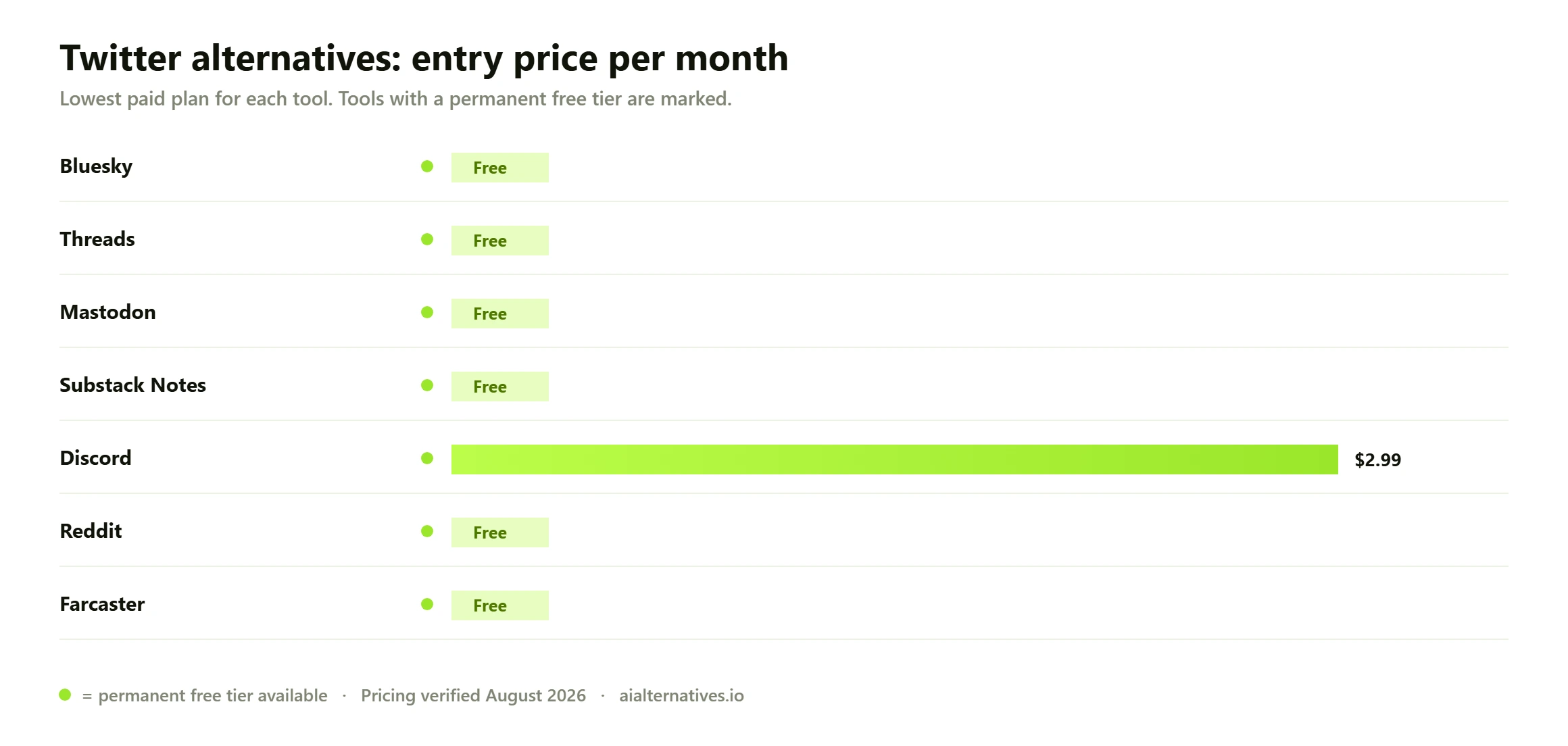
Entry monthly price across every Twitter alternative we tested. Green dot marks a permanent free tier. Pricing verified August 2026.
Why people are leaving Twitter (X)
Cost is the loudest reason you’ll hear. On February 19, 2025, X raised Premium+ from $22 to $40 a month, an 82% jump, hours after xAI shipped Grok 3. Annual Premium+ now runs $395.
Then features moved behind that wall. On March 26, 2026, X restricted X Pro, the tool most people still call TweetDeck, to Premium+ subscribers only. If you were on Standard Premium paying $8 a month, you lost access overnight, with no announcement beyond a help-center edit.
Reach slipped too, and you may have felt it in your own replies. Third-party estimates put X at roughly 561 million monthly users in July 2025, down from 586 million a year earlier. Mobile daily actives fell about 15% across the same stretch.
Pew recorded a partisan flip alongside it. 24% of Republicans reported using X versus 19% of Democrats, reversed from two years earlier. Nobody leaves over just one thing. You leave over price, changed defaults, and a feed that stopped matching who you follow.
Twitter alternatives compared side by side
All prices below were checked on official pricing pages in August 2026.
Tool
Best for
Starting price
Free plan
Bluesky
Closest feel to old Twitter
Free
Yes, no paid tier at all
Threads
Largest reachable audience
Free
Yes, ad-supported
Mastodon
Ad-free, community-run posting
Free
Yes, donations optional
Substack Notes
Writers building paid audiences
Free
Yes, 10% fee only on paid subs
Discord
Real-time niche communities
Free / $2.99 per mo
Yes, Nitro is cosmetic
Reddit
Topic-first discussion threads
Free
Yes, optional ad-free tier
Farcaster
Crypto and developer early adopters
Free
Yes, signup fee removed Oct 2025
The best twitter alternatives in 2026, reviewed
1. Bluesky
Bluesky does the thing nobody else does: it feels like Twitter in 2014. You get a chronological timeline, short posts, sharp replies, and custom feeds anyone can build and share. It shipped drafts in February 2026, photo carousels and an AI feed builder called Attie in April, encrypted DMs in May, and group chats in June.
The honest problem is churn. Similarweb data reported in August 2026 put monthly actives at 10.4 million in June, down 27% year over year, and daily actives near 3 million, roughly half the late-2024 peak. CEO Toni Schneider frames this as fine because the company is betting on the AT Protocol rather than the app. Pick it if you want a usable, ad-free feed for yourself today. Price: free.
2. Threads
Threads is where the people actually are. Meta’s June 2026 announcement put it at 500 million monthly users, and the Instagram tie-in means you start with an audience instead of zero. June 2026 also brought Communities out of beta and a control called Your Algo that lets you steer your own feed for one, three or seven days.
What it lacks is news reflexes. The feed leans lifestyle, links historically get less reach than native text, and Meta owns every dial. Pick it if you want distribution and you don’t need to break news yourself. Price: free.
3. Mastodon
Mastodon is the option with no ads, no ranking algorithm, and no shareholder deciding what you see. Version 4.5, released November 6, 2025, finally brought quote posts to every server with per-post controls to blunt harassment. In early 2026 the project completed its move to nonprofit status, with founder Eugen Rochko stepping down as CEO and Felix Hlatky taking over as executive director.
What it lacks is scale and onboarding polish. Estimates put monthly actives between 750,000 and 1 million, and picking a server can still confuse you at first. Pick it if you want control and can live with a small room. Price: free.
4. Substack Notes
Notes is the short-post feed attached to Substack. That attachment is the whole advantage: every note you write points at a newsletter you can actually monetise, so your replies convert into subscribers rather than evaporating.
What it lacks is breadth. It skews heavily toward writers, and if you don’t publish anything longer, the surrounding machinery is wasted on you. Posting is free; Substack takes 10% only when you charge your readers.
5. Discord
Discord solves a problem no public feed can. Your conversation happens inside servers you join deliberately, so there are no strangers quote-posting you to their followers. For hobby groups, game communities, and professional circles, it has quietly absorbed a lot of what used to be your Twitter replies.
What it lacks is reach and searchability. Nothing you write here gets discovered by outsiders. Free covers chat, voice and video; Nitro Basic starts at $2.99 per month and Nitro at $9.99, both purely optional if you want extras.
6. Reddit
Reddit is the durable one. Threads stay indexed, arguments get resolved in public, and a good answer you post keeps earning traffic for years. If you left X because the discourse got shallow, subreddits are your fastest fix.
What it lacks is identity. You build a subreddit’s audience, not your own, and self-promotion gets removed fast. Free to use, with an optional paid ad-free tier.
Centralized, federated, and AT Protocol: what actually differs
These three models decide who can take your audience away from you. It’s worth ten seconds of your thought before you commit.
Centralized: Threads
Meta owns the servers, your identity, and the ranking. One product decision can halve your reach with no appeal. Threads does publish to the fediverse over ActivityPub if you opt in, but your account still lives at Meta either way.
Federated: Mastodon and ActivityPub
Thousands of independent servers speak a shared standard called ActivityPub, so accounts on different servers can follow each other. Whoever runs your server sets the rules and pays the bill. You can move servers and carry your followers with you, though your old posts stay behind.
AT Protocol: Bluesky
Your identity here is a portable identifier plus a handle you can point at a domain you own. Data sits on a personal data server, and feeds and moderation are separate services you can swap. In practice nearly everyone still uses Bluesky’s own infrastructure, so the portability is real but mostly theoretical today.
How to choose
Match the platform to your job, not to your ideology.
You want the old Twitter feeling back: Bluesky. Nothing else is close.
You need audience size above all: Threads, at 500 million monthly users.
You want no ads and no algorithm: Mastodon.
You write and want paying readers: Substack Notes.
You want a private room, not a stage: Discord.
You want your posts to still matter in a year: Reddit.
If you research the best twitter alternatives 2026 has to offer, you’ll likely end up running two, not one. Bluesky plus Threads is the common pair: one for conversation, one for reach.
Is switching worth it?
Partly. Network effects are stubborn, and the numbers say so plainly. When Pew studied news influencers in February and March 2025, 82% had an X account and 43% had Bluesky, but only 6% had Bluesky without X. Most people added a platform. They didn’t swap one.
So set your expectations. You won’t rebuild a 20,000-follower account somewhere else this quarter. What you will get is a calmer feed, no $40 subscription, and posts that reach the people who chose to follow you.
Stay on X if breaking news, live sports, finance chatter, or a specific professional community is why you’re there. Those crowds largely didn’t move, and pretending otherwise costs you.
Leave, or at least add, if you post mainly for your own circle, you’re paying for features that keep moving behind higher tiers, or you just no longer enjoy opening the app. Every option here is free, so the only thing you risk is an evening of your time.
Questions
Twitter alternatives FAQs
The questions people actually ask on Google, Reddit and Quora — answered with what we verified this month.
Bluesky if you want the closest replacement for old Twitter, Threads if you want the biggest audience. Bluesky has roughly 46 million registered accounts and a chronological, ad-free feed. Threads passed 500 million monthly users in June 2026. Plenty of people run both, and you can too.
02 Is Bluesky dying?
No, but it is shrinking. Similarweb data reported in August 2026 showed monthly active users at 10.4 million in June, down about 27% year over year and roughly half the late-2024 peak. Registrations still climbed past 46 million, so if you signed up, you weren’t alone. Bluesky’s leadership has shifted focus toward the underlying AT Protocol rather than the app alone.
03 Are Twitter alternatives free?
Yes, all seven covered here are free for you to use. Mastodon runs on voluntary donations, Threads and Reddit are ad-supported, and Bluesky has no paid tier at all as of August 2026. Discord’s Nitro at $2.99 per month and Substack’s 10% cut on paid subscriptions are the only charges you’d ever see, and both are optional.
04 Can I move my Twitter followers to another platform?
Not directly. No alternative can import your X follower list, because X does not export it. Tools exist that scan who you follow on X and find matching handles on Bluesky, which recovers a slice of your graph. Expect to rebuild most of it manually.
05 What is the difference between Mastodon and Bluesky?
Mastodon is federated across thousands of independent servers using ActivityPub, so whoever runs your server sets your rules. Bluesky uses the AT Protocol, where your identity is portable and feeds and moderation are swappable services you control. In practice, Mastodon will feel more like email to you, and Bluesky more like Twitter.
06 Why did X Pro stop working on my Premium plan?
X restricted X Pro, formerly TweetDeck, to Premium+ subscribers on March 26, 2026. If you’re on Standard Premium at $8 a month, it no longer includes it. Premium+ costs $40 a month or $395 a year. X gave you no advance notice beyond updating its help centre.
Updated monthly · No paid placements
Still comparing?
See how the top picks square off head to head, or browse every alternative guide we publish.