pricing and licence terms verified 1 September 2026
The Best AI Music Generator in 2026 (And Who Actually Owns the Track)
Pick an AI music generator on sound quality alone and you will eventually hit a wall you did not see coming. The track sounds great. Then you try to put it behind a monetised YouTube video, or send it to a client, or push it to Spotify, and you find out the licence you bought does not stretch that far.
That is the real decision here. Every tool on this page can make a listenable song from a text prompt. Almost none of them grant you the same rights over it. One assigns you full ownership on paid tiers. One keeps the copyright unless you pay for the top plan. One forbids film, TV and radio use below enterprise. One has stopped letting you download your own music at all.
So this guide ranks the best AI music generator options by what you can legally do with the output, then by sound, then by price. Every figure below was read from the vendor’s own pricing page, terms or help centre on 1 September 2026, and we say plainly where a company publishes no number.
The shortlist, ranked by what you can actually do with the output
Eight generators worth your money in 2026. Ranked best-first for a creator who needs to monetise the result, with the licence position stated up front rather than buried.
Best overall
Suno
Best song quality, with a new export limit you must plan around
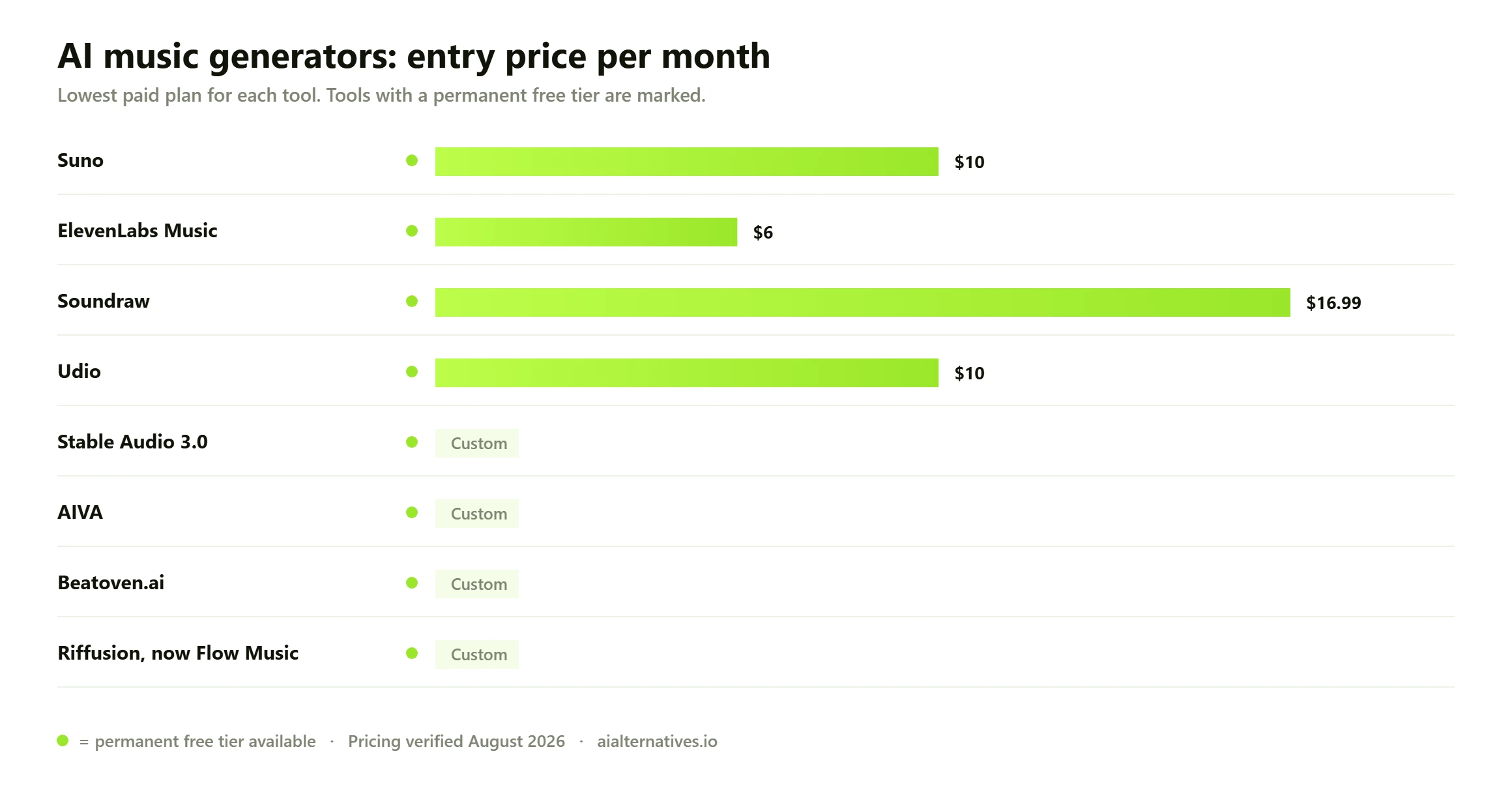
Pro $10/month, or $8/month billed annually. Premier $30/month, or $24/month billed annually
Runner-up
ElevenLabs Music
Best if you need training data you can point to when a client asks
Starter $6/month, Creator $22/month, Pro $99/month, Scale $299/month, Business $990/month
Third pick
Soundraw
Best licence terms for creators who need certainty, not novelty
Creator $16.99/month, Artist Starter $29.99, Artist Pro $35.99, Artist Unlimited $50. Annual billing cuts each by roughly a third
01
Suno
Best song quality, with a new export limit you must plan around
Suno is still the strongest all-round text-to-song model. Full arrangements, coherent vocals, believable genre control, and a library that keeps everything you have ever made.
The catch is new and significant. From 3 September 2026 Suno caps how many tracks you can download: 7 lifetime trial downloads free, 20 a month on Pro, 60 on Premier, uncapped only on Premier Studio. Suno’s help centre confirms unused downloads do not roll over, and the cap applies to your back catalogue too. Extra downloads can be bought beyond the limit.
Rights are clean if you pay. Suno’s terms assign you its right, title and interest in outputs on paid tiers, and its help centre states any song downloaded as a paying subscriber carries commercial rights. Free downloads are personal use only. Suno also warns it makes no representation that copyright will vest in the output at all, which is a machine learning problem rather than a Suno one.
Choose it if you generate a lot and export selectively. Avoid it if your workflow needs bulk exports at the Pro price.
Free tier: Yes. 50 credits daily, roughly 10 songs, but only 7 lifetime downloads and no commercial rights
Pro $10/month, or $8/month billed annually. Premier $30/month, or $24/month billed annually
02
ElevenLabs Music
Best if you need training data you can point to when a client asks
Eleven Music is the one to reach for when someone in the approval chain will ask where the training data came from. ElevenLabs states the model is trained on licensed data only and every track is cleared for commercial use, and it launched alongside deals with Merlin and Kobalt. Music v2 handles long-form structure, genre transitions and multilingual vocals noticeably better than v1.
Read the model-specific terms first, because the tiering is unusual. On Free through Business plans, commercial use is permitted online and offline except film, TV, radio and what ElevenLabs calls Studio Games. Only Enterprise Music removes those exclusions. Streaming rights are prohibited on Free and Starter and permitted from Creator upward. Reselling and stocking a music library are off limits on every self-serve plan.
So if you are scoring a short film or a commercially released game, the $22 Creator plan is not enough, and no listicle tells you that. For a YouTube channel, a podcast bed or a social ad, it is comfortably enough.
Free tier: Yes. 10,000 credits a month with attribution required and no streaming rights
Starter $6/month, Creator $22/month, Pro $99/month, Scale $299/month, Business $990/month
03
Soundraw
Best licence terms for creators who need certainty, not novelty
Soundraw makes instrumental beds rather than radio singles, and it is upfront about what you get. The company states every beat comes with a worldwide, perpetual licence, that you keep 100% of the revenue, and that anything made while subscribed stays licensed for life even if you cancel. Distribution to Spotify, Apple Music and TikTok is explicitly permitted on paid tiers.
That post-cancellation clause is worth more than it sounds. Plenty of subscription music tools quietly tie your right to keep using a track to an active subscription, turning a one-off project into a permanent bill. Soundraw does not.
The editor is the other draw. Generate a track, then move sections, change energy and swap instruments, which suits video editing far better than regenerating and hoping the timing lands. MP3 only on cheaper plans; WAV and stems need Artist Pro or above.
Free tier: You can generate and preview without paying, but downloads require a plan
Creator $16.99/month, Artist Starter $29.99, Artist Pro $35.99, Artist Unlimited $50. Annual billing cuts each by roughly a third
04
Udio
Best sonic detail, but you currently cannot take the music with you
Udio’s outputs have always had a texture and mix quality that reward headphones. It is also the clearest example of why the licence question matters more than the audio question.
After settling with Universal Music Group in October 2025, Udio disabled user downloads on 29 October. Following a public backlash it opened a 48 hour window from 3 November so subscribers could retrieve existing work under pre-deal terms, then closed exports again. A spokesperson called it a difficult but necessary step to support the next phase. The rebuilt platform is designed as a walled garden where you remix with participating artists’ work inside Udio rather than exporting files.
For a remix hobbyist that is genuinely interesting. For anyone who needs an audio file for a timeline or a distributor, it is disqualifying until exports return. Check the current status before you subscribe, because this is the fastest-moving item on this page.
Free tier: Yes. 100 credits a month with a hard 10 per day cap and 3 full songs daily
Standard $10/month, Pro $30/month, or pay as you go at $3 per 100 credits. Prices from a secondary source dated June 2026, see notes
05
Stable Audio 3.0
Best for teams that need indemnification and a model they can self-host
Stability AI positions Stable Audio 3.0 as a model family trained on fully licensed data, with legal indemnification under its enterprise licence. That one sentence is why it appears on procurement shortlists that would never look at a consumer song generator.
You can run it four ways: the web app, the Stability API, an enterprise licence for self-hosting, and open-weight Small and Medium models you can download. If compliance will not let briefs leave your infrastructure, self-hosting is the only realistic option in this category.
It is weaker than Suno at full vocal songs and better at sound design, loops, ambience and production elements. Treat it as a studio component, not a jukebox.
Free tier: Open weights for the Small and Medium models are downloadable
API and enterprise licensing. Stability does not publish per-seat figures openly, so request a quote
06
AIVA
Best for composers who want the copyright in their own name
AIVA is the only tool here that puts ownership in the plan comparison itself, and it does not flatter the cheap tiers. Free and Standard both say copyright owned by AIVA. Only Pro says copyright owned by YOU, with unrestricted monetisation. Standard allows limited monetisation on YouTube, Twitch, TikTok and Instagram; free is non-commercial.
That honesty is useful. It also means anyone on the EUR 11 Standard plan expecting to own their catalogue has a problem, and it is one of the most common misreadings in the category.
Musically AIVA leans orchestral, cinematic and game score, and it exports MIDI and stems, so you can take the idea into a DAW and finish it like a human composition. For film scoring students and game developers that combination is hard to beat.
Free tier: Yes, but AIVA retains the copyright and use is non-commercial
Standard €11/month billed annually, Pro €33/month billed annually. Only Pro transfers copyright to you
07
Beatoven.ai
Best for podcast and video beds, provided you never send it to a distributor
Beatoven generates unique royalty-free music sized to a video or podcast, with mood and instrument controls that make it easy to produce something unobtrusive. Mix and master quality is solid for background use.
The restrictions are the point. Beatoven’s pricing page states reselling is prohibited, distribution to streaming platforms such as Spotify and SoundCloud is not permitted, and tracks cannot be registered with content ID systems. That last one protects you from your own track being claimed against you, but it also means Beatoven is not a route to a released catalogue. Use it for what it is built for: under a talking head, behind a podcast intro, inside a client explainer.
Free tier: Yes, with a limited monthly allowance
Tiered subscriptions described as Starter and Creator. Beatoven’s pricing page did not render figures for us on 1 September 2026, so check it directly rather than trusting a third-party number
08
Riffusion, now Flow Music
Worth watching, but read the terms before you build anything on it
Riffusion began as a clever open research project that generated audio through spectrogram images, and grew into a free, fast, browser-based generator with a loyal following. On 1 September 2026, riffusion.com redirects to Google’s Flow Music, a platform built around a conversational Producer, music video generation and custom audio tools. It advertises free to start with no credit card required.
What the landing page does not do is state ownership or commercial-use terms, and those decide whether you can use the output in paid work. Until you have read the full terms for the new product, treat commercial rights as unconfirmed. We include it because free generation with video output is a real offer. We rank it last because a licence you cannot find is a licence you cannot rely on.
Free tier: Yes. Advertised as free to start with no card required
No pricing tiers published on the landing page we read on 1 September 2026
AI music generators compared at a glance8 tools
#
Tool
Best for
Free tier
Price
01
Suno
Best song quality, with a new export limit you must plan around
Free tier
Pro $10/month, or $8/month billed annually. Premier $30/month, or $24/month billed annually
02
ElevenLabs Music
Best if you need training data you can point to when a client asks
Free tier
Starter $6/month, Creator $22/month, Pro $99/month, Scale $299/month, Business $990/month
03
Soundraw
Best licence terms for creators who need certainty, not novelty
Free tier
Creator $16.99/month, Artist Starter $29.99, Artist Pro $35.99, Artist Unlimited $50. Annual billing cuts each by roughly a third
04
Udio
Best sonic detail, but you currently cannot take the music with you
Free tier
Standard $10/month, Pro $30/month, or pay as you go at $3 per 100 credits. Prices from a secondary source dated June 2026, see notes
05
Stable Audio 3.0
Best for teams that need indemnification and a model they can self-host
Free tier
API and enterprise licensing. Stability does not publish per-seat figures openly, so request a quote
06
AIVA
Best for composers who want the copyright in their own name
Free tier
Standard €11/month billed annually, Pro €33/month billed annually. Only Pro transfers copyright to you
07
Beatoven.ai
Best for podcast and video beds, provided you never send it to a distributor
Free tier
Tiered subscriptions described as Starter and Creator. Beatoven’s pricing page did not render figures for us on 1 September 2026, so check it directly rather than trusting a third-party number
08
Riffusion, now Flow Music
Worth watching, but read the terms before you build anything on it
Free tier
No pricing tiers published on the landing page we read on 1 September 2026
Entry price versus what the licence actually permits. The cheapest plan is rarely the one that clears your use case, and three of these eight restrict commercial use on the tier most people sign up for.
Who actually owns the music you generate
Start here, because everything else is downstream of it. When a song comes out of a prompt, three separate questions get tangled together, and most guides answer none of them.
First: does the vendor give you rights to the file? A contract question, and the easy one. Suno assigns you its interest in outputs on paid plans. AIVA transfers copyright only on Pro. Soundraw grants a worldwide perpetual licence that survives cancellation. ElevenLabs grants commercial use with carve-outs for film, TV, radio and Studio Games below Enterprise. Read the tier, not the homepage.
Second: does anyone else have a claim on it? That is the training data question, and it is why the label settlements matter. A tool trained on licensed catalogues under a signed deal carries less residual risk than one still litigating.
Third: can the output be copyrighted at all? That is not up to the vendor. In the United States copyright protection requires human authorship, and the Copyright Office has been explicit that purely machine-generated material does not qualify, while human contributions to an AI-assisted work can. Suno says as much itself, warning it makes no representation that any copyright will vest in any output.
The practical read: your vendor licence protects you from the vendor. It does not hand you an enforceable copyright. If exclusivity matters, add real human authorship on top, which usually means writing the lyrics, arranging the sections, or finishing stems in a DAW. Our AI tool guides cover the same question for images and text.
How we verified this
Every price, plan name, credit allowance and licence statement on this page was read from the vendor’s own pricing page, terms of service, help centre or model-specific terms on 1 September 2026. Where a vendor does not publish a figure openly, or where a JavaScript-rendered page would not return content, we say so in the tool entry rather than guessing or repeating a number from another comparison site. Litigation and settlement details come from published industry and legal reporting and from the American Federation of Musicians’ own case summary. This page contains no first-hand listening tests or measured benchmarks, and we do not present any.
The export limit nobody put in the headline
Through 2024 and 2025 the pitch for AI music was effectively unlimited: pay ten dollars, generate all month, download everything. In 2026 that ended, and it ended at the top of the market.
Suno’s downloads policy update takes effect on 3 September 2026. Free accounts get up to 7 lifetime trial downloads, personal use only. Pro gets 20 a month, Premier 60, Premier Studio uncapped. Counts reset monthly and unused downloads do not carry over. Everything you have already made stays playable and shareable, but the cap applies when you export it. Suno’s stated reason is that limits make it harder for bad actors to mass-export music, a direct response to fraudulent uploads flooding streaming services. The new terms also ban stream ripping and reserve Suno’s right to watermark and fingerprint outputs.
Udio went further, disabling exports entirely in October 2025 after its Universal settlement, with a single 48 hour retrieval window in early November.
So the question to ask a generator in 2026 is not how many songs can I make. It is how many can I take with me, and what happens to the ones I already made.
Tool
Free tier commercial use
Paid tier commercial use
Export limit
Rights after you cancel
Suno
No, personal use only
Yes, rights assigned on paid plans
7 lifetime free, 20/month Pro, 60/month Premier from 3 Sept 2026
Downloaded tracks keep the licence they were downloaded under
ElevenLabs Music
Yes, with attribution, no streaming
Yes, but no film, TV, radio or Studio Games below Enterprise
Credit-based, no separate download cap published
Output stays subject to the plan it sat under, per the model terms
Soundraw
Preview only
Yes, worldwide and perpetual, keep 100% of revenue
Unlimited on Creator and Artist Unlimited, 10 to 20 on mid tiers
Anything made while subscribed stays licensed for life
Udio
No
Deals signed with UMG and WMG, platform rebuilding
Downloads disabled since Oct 2025, check current status
Tracks pulled in the Nov 2025 window kept pre-deal terms
Stable Audio 3.0
Open weights available to run yourself
Yes, with indemnification under the enterprise licence
Depends on API or licence tier
Governed by your licence agreement
AIVA
No, AIVA owns the copyright
Limited on Standard, full ownership only on Pro
Plan-based download counts
Depends on the tier the track was made under
Beatoven.ai
Limited
Royalty free, but no streaming distribution and no content ID
Plan-based
Check terms, not published clearly
Riffusion / Flow Music
Not stated on the landing page
Not stated on the landing page
Not published
Not published
What the label settlements actually changed for you
In June 2024 the RIAA sued Suno and Udio for the major labels, alleging widespread infringement and seeking up to $150,000 per work. That case shaped the next two years of the category.
Universal Music Group settled with Udio in October 2025. Warner Music Group settled with Suno on 25 November 2025, in a deal that also transferred Songkick to Suno. The terms are not just money. Suno agreed to launch new licensed models in 2026 and deprecate the current ones, to require a paid account for audio downloads, and to give artists and songwriters control over whether their names, images, likenesses, voices and compositions are used in new AI-generated music.
Three things follow. One, the download caps and walled gardens are settlement consequences, not product whims, so they are unlikely to be reversed. Two, model deprecation is real: a version you like today can be retired. Three, the legal weather is not settled. On 5 June 2026 the American Federation of Musicians sued Universal, Atlantic Recording and Warner Records in the Southern District of New York, arguing that licensing catalogues for AI training is a new use requiring musician compensation under the Sound Recording Labor Agreement. That case was live as of August 2026.
What the licence actually grants
Three distinctions are worth internalising before you pay anyone. Royalty free means you do not pay per play; it does not mean you own the recording. Commercial use means you may earn money from it; it does not mean you may distribute it to streaming platforms, and Beatoven explicitly forbids that while permitting commercial use. Ownership means the vendor assigns its interest to you, which Suno does on paid tiers and AIVA does only on Pro. A tool can offer all three, one, or none, and the marketing page rarely tells them apart. The exclusions clause is where the money is: ElevenLabs permits all online and offline commercial use except film, TV, radio and Studio Games on every self-serve plan.
Matching the tool to the actual job
Almost nobody needs the best AI music generator in the abstract. You need the one that clears your use case at a price you can defend. Work backwards from the deliverable.
What you are making
Pick
Why
Monetised YouTube videos and social ads
ElevenLabs Music Creator, or Soundraw
Both clear online commercial use, and Soundraw’s licence survives cancellation
Tracks you intend to release on Spotify or Apple Music
Suno Premier, or Soundraw Artist Pro
Both permit streaming distribution on paid tiers. Beatoven and ElevenLabs Starter do not
A short film, a TV spot or a radio ad
Soundraw, or ElevenLabs Enterprise Music
ElevenLabs self-serve plans exclude film, TV and radio, which catches people out
A commercially released game
Soundraw, AIVA Pro, or ElevenLabs Enterprise
ElevenLabs excludes Studio Games below Enterprise. AIVA Pro transfers copyright
Client work you will hand over
Suno Pro or Premier, or AIVA Pro
You need assignable rights, which means the tier that transfers ownership
Podcast beds and corporate video
Beatoven.ai
Purpose-built for it and cheap, as long as you never need distribution
Orchestral and cinematic scoring with stems
AIVA Pro
MIDI and stem export lets you finish the work in a DAW
Anything with a compliance or procurement review
Stable Audio 3.0
Licensed training data plus indemnification under the enterprise licence
The cost maths most guides skip
Comparing headline subscription prices is nearly useless here, because the unit that matters is not the month. It is the usable export.
Take Suno Pro at $10 a month with 2,500 credits and 20 downloads. The credits will let you generate hundreds of songs. The download cap means you can leave with 20. That is 50 cents per exported track, and AI songwriting is an iterative craft where you might generate six versions to keep one. If your real keep rate is one in six, Premier at $30 for 60 downloads is the sane tier, not Pro.
Now compare Soundraw Creator at $16.99 for unlimited MP3 downloads. If you need 40 background beds a month for a video business, Soundraw is cheaper per usable asset than Suno Premier, despite a lower sticker price and less impressive songs. The tool that wins on a demo reel is often not the tool that wins on your invoice.
One more line item people forget: annual billing. Suno drops from $10 to $8 a month annually, Soundraw from $16.99 to $11.04, AIVA discounts Standard by 26% and Pro by 33%. In a category moving this fast, an annual commitment is also a bet that the terms will not change under you, and 2026 has shown they can.
Getting AI music onto Spotify without it being pulled
Distributors tightened up sharply through 2026 in response to mass AI uploads, and the rejection reasons are consistent enough to plan around.
Check three things before you submit. Does your tier explicitly permit streaming distribution? Free and Starter tiers usually do not, and ElevenLabs starts streaming rights at Creator. Can the track be registered with a content ID system? Beatoven says no, so you cannot claim it or protect it. And did you download the file as a paying subscriber, under the plan that carries commercial rights?
Spotify has publicly said it does not promote or penalise tracks purely for being made with AI tools, so the risk is not the platform’s taste. It is your paperwork. A track downloaded on a free tier and uploaded to a distributor is a licence breach however good it sounds, and that is the version of this that gets accounts terminated.
If you want a catalogue rather than a hobby, keep a record for every release: the tool, the plan, the download date, and the licence text as it read that day. Terms change. Your evidence should not. If you are also weighing where to publish, our Spotify alternatives guide covers platforms that pay differently.
What users consistently report
Across public community threads and platform forums in late 2025 and 2026, the same three complaints recur. Sudden policy changes are the loudest: Udio subscribers described the removal of downloads as a betrayal and reported losing access to work they had paid to create, which prompted the 48 hour retrieval window. Second, people underestimate how many generations it takes to get a keeper, so credit allowances that look generous run out fast. Third, distributor rejections are commonly traced back to the wrong subscription tier rather than the audio itself. These are aggregated impressions from public discussion, not measured findings, and individual experience varies.
How to test a generator before you pay for a year
Give yourself a week and a fixed brief. Use the same prompt on every tool: a real one from a real project, not a fantasy. Same genre, same tempo, same length, same mood.
Then judge four things in order. Does it clear your use case in writing, with your use case absent from any exclusions list? Can you export the number of files you need at the tier you can afford? Does it hold up at the length you need, since most tools are strongest in the first 60 seconds? And can you edit it, or must you regenerate and hope, because regeneration is where credits die.
Only then listen for fidelity. Sound quality is the easiest thing to compare and the least likely reason a project fails. Licence terms are the hardest to compare and the most likely to end one. The same discipline applies to the writing tools that draft your lyrics and briefs, covered in our ChatGPT alternatives guide, and to the AI chatbot you use to run the campaign around a release.
For the source documents themselves, Suno publishes its downloads and terms update in full on its official blog, and the US Copyright Office sets out the human authorship requirement for AI-assisted works at copyright.gov/ai. Both are worth ten minutes before you spend anything.
FAQ
Questions people actually ask
Which is the best AI music generator overall in 2026?
Suno, on sound quality and control, provided you can work inside its export limits. From 3 September 2026 it allows 20 downloads a month on Pro and 60 on Premier. If you need more exports than that, or you need film, TV and radio clearance, Soundraw’s perpetual worldwide licence is the more practical choice even though its songs are simpler.
Do I own the music an AI generator makes for me?
You usually own a licence, not a copyright. Suno assigns you its right, title and interest in outputs on paid tiers. AIVA transfers copyright only on Pro; Free and Standard say copyright is owned by AIVA. Separately, US copyright requires human authorship, and Suno’s own terms warn it makes no representation that copyright will vest in any output. A strong contract with the vendor does not by itself give you an enforceable copyright against a third party.
Can I put AI-generated music on Spotify and monetise it?
Only if your plan permits streaming distribution and you downloaded the file under that plan. Suno grants commercial rights on paid downloads. ElevenLabs permits streaming from the Creator tier upward, not on Free or Starter. Beatoven explicitly does not permit distribution to streaming platforms at all. Check your tier’s terms, not the marketing page.
Why did Suno start limiting downloads?
It follows the Warner Music Group settlement of 25 November 2025, which committed Suno to licensed models and to requiring a paid account for audio downloads. Suno says the caps make it harder for bad actors to mass-export music, addressing fraudulent uploads to streaming services. The limits start on 3 September 2026 at 7 lifetime free, 20 a month on Pro and 60 on Premier, with no rollover.
Is Udio still worth subscribing to?
Only if you are happy creating inside the platform rather than exporting files. Udio disabled user downloads on 29 October 2025 after settling with Universal Music Group, reopened them for a 48 hour window from 3 November, then closed them again. The rebuilt platform is designed around remixing with participating artists’ work rather than file export. Check the current download status before you pay.
What is the best free AI music generator?
ElevenLabs Music has the most usable free tier for real work, at 10,000 credits a month with attribution, though streaming rights are excluded until Creator. Suno’s free tier is now limited to 7 lifetime downloads for personal use only. Flow Music, at the address Riffusion used to occupy, advertises free use with no card required but publishes no commercial terms on the landing page.
Does royalty free mean the same as owning the track?
No. Royalty free means you do not pay per play or per use. It says nothing about who owns the recording, whether you can distribute it, or whether you can register it with a content ID system. Beatoven is royalty free and still forbids streaming distribution and content ID registration. Always read those three permissions separately.
Are the AI music lawsuits over?
The label cases against Suno and Udio settled, Universal with Udio in October 2025 and Warner with Suno in November 2025. But the American Federation of Musicians sued Universal, Atlantic Recording and Warner Records on 5 June 2026 in the Southern District of New York, arguing that licensing catalogues for AI training is a new use requiring musician compensation under the Sound Recording Labor Agreement. As of August 2026 that case was live.
What happens to my songs if a model is retired?
Suno’s help centre states that retiring a model means you can no longer generate new songs with it, but it does not affect anything you have already made. Existing tracks stay in your library and remain playable. Extensions and remixes will use the newer model and may sound noticeably different, so if a track matters, export it while you can.
Which AI music tool is safest for client and agency work?
Stable Audio 3.0 for anything going through procurement, because Stability states the model family is trained on fully licensed data and offers legal indemnification under its enterprise licence, with self-hosting available. For smaller client work without a compliance review, Soundraw’s perpetual worldwide licence and post-cancellation rights are least likely to create a problem two years later.
Next step
Work out the rest of your stack
Music is one line in a production budget. If you are assembling the tools around it, start with the guides below and apply the same test: read the tier, find your use case, then listen.