01
Helcim
Cutting card fees outright
You get interchange-plus pricing with published volume discounts and no contract. On $50,000 a month it typically lands near $1,450 for you versus Stripe’s $1,750.
Free tier: No monthly fee at all, ever
New this week: 6 head-to-head tests added, including Claude vs Gemini for long documents.
See what changed →Stripe still charges you 2.9% + 30¢ on US online cards. That headline rate hasn’t moved. What’s moved is everything stacked on top of it. Billing now costs you 0.7% of subscription volume. Every dispute costs $15. International cards add 1.5%.
Then there’s the other complaint you’ve probably heard. Stripe underwrites you after signup, not before. Your payouts can pause mid-review. If you’re a small merchant, that’s a business-ending week.
This guide ranks 8 Stripe alternatives for you on two things that actually matter: what you pay, and whether your money shows up. Every price below was verified against official pricing pages in August 2026.
Ranked by testing, current pricing and free-tier value. Details on every pick below the list.
Cutting card fees outright
Interchange + 0.50% + 25¢ onlineClosest drop-in Stripe swap
2.89% + 29¢ per transactionAccount stability at volume
$0.13 + interchange + 0.60%Cutting card fees outright
You get interchange-plus pricing with published volume discounts and no contract. On $50,000 a month it typically lands near $1,450 for you versus Stripe’s $1,750.
Free tier: No monthly fee at all, ever
Closest drop-in Stripe swap
You’ll pay slightly less than Stripe on cards here, with PayPal and Venmo built in natively. Chargebacks cost you $15, versus Stripe’s $15 dispute fee.
Free tier: No monthly or setup fee
Account stability at volume
Adyen holds its own acquiring licences, so you aren’t sitting behind an aggregator’s risk model. There is a minimum invoice depending on your industry.
Free tier: No setup, monthly, or closure fees
Selling in person and online
You’ll pay 2.6% + 15¢ in person on the free plan, 2.5% + 15¢ on Plus. Online runs 3.3% + 30¢ free, 2.9% + 30¢ on paid plans.
Free tier: Full free plan, pay per transaction
SaaS selling globally
A merchant of record that registers, files, and remits sales tax and VAT for you. Expensive per transaction, cheap compared to a finance hire.
Free tier: No monthly fee, no migration cost
A dedicated merchant account
The All-in-One plan bundles you a real merchant account, gateway, and fraud tools. Gateway-only runs $25 a month plus 10¢ per transaction.
Free tier: None, $25 monthly minimum
Indie digital products
This is a merchant of record with the simplest checkout you’ll find in this list. Note it’s Stripe-owned now, and it’s migrating users like you to Stripe Managed Payments.
Free tier: No monthly fee for commerce features
Europe-only sellers
You’ll pay roughly a third less than Stripe on European consumer cards here, with iDEAL at €0.32 flat. Just know it’s not available if you’re a US merchant.
Free tier: No monthly minimum or lock-in
| # | Tool | Best for | Free tier | Price |
|---|---|---|---|---|
| 01 | Helcim | Cutting card fees outright | Trial only | Interchange + 0.50% + 25¢ online |
| 02 | PayPal Braintree | Closest drop-in Stripe swap | Trial only | 2.89% + 29¢ per transaction |
| 03 | Adyen | Account stability at volume | Trial only | $0.13 + interchange + 0.60% |
| 04 | Square | Selling in person and online | Free tier | Free / $49 per mo per location |
| 05 | Paddle | SaaS selling globally | Trial only | 5% + 50¢ per checkout |
| 06 | Authorize.net | A dedicated merchant account | Free tier | $25 per mo + 2.9% + 30¢ |
| 07 | Lemon Squeezy | Indie digital products | Trial only | 5% + 50¢ per transaction |
| 08 | Mollie | Europe-only sellers | Trial only | From 1.80% + €0.25 (EEA cards) |
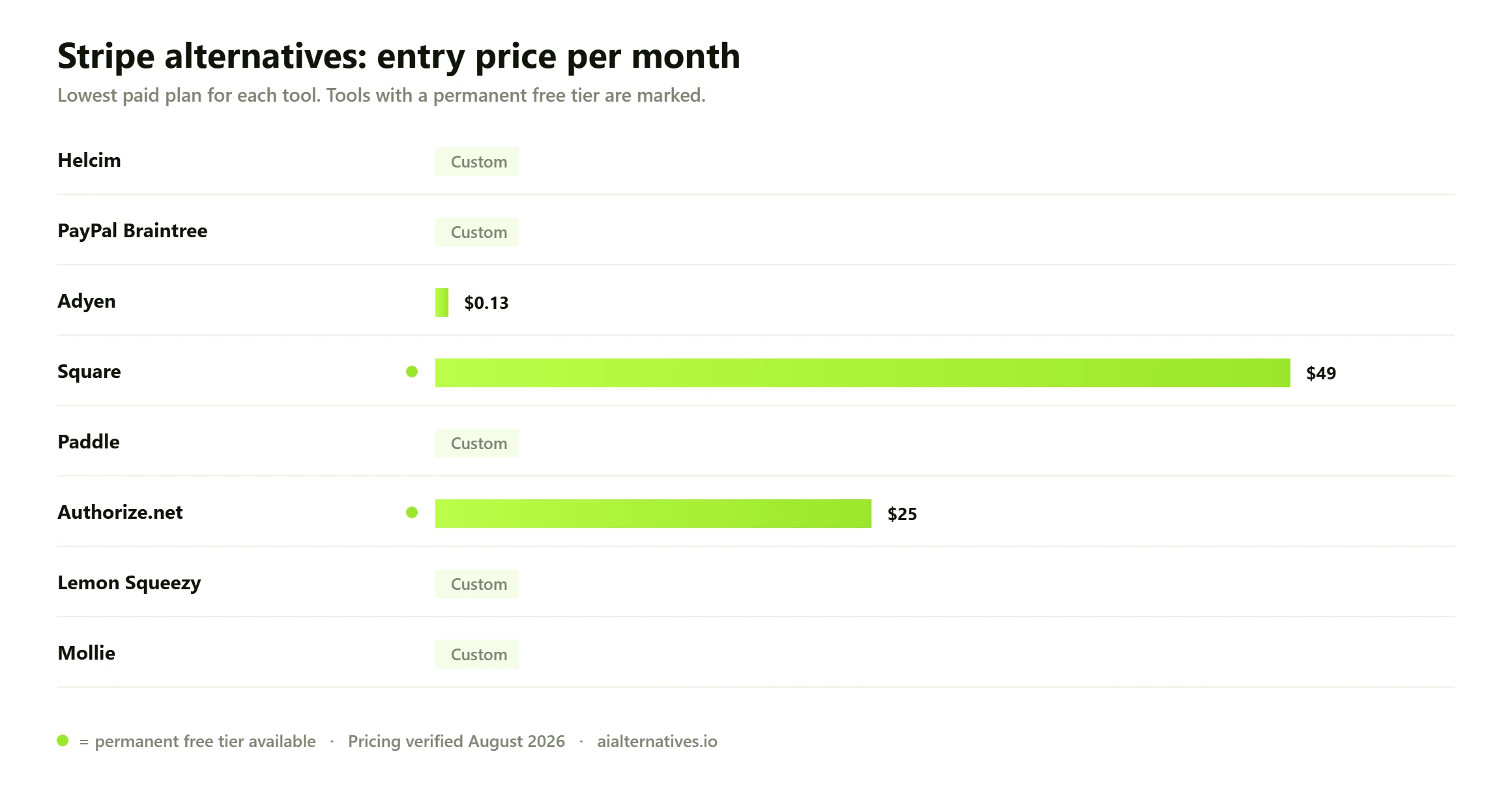
Stripe’s headline rate hasn’t changed. Stripe’s published US pricing is still 2.9% + 30¢ for domestic online cards. The problem is what sits on top of it.
In late June 2024, Stripe collapsed its two Billing tiers — 0.5% Starter and 0.8% Scale — into a single plan at 0.7%, and that’s probably part of why your bill has crept up. New accounts moved on 10 July 2024. Existing customers were grandfathered until 30 June 2025, then repriced. Revenue Recognition was split out as a separate 0.25% fee. One-time invoices now cost 0.5% each.
International cards add 1.5% to what you pay. Currency conversion adds 1%. Each dispute costs you $15 whether you win or lose. Instant Payouts run 1.5% with a 50¢ minimum. ACH is 0.8%, capped at $5. There’s now also a Billing subscription plan starting at $620 a month on a one-year contract.
Stripe is a payment aggregator. You get approved in minutes, then underwritten later. Stripe’s own payout documentation says your first payout is typically scheduled 7–14 days after your first successful payment, and might take longer depending on your industry risk level.
Stripe’s Services Agreement defines a Reserve as collateral funds Stripe holds and controls against potential liabilities. It also lets Stripe suspend an account immediately if fraud rates rise or requested information isn’t provided promptly.
Let’s be fair about this. Most merchants never see a hold. The complaints cluster in Stripe’s own restricted categories: content platforms, crowdfunding, crypto, telehealth, NFTs, and travel. Aggregators manage that risk by pausing payouts, which is legitimate risk management — but the cash-flow cost lands on you, not them. If you sell in one of those categories, a dedicated merchant account is simply the safer structure for you.
| Tool | Best for | Starting price | Free plan |
|---|---|---|---|
| Helcim | Cutting card fees outright | Interchange + 0.50% + 25¢ | Yes, no monthly fee |
| PayPal Braintree | Closest drop-in Stripe swap | 2.89% + 29¢ | Yes, no monthly fee |
| Adyen | Account stability at volume | $0.13 + interchange + 0.60% | No monthly fee, minimum invoice applies |
| Square | Selling in person and online | Free, or $49/mo per location | Yes, full free plan |
| Paddle | SaaS selling globally | 5% + 50¢ per checkout | No monthly fee |
| Authorize.net | A dedicated merchant account | $25/mo + 2.9% + 30¢ | No |
| Lemon Squeezy | Indie digital products | 5% + 50¢ | No monthly fee |
| Mollie | Europe-only sellers | From 1.80% + €0.25 | No monthly minimum |
Percentages are abstract. Here’s the same month priced across each processor: $50,000 in online card volume across 1,000 transactions, averaging $50 each.
| Processor | Published rate | Estimated monthly cost |
|---|---|---|
| Adyen | $0.13 + interchange + 0.60% | ~$1,380 |
| Helcim | Interchange + 0.50% + 25¢ | ~$1,450 |
| PayPal Braintree | 2.89% + 29¢ | $1,735 |
| Stripe | 2.9% + 30¢ | $1,750 |
| Authorize.net | $25 + 2.9% + 30¢ | $1,775 |
| Square Plus | $49 + 2.9% + 30¢ | $1,799 |
| Square (free plan) | 3.3% + 30¢ | $1,950 |
| Stripe + Stripe Billing | 2.9% + 30¢ + 0.7% | $2,100 |
| Paddle / Lemon Squeezy | 5% + 50¢ | $3,000 |
The Adyen and Helcim figures assume a blended interchange plus scheme cost near 1.9%, which is typical for a US consumer card mix. Yours will differ. Premium rewards cards push it up, debit pulls it down.
The gap that matters: interchange-plus saves roughly $300–$370 a month here, or about $4,000 a year. Merchant-of-record pricing costs $1,250 more, and buys you out of tax filing.
Helcim prices you at interchange plus a margin instead of a flat rate. Online, that’s interchange + 0.50% + 25¢ on your first $50,000 a month, falling to +0.35% + 20¢ above $100,000 and +0.15% + 15¢ above $1M. ACH is 0.5% + 25¢, capped at $6.
What it lacks is Stripe’s developer surface. The API is thinner and the integration library is smaller. Helcim also serves the US and Canada only. Pick it if you’re a straightforward US business paying Stripe over $1,000 a month in fees.
Braintree is PayPal’s developer-facing gateway, and your most familiar migration from Stripe. US cards run 2.89% + 29¢, marginally under Stripe. Chargebacks cost you $15. ACH is 0.75% capped at $5.
The real advantage for you is wallets: PayPal and Venmo (3.49% + 49¢) are first-party, which Stripe still can’t match. What it lacks is Stripe’s documentation quality and product depth. Underwriting is PayPal’s, which has its own hold reputation, so don’t expect this to be a stability upgrade.
Adyen holds its own acquiring licences across major markets. You’re a direct merchant, not a sub-account inside an aggregator’s risk pool. That single structural difference is why larger merchants move here after a Stripe hold.
Pricing is interchange++: $0.13 plus interchange plus 0.60% on Visa and Mastercard, with no setup, monthly, or closure fees for you. What it lacks is accessibility. Onboarding takes weeks, there’s a minimum invoice by industry, and Adyen sells to companies doing real volume. Realistically, look here if you’re above $1M a year.
Square’s free plan is 2.6% + 15¢ in person and 3.3% + 30¢ online. Square Plus, at $49 per location per month, drops those to 2.5% + 15¢ and 2.9% + 30¢. Premium is $149 and gets you 2.4% + 15¢ in person. Hardware, POS, invoicing, and payroll all live in one account.
What it lacks: online, Square isn’t cheaper than Stripe for you unless you pay for Plus. Manual entry is a steep 3.5% + 15¢. Pick it if you run retail, a restaurant, or a service business with a storefront attached.
Paddle is a merchant of record, not a processor. It charges you 5% + 50¢ per checkout and becomes the legal seller: it registers for sales tax and VAT, collects it, files it, and remits it on your behalf. Subscription billing, dunning, and buyer support are all bundled in.
What it lacks is cheapness. At $50,000 a month you’ll pay around $3,000 versus $1,750 on raw Stripe. That’s the wrong trade if you sell to one country. It’s the right trade the moment you’re registered in five.
The All-in-One plan runs you $25 a month plus 2.9% + 30¢ and includes an actual merchant account rather than an aggregator sub-account. Gateway-only is $25 a month plus 10¢ per transaction and a 10¢ daily batch fee, if you already have acquiring elsewhere. eCheck runs 0.75%.
What it lacks is a modern developer experience. The API is dated and the dashboard shows its age. Pick it when predictability and fraud tooling matter more to you than elegance.
If the 0.7% Billing fee is your actual complaint, you may not need a new processor at all. You need a different billing layer sitting on top of one.
Run the math yourself before you move. On $50,000 a month of subscription volume, Stripe Billing costs $350. Recurly Starter costs about $339. Chargebee Flow costs $800. On price alone, Stripe Billing is genuinely hard for you to beat at small and mid scale. You’d switch for entitlements, complex proration, or revenue recognition — not for savings.
One caveat you should know about Lemon Squeezy: Stripe acquired it in 2024, and on 28 January 2026 the company confirmed Stripe Managed Payments is live across 35 or more countries, with a migration path for existing users. If you leave Stripe for Lemon Squeezy, you haven’t actually left Stripe.
Connect is the hardest piece for you to replace. Stripe bundles it with Payments at no extra charge, with an optional 0.25% platform revenue-share fee if you want to monetise payments. Nothing else matches its onboarding flow. These come closest.
The split is simple. If payments are a revenue line for your platform, Tilled and Adyen for Platforms hand you more margin per transaction than Connect does. If you just need to split a payment and move on, Connect being free is difficult to argue with.
You’re paying too much and you’re a normal US business. Go Helcim. Interchange-plus beats 2.9% flat for almost anyone processing over about $10,000 a month.
You’ve been frozen or you’re in a restricted category. Get off aggregator pricing. Adyen or a dedicated merchant account through Authorize.net gives you a direct relationship instead of a sub-account.
You sell software to 20 countries. Paddle. The 5% looks brutal until you price the alternative: registering, filing, and remitting VAT and sales tax yourself.
You sell in a shop and online. Square. Nobody else does both this cleanly at this price.
Your only complaint is the 0.7% Billing fee. Keep Stripe for processing. Compare Recurly and Chargebee for the billing layer, and check the math first.
You’re selling only inside Europe. Mollie. EEA consumer cards at 1.80% + €0.25 undercut Stripe substantially, and iDEAL at €0.32 flat is unbeatable in the Netherlands.
If your business does under about $10,000 a month, no. The fee difference is maybe $30 a month for you. Rebuilding checkout, webhooks, and reconciliation costs more than that in engineering time alone.
Above roughly $50,000 a month, the arithmetic flips hard. Moving from 2.9% flat to interchange-plus saves around $4,000 a year at that volume, and the saving grows linearly while your integration cost stays fixed.
Stay on Stripe if you need Connect, if your product depends on Stripe-native tooling like Radar or Terminal, or if your engineering team is small and busy. Stripe’s docs and reliability remain the best in the category, and that’s worth real money.
Leave if you’ve had a payout hold, if you’re in a restricted category, or if you can see your fee line crossing $2,000 a month. And do this regardless of what you decide: keep a second processor onboarded and idle. A backup gateway costs nothing until the day you need it, and on that day it’s the difference between a bad week and a closed business.
The questions people actually ask on Google, Reddit and Quora — answered with what we verified this month.
How we testHelcim is your cheapest option for most US businesses, at interchange + 0.50% + 25¢ online with no monthly fee. On $50,000 a month across 1,000 transactions that works out near $1,450 for you, versus $1,750 on Stripe. Adyen can go lower at $0.13 + interchange + 0.60%, but it’s aimed at merchants doing over $1M a year.
Stripe is an aggregator, so it approves you quickly and underwrites you afterwards. Stripe’s docs note your first payout is typically 7–14 days out and can take longer depending on your industry’s risk level, and its Services Agreement lets it hold a Reserve or suspend your account if fraud rates rise. Holds concentrate in Stripe’s restricted categories: content platforms, crowdfunding, crypto, telehealth, NFTs, and travel. A dedicated merchant account avoids this structure entirely.
Braintree is marginally cheaper at 2.89% + 29¢ versus Stripe’s 2.9% + 30¢, and its chargeback fee is $15. Standard PayPal Checkout is more expensive at 3.49% + 49¢, while Advanced Credit and Debit Card Payments is 2.89% + 29¢ with no monthly fee. Use Braintree if you want the cheaper card rate, and add PayPal Checkout only as a wallet option.
Adyen for Platforms is the closest match on features, with direct acquiring and multi-party payouts, but onboarding is enterprise-length. Tilled is the practical pick for software platforms that want to monetise payments: $500 a month with a 70% revenue share under $5M monthly volume. PayPal Commerce Platform is fastest to launch. Note Stripe bundles Connect free with Payments, so you’re switching for margin or stability, not cost.
Yes. Stripe acquired Lemon Squeezy in 2024, and on 28 January 2026 Lemon Squeezy confirmed Stripe Managed Payments is live in 35 or more countries with a migration path for existing users. If you’re leaving Stripe over account risk or platform dependence, Lemon Squeezy doesn’t solve that. Paddle is the independent merchant-of-record option.
No. Mollie serves European Economic Area merchants and the UK, and its published pricing is in euros and pounds only. Its rates are strong if you’re selling in Europe, at 1.80% + €0.25 for EEA consumer cards and €0.32 flat for iDEAL. If you’re a US merchant, look at Helcim, Braintree, or Adyen instead.
See how the top picks square off head to head, or browse every alternative guide we publish.