The 8 Best Shopify Alternatives in 2026, Ranked by True Cost
If you’re running a Shopify store, here’s the thing: it still works fine. You’re just paying more than the sticker price led you to believe.
Your Basic plan is $39 a month. Add four typical apps and you’re near $130. Then Shopify Payments takes 2.9% plus 30 cents on every order you process. Switch to a different gateway and Shopify tacks on another 2% for the privilege.
This guide walks you through 8 Shopify alternatives, ranked by what you’ll actually pay each month. We checked every price here against official pricing pages in August 2026, so you’re comparing real numbers. No affiliate picks, no filler.
Ranked by testing, current pricing and free-tier value. Details on every pick below the list.
Best overall
WooCommerce
Full control, no revenue share
Free plugin + hosting from $25 per mo
Runner-up
BigCommerce
Growing stores tired of apps
From $29 per mo (annual), $39 monthly
Third pick
Squarespace Commerce
Design-led small catalogs
From $19 per mo (annual)
01
WooCommerce
Full control, no revenue share
A free WordPress plugin with zero platform fees and zero revenue share. You pick the gateway, the host, and the plugins yourself, and nobody takes a cut of your sales.
Free tier: Software is free and open source; hosting is not
Free plugin + hosting from $25 per mo
02
BigCommerce
Growing stores tired of apps
If you want the closest like-for-like Shopify swap, this is it. Multi-currency, faceted search and B2B tools come built in, and if you use an embedded provider like Stripe, you won’t pay a BigCommerce transaction fee.
Free tier: No free plan, free trial only
From $29 per mo (annual), $39 monthly
03
Squarespace Commerce
Design-led small catalogs
You get templates that look like you hired a designer. On Core and above, you pay 0% Squarespace transaction fee, though be aware prices rose up to 26% in July 2026.
Free tier: No free plan, 14-day trial
From $19 per mo (annual)
04
Ecwid by Lightspeed
Adding a cart to any site
This one embeds a working store into a site you already own, including WordPress and Wix. Whichever tier you pick, Ecwid charges no transaction fee.
Free tier: The old free-forever plan is gone; entry is $5
$5 to $149 per mo
05
Wix eCommerce
First-time store builders
You’ll find this the friendliest drag-and-drop builder in this list. Wix takes no cut of your sales beyond standard payment processing, but if your catalog is large, it’ll start to strain.
Free tier: Free site plan exists, but selling requires a paid plan
From $29 per mo (annual)
06
Square Online
Free storefront plus in-person sales
This is the only truly free storefront on your list. It shares one inventory with Square’s point of sale, so if you sell in person too, your retail and online stock stay in sync automatically.
Open-source headless commerce with no license fee and no GMV tax. You keep the source code and the data, but you’ll need to supply the engineers.
Free tier: MIT-licensed core, free forever if you self-host
Free self-hosted / cloud from $29 per mo
08
Etsy
Handmade and craft sellers
This isn’t a website builder, it’s a marketplace with buyers already browsing. It’s your cheapest way to test demand if you have no traffic and no ad budget yet.
Free tier: No monthly fee, fees are per sale
$0.20 per listing + 6.5% transaction fee
Shopify alternatives compared at a glance8 tools
#
Tool
Best for
Free tier
Price
01
WooCommerce
Full control, no revenue share
Free tier
Free plugin + hosting from $25 per mo
02
BigCommerce
Growing stores tired of apps
Trial only
From $29 per mo (annual), $39 monthly
03
Squarespace Commerce
Design-led small catalogs
Trial only
From $19 per mo (annual)
04
Ecwid by Lightspeed
Adding a cart to any site
Free tier
$5 to $149 per mo
05
Wix eCommerce
First-time store builders
Free tier
From $29 per mo (annual)
06
Square Online
Free storefront plus in-person sales
Free tier
Free / $49 per mo (Plus)
07
Medusa
Dev teams replacing Shopify Plus
Free tier
Free self-hosted / cloud from $29 per mo
08
Etsy
Handmade and craft sellers
Trial only
$0.20 per listing + 6.5% transaction fee
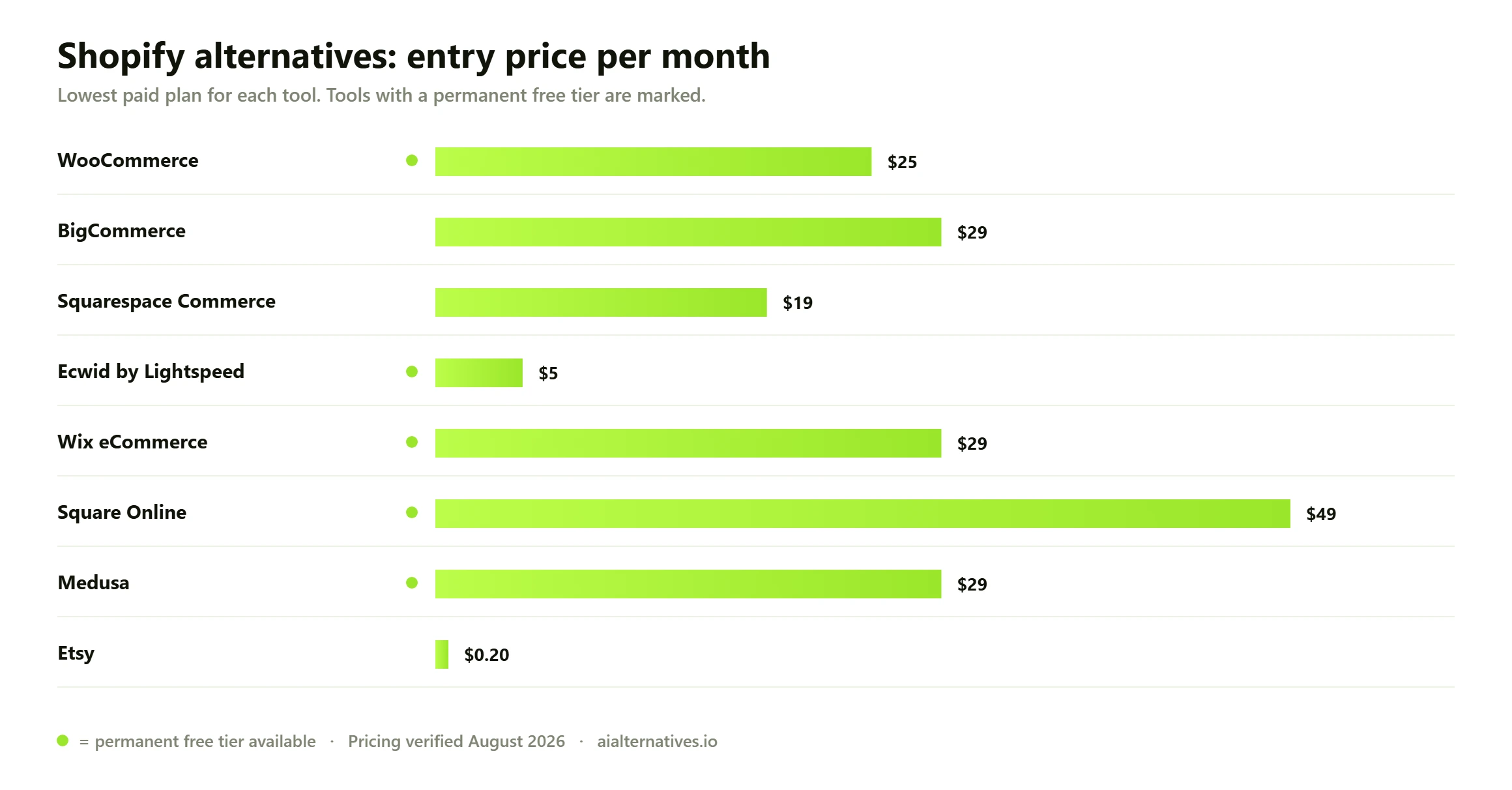
Entry monthly price across every Shopify alternative we tested. Green dot marks a permanent free tier. Pricing verified August 2026.
Why people are leaving Shopify
Shopify’s problem isn’t your base plan. It’s everything you stack on top of it.
In 2024 Shopify raised Plus from $2,000 to $2,500 a month, a 25% jump. You could have locked in $2,300 by signing a three-year agreement before April 24, 2024. The third-party gateway fee on Plus rose at the same time, from 0.15% to 0.2%.
Smaller merchants feel it differently. Shopify charges an extra fee if you don’t use Shopify Payments: 2% on Basic, 1% on Grow, 0.6% on Advanced, per its own published pricing. On $30,000 of monthly sales, that 2% is $600 gone before card processing even starts.
Then there’s the app tax. One merchant on Shopify’s own community forum ran the numbers: a $29-a-month app costs about $2,000 over five years. That sentiment shows up constantly in seller forums.
On April 10, 2025 Shopify also renamed its mid-tier ‘Shopify’ plan to ‘Grow.’ Pricing and features stayed identical. But if you re-read your invoice around then, you weren’t alone in starting to shop around.
Shopify alternatives compared at a glance
Tool
Best for
Starting price
Free plan
WooCommerce
Full control, no revenue share
Free + hosting from $25 per mo
Yes (software only)
BigCommerce
Growing stores tired of apps
$29 per mo annual / $39 monthly
No, trial only
Squarespace Commerce
Design-led small catalogs
$19 per mo annual
No, 14-day trial
Ecwid by Lightspeed
Adding a cart to any site
$5 per mo
No, free plan retired
Wix eCommerce
First-time store builders
$29 per mo annual
Free site, no selling
Square Online
Free store plus in-person sales
$0 per mo
Yes, fully free
Medusa
Dev teams replacing Plus
Free self-hosted / $29 per mo cloud
Yes, MIT licensed
Etsy
Handmade and craft sellers
$0.20 per listing + 6.5%
Yes, no monthly fee
The best Shopify alternatives, reviewed
1. WooCommerce
WooCommerce is the free, open-source plugin that turns your WordPress site into a store. You pay no monthly platform fee and no revenue share on a single order.
What it does better: you own the stack. There’s no app store gatekeeper, no penalty if you choose Stripe or PayPal, no processor forced on you. If you want WooPayments instead, it runs roughly 2.9% plus 30 cents.
What it lacks: a support desk. You’re the sysadmin now. Hosting runs about $25 to $350 a month depending on your traffic, and extensions cost $29 to $299 a year each.
Pick it if you want maximum control and have someone technical on hand. Over three years, it’ll almost always be the cheapest option on your list.
2. BigCommerce
BigCommerce is your closest like-for-like swap. Core runs $39 a month, or $29 if you bill annually. Growth is $105 and Scale is $399.
Better: more comes built in, so you buy fewer apps. Route orders through embedded payment providers like Stripe, PayPal, Klarna or Affirm and you’ll pay a 0% BigCommerce transaction fee.
Lacks: Shopify’s theme and app ecosystem, and your plan caps trailing-twelve-month sales. Core stops at $30K GMV and Growth at $100K, so you’ll upgrade because of revenue, not because you need more features.
Pick it if you’re outgrowing Basic and your app bill has already crept past your plan fee.
3. Squarespace Commerce
Squarespace is your design pick. Annual plans now run $19 for Basic, $29 for Core, $49 for Plus and $99 for Advanced.
Better: you get templates that look expensive without hiring a designer, plus 0% Squarespace transaction fee on Core and above.
Lacks: depth. If you run a big catalog, complex shipping logic or B2B workflows, this isn’t built for you, and Basic still keeps a 2% fee on your store sales.
Watch the trend, though, since it affects what you’ll pay next. In July 2026 Squarespace raised annual prices by up to 26%, with Core jumping from $23 to $29, following Permira’s $7.2 billion take-private deal in October 2024.
4. Ecwid by Lightspeed
Ecwid, now part of Lightspeed, bolts a store onto a site you already have. It embeds into WordPress, Wix, a static page or your social profile.
Better: cheap entry and no platform transaction fees at any tier you pick. Starter is $5 a month for 10 products, Venture is $35 ($29 annual) for 100.
Lacks: the free plan it was famous for. Ecwid’s pricing page now starts at $5, so free forever is off the table for you now.
Pick it if your website is already fine and you just need a working cart bolted on.
5. Wix eCommerce
Wix is your friendliest builder here. Selling starts on Core at about $29 a month billed annually, with Business around $39 and Business Elite at $159.
Better: genuine drag-and-drop that you can finish in a weekend even without design skills. Wix takes no percentage of your sales beyond payment processing.
Lacks: if your catalog is heavy or you need deep integrations, it’ll strain, and swapping templates later means rebuilding your pages.
Pick it if this is your first store and getting live fast matters more to you than long-term ceiling.
6. Square Online
Square Online is the one genuinely free storefront in this comparison. You can publish and start selling for $0 a month.
Better: it shares one inventory with Square’s point of sale, so if you run a market stall and a website, they stay in sync without an extra app.
Lacks: cheap processing on the free tier. Square Free charges you 3.3% plus 30 cents online. Square Plus at $49 a month per location drops that to 2.9% plus 30 cents, so the upgrade pays for itself once you hit around $6,000 in monthly online sales.
Pick it if you sell in person too, or you just want to test an idea for nothing.
What your store really costs per month
Your plan price is the smallest line on the bill. Here’s how the math usually runs if you’re on Shopify Basic.
Your plan: $39 a month
Four apps you’ll likely add (reviews, email, upsells, subscriptions): roughly $90 to $120 a month
Premium theme: $180 to $400, one time
Card processing: 2.9% + 30c per order via Shopify Payments
Extra fee if you pick another gateway: 2% on Basic
At $20,000 in monthly sales, that’s around $130 in software plus roughly $580 in card fees. Call it $710 a month before you’ve spent a dollar on traffic.
Run the same three lines for every platform on your shortlist: plan fee, replacement apps, and sales multiplied by any platform transaction fee. E-commerce reached $340.2 billion in Q2 2026, or 17.1% of all US retail sales, according to the US Census Bureau. At that scale, a one-point fee difference is a salary.
Free Shopify alternatives, and the catch
Free Shopify alternatives do exist. The cost just moves somewhere else, and you’ll want to know where before you commit.
Actually free to start
Square Online — $0 a month, a real storefront, 3.3% + 30c online processing.
WooCommerce — free and open source. Hosting from about $25 a month is your real bill.
Medusa — MIT licensed and free to self-host. You supply the developers.
Etsy — no monthly fee at all, just $0.20 per listing and 6.5% per sale.
What changed in the free tier
Free plans are quietly disappearing on you. Ecwid’s plans now start at $5 a month rather than $0. Shift4Shop, once known for a $0 US plan on its homepage.
If your budget is genuinely zero, Square Online is your honest answer. If you’ve got technical help on hand, WooCommerce will cost you less across a year than any hosted plan here.
Shopify Plus alternatives for enterprise-scale stores
Shopify Plus starts around $2,300 a month on a three-year commitment and $2,500 otherwise, after the 2024 increase from $2,000. If your volume is high, your contract may shift to a percentage of GMV instead of a flat fee. If you’re being quoted that, these three Shopify Plus alternatives are worth a hard look.
BigCommerce Enterprise
Starts at $1,499 a month billed annually, with contracted payment rates and no platform transaction fee. It’s your most direct swap if you run a catalog-heavy brand and want to keep a hosted platform.
Medusa
Open source under the MIT license, so you pay no license fee and no GMV tax. Medusa Cloud runs $29, $99 and $299 a month across Develop, Launch and Scale. You keep your source code and data on every tier.
WooCommerce at scale
Pair it with managed hosting and a caching layer, and Woo handles serious volume for a fraction of a Plus invoice. The trade-off: uptime becomes your problem, not a vendor’s.
How to choose
Match the platform to your job, not to the review score. If you’re picking a Shopify alternative, you’ll probably fall into one of these buckets.
If this is your first store on zero budget: Square Online.
If you want a beautiful small catalog: Squarespace Commerce or Wix.
If your existing site just needs a cart: Ecwid.
If you’re growing fast and your app bill is out of control: BigCommerce.
If you want the lowest long-run cost and have technical help available: WooCommerce.
If you sell handmade goods with no traffic yet: Etsy.
If you’re replacing Plus with an in-house dev team: Medusa.
One filter beats all the others: can you use the platform’s native payment processor in your country? If not, the extra transaction fee decides it for you.
Is switching worth it?
Often, no. If Shopify Payments already handles your orders and you run three apps, you’re paying roughly market rate. Migrating will cost you rankings, staff hours, and probably a chaotic month.
Switching pays off in three situations. You’re spending over $150 a month on apps for features another platform includes natively. You can’t use Shopify Payments in your region and you’re eating the 2% penalty. Or you’re being quoted Plus pricing for a store doing under $2 million a year.
Run one real month of numbers on both platforms before you commit. If the gap is under $50 a month, stay where you are and put that effort into traffic instead.
Questions
Shopify alternatives FAQs
The questions people actually ask on Google, Reddit and Quora — answered with what we verified this month.
Square Online is your best genuinely free option. You get a working storefront for $0 a month and pay 3.3% plus 30 cents per online sale. WooCommerce is free software, but you’ll need paid hosting, usually $25 a month or more. Ecwid dropped its free plan, so its entry tier is now $5 a month.
02 Is WooCommerce actually cheaper than Shopify?
Usually yes, over a year or more. There’s no monthly platform fee and no revenue share, so your costs are hosting ($25 to $350 a month) plus extensions ($29 to $299 a year each). The catch is time: you handle updates, security and troubleshooting yourself. If you’d need to hire that out monthly, your savings shrink fast.
03 Does Shopify charge extra if I use PayPal instead of Shopify Payments?
Yes. Shopify adds a transaction fee on top of the gateway’s own charge: 2% on Basic, 1% on Grow, 0.6% on Advanced and 0.2% on Plus. If you’re doing $30,000 a month in Basic sales, that’s $600 a month out of your pocket. BigCommerce, Wix and Ecwid charge 0% on their own supported providers.
04 What are the best Shopify Plus alternatives in 2026?
BigCommerce Enterprise (from $1,499 a month billed annually) is your closest hosted swap, with no platform transaction fee. Medusa is the open-source route: MIT licensed, free to self-host, with cloud plans at $29, $99 and $299 a month. Shopify Plus itself starts near $2,300 a month on a three-year deal after the 2024 hike from $2,000.
05 Will I lose my SEO if I migrate off Shopify?
Only if you skip the redirects. Shopify uses fixed URL patterns like /products/ and /collections/, so you’ll need to map every old URL to its new one with 301 redirects before you switch DNS. Expect a dip of two to six weeks while Google recrawls. Keep your product copy, titles and meta descriptions identical during the move.
06 Is BigCommerce better than Shopify?
It’s better on cost per feature, not on ecosystem. BigCommerce ships multi-currency, faceted search and B2B tools natively that you’d pay extra for as Shopify apps, and it charges you nothing extra for Stripe or PayPal. Shopify still wins on themes, app selection and checkout conversion. Plans are priced the same at $39, $105 and $399 a month.
Updated monthly · No paid placements
Still comparing?
See how the top picks square off head to head, or browse every alternative guide we publish.