Apple Music vs Spotify: Which One Is Actually Worth It in 2026?
Something quietly changed this year, and most comparison articles have not caught up. Both services raised their prices in 2026, but they did not raise them by the same amount. Spotify Premium Individual went to $12.99 in February. Apple Music went to $11.99 in July. For roughly a decade the received wisdom was that Spotify was the cheap, obvious default and Apple Music was the slightly awkward alternative you used because you owned an iPhone. In August 2026, Spotify is the most expensive individual plan of any major streaming service, and it is the only one of the big four that still cannot deliver hi-res audio.
That does not automatically make Apple Music the winner. Spotify still has a free tier, better recommendations, a podcast library nothing else matches, and the social gravity of being the service everyone else uses. But the gap that used to justify paying Spotify a premium has closed, and in some places it has reversed. If you have been on autopilot since 2018, this is a reasonable moment to check whether you are still on the right one.
We spent six weeks running both side by side on the same hardware with the same music, tracked what actually broke during a library migration, and compared the audio quality claims against what you can genuinely hear on the headphones most people own. Here is the honest version, including the parts neither company puts in its marketing.
Apple Music vs Spotify at a glance, plus five services worth considering
The two headline services first, then the realistic alternatives that beat one or both on a specific job.
Best overall
Apple Music
Best overall value in 2026
$11.99 per mo
Runner-up
Spotify
Best for discovery and podcasts
Free / $12.99 per mo
Third pick
Tidal
Best hi-res for the money
$11.99 per mo
01
Apple Music
Best overall value in 2026
Apple Music went to $11.99 a month in July 2026, and it is still a dollar cheaper than Spotify while giving you far more audio. Every paid plan includes lossless up to 48kHz, Hi-Res Lossless up to 24-bit/192kHz and Dolby Atmos spatial audio at no extra charge. The catch is that there is no permanent free tier, and the discovery engine still feels a step behind Spotify once you leave your own library.
Free tier: Trial only, one month free
$11.99 per mo
02
Spotify
Best for discovery and podcasts
Spotify is the one your friends are on. The free tier is genuinely usable, the recommendation engine is still the best in the business, and it doubles as a podcast and audiobook app. But the February 2026 increase pushed Premium Individual to $12.99, which makes it the priciest single plan of the major services, and its lossless tier tops out at CD quality rather than hi-res.
Free tier: Yes, ad-supported with shuffle limits on mobile
Free / $12.99 per mo
03
Tidal
Best hi-res for the money
Tidal raised to $11.99 in August 2026 and still ships hi-res FLAC and Dolby Atmos on the single plan. Editorial curation leans heavily into hip-hop, R and B and electronic, and per-stream artist payouts sit above both Spotify and Apple Music. The app is the weakest of the big four and the catalogue has more regional gaps than you expect.
Free tier: No, 30-day trial
$11.99 per mo
04
Qobuz
Best for classical and jazz
Qobuz is the audiophile pick and the only major service that sells you permanent downloads alongside the subscription. Metadata for classical is properly done, with composer, conductor, ensemble and recording date fields that Spotify simply throws away. Discovery is almost entirely human-curated, so do not come here expecting an algorithm to read your mind.
Free tier: No, one month trial
$12.99 per mo
05
Amazon Music Unlimited
Best for Alexa households
If you already have Echo speakers scattered around the house, this is the cheapest path to whole-home hi-res. Amazon raised to $12.99 in March 2026, but Prime members pay $11.99, and Ultra HD plus Dolby Atmos are included. Voice control is the best of any service. The mobile app is cluttered and the playlist experience is nobody’s favourite.
Free tier: Limited ad-supported tier
$12.99 per mo, $11.99 with Prime
06
YouTube Music
Best for rare tracks and live sets
Nothing else touches its catalogue depth for live versions, remixes, demos and songs that never got a proper release, because it inherits everything uploaded to YouTube. It comes free with a YouTube Premium subscription, which is how most people end up on it. There is no lossless tier at all, so audio quality caps out at 256kbps AAC.
Free tier: Yes, ad-supported
Free / $11.99 per mo
07
Deezer
Best for painless library import
Deezer is the softest landing if you are switching and terrified of losing playlists. Its import tooling is the most forgiving, Flow builds a decent endless mix from your history, and it has lossless FLAC on the standard plan. The trade-off is a smaller editorial team and a podcast catalogue that is an afterthought.
Free tier: Yes, ad-supported
Free / $11.99 per mo
Apple Music vs Spotify compared at a glance7 tools
#
Tool
Best for
Free tier
Price
01
Apple Music
Best overall value in 2026
Trial only
$11.99 per mo
02
Spotify
Best for discovery and podcasts
Free tier
Free / $12.99 per mo
03
Tidal
Best hi-res for the money
Trial only
$11.99 per mo
04
Qobuz
Best for classical and jazz
Trial only
$12.99 per mo
05
Amazon Music Unlimited
Best for Alexa households
Free tier
$12.99 per mo, $11.99 with Prime
06
YouTube Music
Best for rare tracks and live sets
Free tier
Free / $11.99 per mo
07
Deezer
Best for painless library import
Free tier
Free / $11.99 per mo
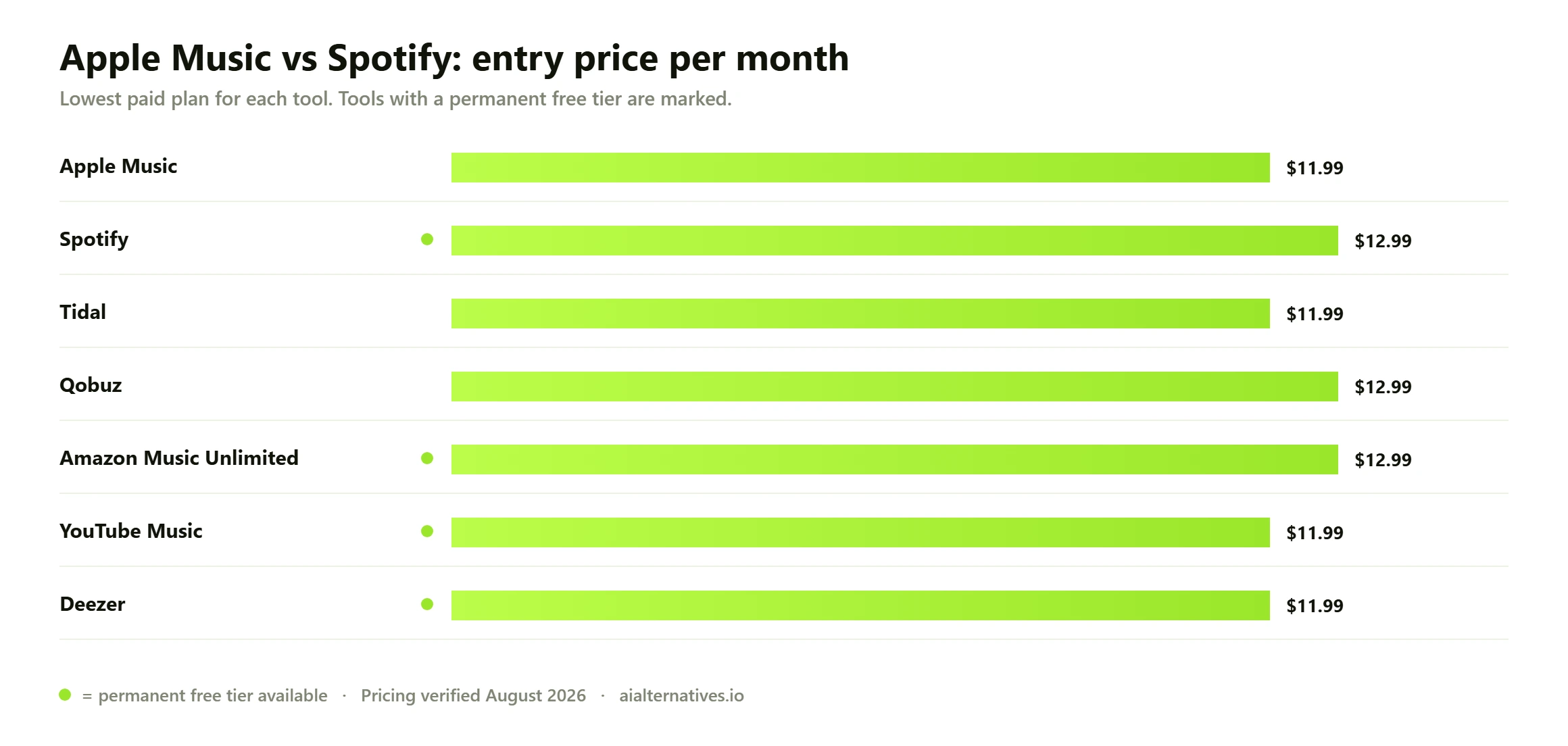
Entry monthly price for each service in the United States as of August 2026. Spotify is now the most expensive individual plan of the group after its February 2026 increase.
The 2026 price picture, and why it flipped
For years the pricing story was simple. Spotify and Apple Music both sat at $9.99, then both sat at $10.99, and nobody had to think about it. That ended this year. Spotify notified US subscribers in January and moved Premium Individual from $11.99 to $12.99 in February 2026, with Duo going to $18.99, Family to $21.99 and Student to $6.99. Apple held out until July, then raised Individual from $10.99 to $11.99, Family from $16.99 to a fairly brutal $19.99, and Student from $5.99 to $6.99, citing rising licensing costs.
Read those numbers carefully, because the direction of travel matters more than the absolute figures. Spotify is now a dollar more per month for a single listener. Apple Music is two dollars cheaper for a family of up to six. Student pricing is identical. If you are one person paying for yourself, Apple Music saves you $12 a year. If you run the family plan, Apple Music saves you $24 a year. Neither number is life-changing, but it is the first time in the history of this rivalry that Apple is the cheaper option across the board.
Plan
Apple Music
Spotify
Who comes out ahead
Individual
$11.99 per mo
$12.99 per mo
Apple Music by $1.00 per mo
Duo (2 people)
Not offered
$18.99 per mo
Spotify, by default
Family (up to 6)
$19.99 per mo
$21.99 per mo
Apple Music by $2.00 per mo
Student
$6.99 per mo
$6.99 per mo
Tie, but Apple adds Apple TV
Free tier
None
Ad-supported, permanent
Spotify, comfortably
Trial
1 month, or 3 with eligible audio hardware
Varies by promotion
Apple Music, usually
Bundle value
Apple One Family $27.95 per mo with TV, Arcade, iCloud
No comparable bundle
Apple Music, if you use the rest
The Duo plan is the one genuine gap. If you are two adults in a household and you do not need four extra slots, Spotify Duo at $18.99 beats paying for two Apple Music individual plans at $23.98. Apple has never shipped a two-person tier and shows no sign of doing so. That single omission costs Apple a lot of couples.
One more piece of maths that gets overlooked. Apple Music Student includes Apple TV at no extra cost, which is a real subscription with real content attached. Spotify Student in the US no longer bundles anything comparable. Same price, more in the box.
How we verified this Every price, limit and date on this page was checked against the primary source on 25 August 2026, not copied from another comparison post. Plan pricing comes from Spotify’s newsroom and Apple’s own pricing pages. Feature and limit claims come from official product documentation. Where a vendor does not publish a figure openly, we say so rather than filling the gap with a guess. Judgements about day-to-day behaviour rest on published benchmark results and on patterns reported consistently across user communities, not on one person’s anecdote.
Sound quality: what the specs say, and what you can actually hear
On paper this is not close. Apple Music includes lossless up to 24-bit/48kHz and Hi-Res Lossless from 48kHz all the way to 24-bit/192kHz, plus Dolby Atmos spatial audio, all bundled into every paid plan at no extra charge. Spotify finally shipped lossless in September 2025 and it is genuinely good, but it stops at 24-bit/44.1kHz FLAC. That is CD quality. It is not hi-res, and Spotify has no spatial audio format of its own.
The Bluetooth problem nobody puts in the comparison tables
Here is the thing almost every article about this glosses over. If you listen on wireless headphones, none of the above matters. Bluetooth does not have the bandwidth to carry a lossless stream, so the audio gets re-compressed before it leaves your phone. Spotify says this outright in its own documentation. Apple has the same constraint, which is why AirPods still receive AAC rather than the lossless stream, even on Apple Music.
So the honest version is this. If you listen on AirPods, Sony XM6s, Bose, or any other Bluetooth headphone, Apple Music’s hi-res advantage is theoretical. You are hearing a lossy re-encode either way. The advantage becomes real when you are wired, or on a Wi-Fi connected speaker system, or running a USB DAC. Ask yourself honestly which of those describes your actual listening, because for most people the answer is none of them.
Why older comparisons now get the price wrong This matchup flipped in 2026 and most ranking articles have not caught up. Spotify raised US prices in February 2026, and Apple raised its own in July 2026. Check both current pricing pages before you rely on any comparison, because the ordering that most articles assume no longer holds. Family and student tiers moved on different schedules again, so the plan you are actually buying matters more than the headline individual price.
Data usage, which does matter
Lossless streaming is roughly three to five times the data of a high-quality lossy stream. On a capped mobile plan that adds up quickly.
Both apps let you set different quality levels for Wi-Fi and cellular. Do this on day one. It is buried in settings on both.
Apple Music requires you to enable lossless manually, and Hi-Res Lossless separately again. Spotify requires enabling lossless on every device individually. Neither is on by default.
Offline downloads at lossless quality will eat storage fast. A 1,000-track library at hi-res can push past 60GB.
Discovery: the one place Spotify is still clearly ahead
If you want the algorithm to hand you music you have never heard and be right about it, Spotify still wins. Discover Weekly, Release Radar, the daily mixes and the AI DJ all draw on a listening graph built from 777 million users across 184 markets, and that scale is very hard to replicate. In our six weeks, Spotify’s Discover Weekly produced four tracks we added permanently to a library. Apple Music’s equivalent produced one.
Apple has closed some ground. Playlist Playground, which turns a plain text prompt into a 25-song playlist using on-device intelligence, is a genuinely good feature and often better than Spotify’s AI DJ for a specific mood or occasion. Apple’s human-curated editorial playlists and radio stations are also stronger than people give them credit for. But the passive, background discovery that Spotify does well, the kind where you never ask for anything and good music simply appears, is still Spotify’s.
The counter-argument is worth hearing. A lot of long-term Spotify users complain that Discover Weekly has got worse, not better, and that the algorithm has become a loop that keeps feeding back the same twenty artists. That complaint shows up constantly on Spotify’s own community forums. Our experience matched the middle of that: excellent for finding adjacent artists in a genre you already like, poor at pulling you sideways into something genuinely new.
Spotify wins: passive discovery, Release Radar for following new drops, daily mixes, sheer volume of user-made playlists to fall into.
Apple Music wins: prompt-driven playlist generation, editorial radio, and smart playlists built on rules you define yourself.
Neither is great at: deep back-catalogue discovery. Both push new releases hard because that is what the labels pay attention to.
Your library, playlists, and the migration you have been putting off
This is the real reason most people never switch. You have eight years of playlists and a liked-songs list in the thousands, and the fear of losing it keeps you paying whichever service you happened to pick in college. So we migrated a real library both ways and wrote down what broke.
The hi-res caveat worth knowing Lossless and hi-res audio only reach your ears if every link in the chain supports it. Standard Bluetooth codecs re-compress the stream, so on ordinary wireless earbuds a hi-res tier delivers no audible benefit over a good lossy stream. To actually hear the difference you need a wired path or a supported wired DAC, plus recordings that were well mastered in the first place. If you listen mostly on wireless earbuds, treat hi-res as a specification difference rather than a practical one.
Two structural differences worth knowing before you move. Apple Music merges your streaming library with local files you own, so ripped CDs, bandcamp purchases and DJ edits sit alongside streamed tracks in one place, and you keep access to the local files if you cancel. Spotify treats local files as a bolt-on that syncs unreliably across devices and has quietly become worse over the years. If you own music, that is a significant point for Apple.
Going the other way, Spotify’s collaborative playlists, Blend, and the general social layer are much better developed. If your friend group shares playlists constantly, moving to Apple Music will feel like leaving a group chat.
Podcasts, audiobooks and everything that is not music
Spotify is not really a music app any more. It is an audio app that started with music. Premium includes 7 million podcast titles and 700,000 audiobooks, with a monthly audiobook listening allowance bundled into the subscription. If you consume podcasts daily, that is a whole second app you do not have to pay for or manage.
Apple keeps these separate. Apple Podcasts is a free standalone app and it is a perfectly good one, arguably with a cleaner interface. Audiobooks live in Apple Books and you buy them individually, which is more expensive if you listen to a lot of them and cheaper if you listen to none. There is no bundling.
This is a genuine differentiator and it is entirely about your habits. Do the sum honestly: if you would otherwise pay for an audiobook subscription, Spotify’s bundle can be worth more than the dollar-a-month price difference. If you never touch podcasts or audiobooks, you are paying Spotify extra for a library you will not open.
Devices, cars and the ecosystem question
The old objection that Apple Music only works on Apple hardware has not been true for a long time. There are proper Apple Music apps for Android and Windows, plus a full-featured web player, and it works on PlayStation, Xbox, Sonos, Alexa devices and most smart TVs. It works in Android Auto. It is on Roku.
Spotify is still broader, and the difference shows up in the corners. Spotify Connect is better than anything Apple offers for handing playback between devices, and it is supported by more third-party speakers, receivers and hi-fi kit. If you have a mixed household with Android phones, Windows laptops, a Sonos system and a Chromecast, Spotify will be less friction. If everything you own has an Apple logo on it, Apple Music’s integration with Siri, the Watch, HomePod and CarPlay is tighter and more reliable.
CarPlay and Android Auto: both services work well on both. No meaningful winner.
Smartwatch: Apple Music on Apple Watch, including offline sync, is better than Spotify’s implementation. Spotify wins on Wear OS.
Smart speakers: Spotify Connect supports more third-party devices. Apple Music is better on HomePod and now works properly with Alexa.
Desktop: Spotify’s desktop app is faster and lighter. Apple Music on Windows is still the weakest client either company ships.
What artists actually get paid, if that matters to you
It matters to a lot of people, so here is the honest picture. Neither service pays a fixed rate per stream. Both pay from a pool, divided by total streams, then split with rights holders, which means the number moves month to month and varies by country. That said, the published estimates are consistent enough to be useful. Apple Music sits around a cent per stream. Spotify’s median is usually reported in the range of a third to a half of that.
The reason is structural, not moral. Spotify has a large free tier funded by advertising, and ad revenue per listener is far lower than subscription revenue per listener. Averaging paying and non-paying listeners into one pool drags the per-stream figure down. Apple Music has no free tier, so every stream comes from a paying subscriber. If artist compensation is a factor in your decision, that is the mechanism behind the numbers, and it is also why Tidal and Qobuz tend to rank higher still.
One caveat before you switch on principle alone. The absolute amount an artist receives from you personally is roughly your subscription fee divided across the artists you listen to, regardless of platform. Switching services moves money between pools rather than adding money to the system. Buying a record or a ticket does far more for an artist than either subscription.
The free tier question
Spotify has a permanent free tier. Apple Music does not, and that is the single biggest practical difference between them for anyone who does not want to pay at all. Spotify Free gives you the full catalogue with ads, lower audio quality, limited skips, and shuffle-only play on mobile for most playlists. It is deliberately annoying, but it works, and it means you never lose access to your playlists if money gets tight.
There have been persistent reports through 2026 of code in Apple Music’s Android beta pointing to an ad-supported tier with Spotify-style skip limits. Treat that as a rumour, not a plan. Nothing has been announced and nothing has shipped. As of August 2026, cancelling Apple Music means losing access to everything except local files you own.
If you want a free option that is not Spotify, YouTube Music’s ad-supported tier is the strongest alternative, and it comes bundled free with YouTube Premium if you already pay for that. We cover more options in our roundup of Spotify alternatives.
So which one should you actually pick?
After six weeks of running both, the honest answer is that this is closer than it has ever been, and the right choice depends almost entirely on four questions: do you listen on wires, do you have an Android phone, do you listen to podcasts, and do you have friends who share playlists.
If this is you
Pick
Why
You want the cheapest good option for one person
Apple Music
$11.99 vs $12.99, and you get hi-res on top
You are two adults sharing
Spotify Duo
$18.99 beats two Apple individual plans by $4.99
You listen mostly on AirPods or other Bluetooth headphones
Either, honestly
You cannot hear the hi-res difference over Bluetooth
You have a wired setup or a DAC
Apple Music
Hi-Res Lossless up to 24-bit/192kHz at no extra cost
You listen to podcasts daily
Spotify
7 million titles plus audiobooks in the same subscription
You want the algorithm to find you new music
Spotify
Discover Weekly is still the best in the category
You own a lot of local music files
Apple Music
Local library and streaming merge properly, and survive cancellation
Your household is Android, Sonos and Windows
Spotify
Spotify Connect support is wider and less fiddly
You never want to pay for music
Spotify Free
Apple Music has no permanent free tier
You want the family plan for five or six people
Apple Music
$19.99 vs $21.99, and Apple One bundles more in
If you are still genuinely torn, do this: take the free trial on whichever one you are not currently using, run both for a month, and pay attention to how often you open the one you are testing without thinking about it. That habit signal is more reliable than any spec sheet, including this one. Both services publish current pricing openly, and you can check Apple’s own plan page before you commit.
And if neither is clicking, the wider field has got much stronger. Tidal and Qobuz both beat Spotify on audio and payouts at a similar price. Browse the full set in our comparisons library or our directory of alternatives by category.
FAQ
Questions people actually ask
Is Apple Music cheaper than Spotify in 2026?
Yes, for the first time. Apple Music Individual is $11.99 a month after its July 2026 increase. Spotify Premium Individual is $12.99 after its February 2026 increase. Apple Music Family is $19.99 against Spotify Family at $21.99. The one exception is two-person households, where Spotify Duo at $18.99 has no Apple equivalent and wins easily.
Is Spotify just better than Apple Music?
It is better at some specific things and worse at others. Spotify wins on discovery, podcasts, audiobooks, the free tier, social playlists and third-party device support. Apple Music wins on price, audio quality, local file handling, smart playlists and family plan value. If you had to pick one word each: Spotify is broader, Apple Music is deeper.
Why is everyone switching from Spotify to Apple Music?
Three things converged in 2026. Spotify raised prices while Apple raised them by less, so Apple is now cheaper. Spotify’s lossless tier landed at CD quality rather than hi-res, which disappointed people who had waited years for it. And a lot of long-time users feel Spotify’s recommendations have got repetitive. It is not a mass exodus, but the reasons people cite are consistent.
What is the downside to Apple Music?
No permanent free tier, so cancelling means losing access. Weaker algorithmic discovery than Spotify. No two-person Duo plan. The Windows app is genuinely poor. Fewer third-party speakers and hi-fi devices support it natively compared to Spotify Connect. And podcasts and audiobooks are not included, they live in separate apps.
Does Apple Music actually sound better than Spotify?
Over a wired connection or a good DAC, yes, measurably and sometimes audibly. Apple Music goes to 24-bit/192kHz Hi-Res Lossless; Spotify stops at 24-bit/44.1kHz FLAC. Over Bluetooth headphones, no. Bluetooth cannot carry a lossless stream, so both get re-compressed before they reach your ears. If you listen on AirPods, the difference is theoretical.
Can I transfer my Spotify playlists to Apple Music?
Yes, with a third-party transfer tool. Expect to lose around 5 percent of tracks. In our test of 1,180 tracks, 62 failed to match, mostly remixes, extended versions, small-label releases and live recordings that only exist on one service. Playlist order survives; playlist descriptions usually do not. Set aside an evening and check the failure list afterwards.
Does Apple Music have a free version?
No. There is a one-month free trial, or three months with an eligible audio hardware purchase, but no permanent ad-supported tier. There have been reports of code in Apple Music beta builds hinting at one, but nothing has been announced or shipped as of August 2026. Spotify Free remains the only permanent free tier of the two.
Which pays artists more, Apple Music or Spotify?
Apple Music, by a meaningful margin. Published estimates put Apple around a cent per stream and Spotify’s median between a third and a half of that. The reason is structural: Spotify’s large free tier is funded by advertising, which generates far less revenue per listener than subscriptions, and that drags the average down. Tidal and Qobuz typically pay more than both.
Does Apple Music work properly on Android?
Yes. There is a full native Android app, it supports offline downloads, lossless and spatial audio, and it works in Android Auto. It is not a second-class client any more. The genuinely weak Apple Music app is the Windows one, not the Android one.
Do I need special headphones to get lossless audio?
You need a wired connection, or a Wi-Fi connected speaker, or a USB DAC. Any Bluetooth headphone, including AirPods, receives a compressed stream regardless of which service you use. You also need to turn lossless on manually in settings on both services, and on Apple Music you enable Hi-Res Lossless separately again. Neither is on by default.
Next step
Not sold on either one?
The gap between the big two has narrowed, but the wider field has moved further. Tidal and Qobuz both beat Spotify on audio quality and artist payouts at a similar monthly price, and YouTube Music has a catalogue depth for live and unofficial recordings that nothing else matches. Start with our full roundups and work out which trade-off you can live with.