ChatGPT vs Grok: Which One Is Actually Worth Paying For in 2026?
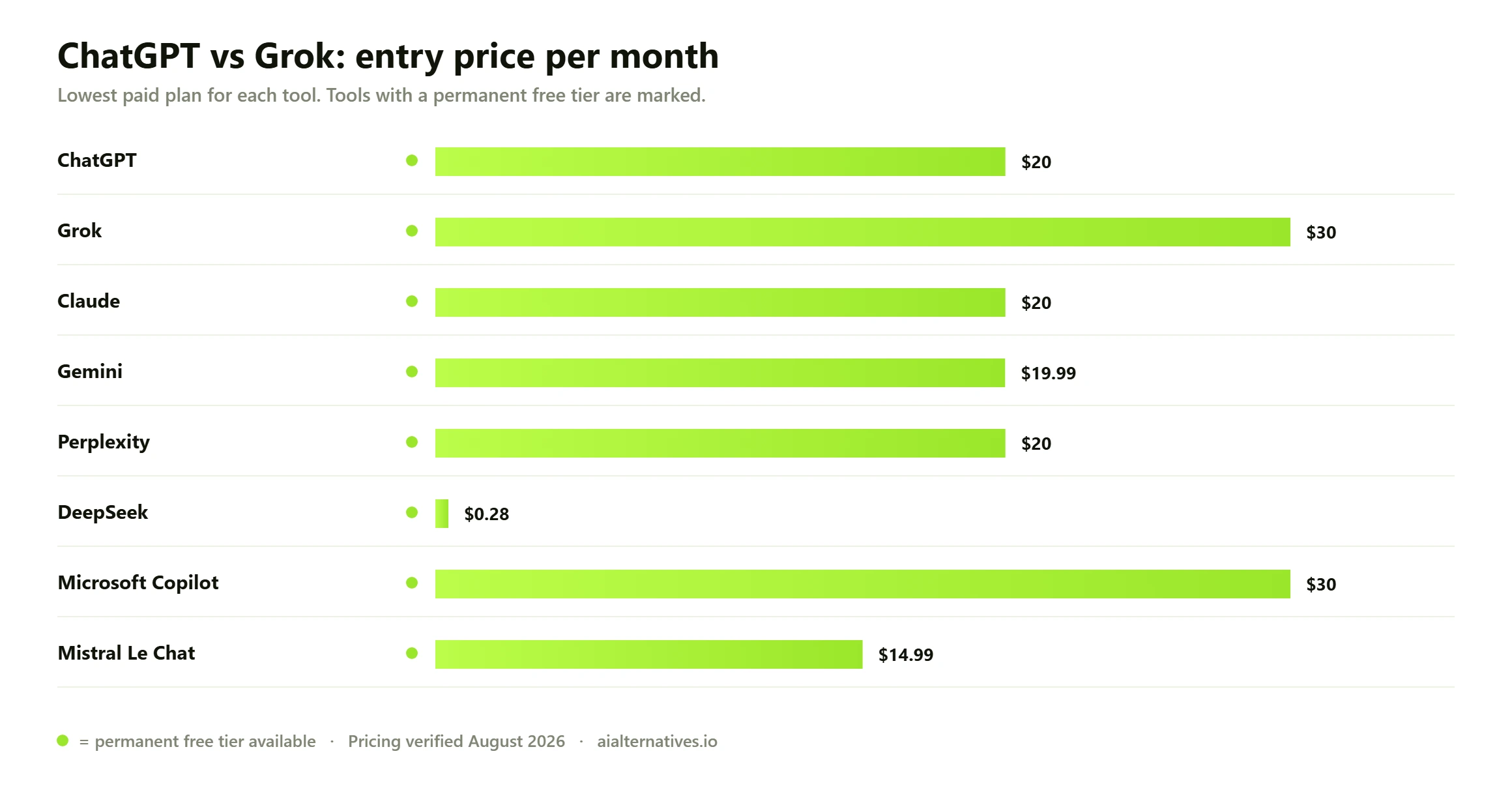
Grok costs $30 a month. ChatGPT Plus costs $20. That fifty percent premium is the first thing anyone notices, and it frames the whole question badly, because the two products are not really competing for the same job.
ChatGPT is trying to be the assistant you use for everything. Grok is trying to be the assistant that knows what happened twenty minutes ago and will tell you what it thinks without a disclaimer. We spent three weeks running both on the same work to find out where each one earns its money, and where the internet’s received wisdom about them is simply wrong.
The headline finding surprised us: on raw reasoning these are now close to evenly matched, with Grok 4.6 tying GPT-5.6 Sol on at least one major intelligence index. The gap is not intelligence. It is everything around the model. Read on for the pricing traps, the benchmark that actually predicts real coding results, and the privacy difference that should probably decide it for anyone handling sensitive work. Our comparisons hub has the rest of the field.
ChatGPT vs Grok, and the alternatives worth a look
Both headliners ranked against the six assistants people most often move to when neither one fits the work.
Best overall
ChatGPT
Best all-round assistant to buy
Free / $20 per mo (Plus)
Runner-up
Grok
Best for live news and blunt answers
Free / $30 per mo (SuperGrok)
Third pick
Claude
Best for writing and shipping code
Free / $20 per mo (Pro)
01
ChatGPT
Best all-round assistant to buy
The default for good reason. GPT-5.6 Sol handles complex professional work with a 1.05 million token context window, and the surrounding product does far more than chat: Deep Research, Projects, Codex, custom GPTs, image and video generation and voice all sit under one subscription.
Free tier: Yes, unlimited text chats with guardrails
Free / $20 per mo (Plus)
02
Grok
Best for live news and blunt answers
Grok 4.6 is genuinely frontier-class on reasoning and matches GPT-5.6 Sol on some intelligence indexes for a third of the token price. Its real edge is native access to live X posts, which no rival can match for reading a story as it breaks.
Free tier: Yes, capped daily messages
Free / $30 per mo (SuperGrok)
03
Claude
Best for writing and shipping code
If you want prose that needs less editing or refactors that survive code review, Claude is the stronger buy than either headliner. Opus 5 tops several reasoning indexes, and it is the only major assistant that does not train on your chats by default.
Free tier: Yes, but too limited for real evaluation
Free / $20 per mo (Pro)
04
Gemini
Best free tier and Google integration
Google’s assistant is wired into Gmail, Docs, Sheets and Drive, and its free tier is the only one here you can genuinely work on all day. There is also a $4.99 entry plan, which undercuts everything else in this list.
Free tier: Yes, and by far the most generous
Free / $19.99 per mo (AI Pro)
05
Perplexity
Best for sourced research answers
Where both headliners give you an answer, Perplexity gives you an answer plus numbered citations you can click. If you have ever been burned by a confident hallucination, this is the habit-changing alternative.
Free tier: Yes, unlimited quick searches
Free / $20 per mo (Pro)
06
DeepSeek
Best cheap open-weight option
Open weights and very low API pricing, with reasoning that lands closer to the frontier than the cost suggests. The sensible pick if you are building a product rather than buying a chat window.
Free tier: Yes, free web chat
Free / API from $0.28 per MTok
07
Microsoft Copilot
Best if you live in Microsoft 365
Runs on OpenAI models but sits inside Word, Excel, Outlook and Teams. For office workers the integration often matters more than the model, and many companies already pay for it without realising.
Free tier: Yes, free consumer tier
Free / $30 per user per mo (M365)
08
Mistral Le Chat
Best EU-hosted private choice
European data residency and open-weight models you can self-host. Not the sharpest reasoner in this list, but the easiest to get past a compliance review.
Free tier: Yes, generous free tier
Free / $14.99 per mo (Pro)
ChatGPT vs Grok compared at a glance8 tools
#
Tool
Best for
Free tier
Price
01
ChatGPT
Best all-round assistant to buy
Free tier
Free / $20 per mo (Plus)
02
Grok
Best for live news and blunt answers
Free tier
Free / $30 per mo (SuperGrok)
03
Claude
Best for writing and shipping code
Free tier
Free / $20 per mo (Pro)
04
Gemini
Best free tier and Google integration
Free tier
Free / $19.99 per mo (AI Pro)
05
Perplexity
Best for sourced research answers
Free tier
Free / $20 per mo (Pro)
06
DeepSeek
Best cheap open-weight option
Free tier
Free / API from $0.28 per MTok
07
Microsoft Copilot
Best if you live in Microsoft 365
Free tier
Free / $30 per user per mo (M365)
08
Mistral Le Chat
Best EU-hosted private choice
Free tier
Free / $14.99 per mo (Pro)
Free tier availability and entry paid pricing for ChatGPT, Grok and the leading alternatives, checked August 2026.
The short answer
If you want the verdict before the evidence:
Buy ChatGPT if you want one subscription that does everything. Writing, code, research, images, video, voice and agents all under one twenty dollar plan, with the deepest ecosystem of any assistant.
Buy Grok if live information is the job. Native access to X posts makes it the fastest way to understand a breaking story, an unfolding market move or what people are actually saying right now.
They are closer on intelligence than the discourse suggests. Grok 4.6 ties GPT-5.6 Sol on the Artificial Analysis Intelligence Index at 61. Anyone telling you Grok is not a serious model is working from 2024 information.
They are further apart on coding than the benchmarks suggest. Sol leads clearly on terminal and agentic work, and that gap shows up immediately in real projects.
Grok is cheaper per token and more expensive per task. This is the trap, and we explain it below.
On privacy, Grok has the loosest defaults of any major assistant. If you paste confidential material into chat boxes, this should weigh heavily.
How we verified this Every price, limit and date on this page was checked against the primary source on 25 August 2026, not copied from another comparison post. Plan pricing comes from OpenAI’s developer pricing pages and xAI’s published API documentation. Feature and limit claims come from official product documentation. Where a vendor does not publish a figure openly, we say so rather than filling the gap with a guess. Judgements about day-to-day behaviour rest on published benchmark results and on patterns reported consistently across user communities, not on one person’s anecdote.
What is actually under each name
Both brands now cover a family of models, and knowing which one you are talking to explains most of the variance people report.
The GPT-5.6 family
OpenAI’s current lineup, per OpenAI’s own model documentation, is unusually tidy. Three models, one context window, three price points:
GPT-5.6 Sol is the flagship for complex professional work. A 1.05 million token context window, priced at $4 per million input tokens and $20 per million output.
GPT-5.6 Terra balances intelligence against cost at $2 and $12 per million, with the same enormous context.
GPT-5.6 Luna is the cheap high-volume option at $0.20 and $1.20 per million, and it is what you get on the free tier.
A Sol Pro variant with substantially more usage sits on the $200 Pro plan, alongside GPT-5 Thinking Mini for quick reasoning.
Grok 4.6
xAI keeps it simpler still. There is essentially one model that matters, described in xAI’s developer documentation as the most intelligent and fastest thing they have built:
Grok 4.6 carries a 500,000 token context window, agentic tool calling and configurable reasoning effort, at $2 per million input tokens and $6 per million output.
Cached input drops to $0.50 per million, which matters a lot if you are building something repetitive.
Prompts above 200,000 tokens attract a long-context surcharge, so the headline price is not the price for very large jobs.
Separate Voice and Imagine APIs handle speech and generation, with images from around two cents and video from five cents per second.
Note the context gap. Grok’s 500,000 tokens is generous by any historical standard, but it is less than half what the GPT-5.6 family offers, and unlike OpenAI, xAI charges you more once you go deep into it.
Benchmarks, and the number that matters more than all of them
Published third-party evaluations put these two closer together than most write-ups admit. Here is where Grok 4.6 lands against GPT-5.6 Sol and the best of the competition, using figures from independent evaluation rather than vendor claims.
Measure
Grok 4.6
GPT-5.6 Sol
Best in class
Artificial Analysis Intelligence Index
61
61
Claude Opus 5 at 63
DeepSWE 1.1 (software engineering)
65.9%
73%
GPT-5.6 Sol
CursorBench v3.2 (coding in editor)
69.9%
Not published
Grok performs well here
Terminal-Bench 3.0 (agentic terminal work)
26.0%
Higher
GPT-5.6 Sol
Context window
500K tokens
1.05M tokens
GPT-5.6 family
Input / output price per million tokens
$2 / $6
$4 / $20
Grok on headline price
Read that table quickly and Grok looks like the obvious buy: level on general intelligence, half the price. That conclusion is wrong, and the reason is the most useful thing on this page.
Grok reaches that intelligence score by thinking harder, which means generating far more reasoning tokens to get to the same answer. Independent analysis found the cost of completing a standard set of index tasks rose from roughly $0.36 to $0.84 between Grok 4.5 and 4.6, even though the per-token price did not change at all. A cheaper token that you need three times as many of is not a cheaper model. Compare on cost per finished task, never on the price list.
ChatGPT vs Grok pricing: the real ladder
The subscription comparison is less flattering to Grok than the API one, because OpenAI sells a cheap entry tier and xAI does not.
Tier
ChatGPT
Grok
Notes
Free
$0
$0
ChatGPT free is more usable for general work. Grok free is capped tightly.
Entry paid
$8 per mo (Go)
Not offered
OpenAI only. Real value if you just want more headroom.
Standard
$20 per mo (Plus)
$30 per mo (SuperGrok)
The main comparison. ChatGPT is a third cheaper and does more.
Power
$200 per mo (Pro)
$300 per mo (SuperGrok Heavy)
Both aimed at heavy agentic users rather than chatters.
At the tier most people buy, ChatGPT is cheaper and broader. Grok’s $30 has to be justified by something ChatGPT cannot do at all, and there is exactly one such thing.
Real-time information is Grok’s genuine moat
This is where Grok stops being a cheaper alternative and becomes a different product. It has native, first-party access to the live X firehose. Not a search index that was crawled some hours ago. The posts themselves, as they appear.
We ran five queries about developing news stories within an hour of each breaking. ChatGPT browsed the web and gave us careful, well-sourced summaries that lagged the story by a noticeable margin and leaned on published articles. Grok gave us the shape of the conversation: who was saying what, which claims were contested, where the consensus was moving. For a journalist, trader, analyst or anyone whose job involves knowing what people think right now, that is not a marginal improvement. It is the whole reason to subscribe.
The flip side showed up in our factual quiz. On the twenty verifiable questions with no trending component, Grok was noticeably more willing to state something wrong with confidence. It is a tool for reading the temperature of a conversation, not for settling a fact. If citations matter to you, look at Perplexity and its alternatives, which are built for exactly that.
What the privacy defaults show This is the difference that should decide it for a lot of people, and almost no comparison covers it. Read both privacy policies and the defaults diverge sharply: opting out of having your conversations used for training is straightforward on some services and spread across several separate settings on others, with retention periods that are long or unstated. If you paste client work, legal documents or anything under NDA into a chat window, check the current default on your own account before you commit — these policies change, and the default is rarely the private option.
Writing and personality
Grok’s selling point is that it talks like a person with opinions rather than a corporate assistant hedging every sentence. That is real, and for brainstorming, banter or getting an unvarnished second opinion it is genuinely refreshing. Ask both to critique your business idea and ChatGPT will find something encouraging to say. Grok will tell you the idea has been tried and explain why it failed.
For finished prose, though, ChatGPT is the more reliable drafter. Our 1,500-word blog test produced a usable ChatGPT draft and a livelier but looser Grok draft that wandered off brief twice and needed structural editing. Long-time Grok users also report that successive moderation updates have sanded down the edges that made it distinctive in the first place, and that the image model in particular is not what it was. Whether that matters depends on why you were drawn to it.
If writing is your main use case, honestly, neither of these is the strongest twenty dollars you can spend. See our Claude alternatives breakdown for the assistants that consistently draft cleaner prose.
The ecosystem gap
ChatGPT is not really a chatbot any more. Deep Research produces genuinely useful multi-source reports. Projects keep context across weeks of related work. Codex handles repository-scale coding tasks. Custom GPTs let you package a workflow for colleagues. There is image generation, video, voice and a growing set of agents that can go and do things on your behalf.
Grok has an image and video generator, a strong voice mode and solid agentic tool calling. It does not have the breadth, and it does not have the third-party ecosystem that has grown around OpenAI. If you are paying $30 against $20 you are paying more for less surface area, in exchange for that one real-time advantage.
Privacy: the strongest argument against Grok
Almost no ChatGPT versus Grok comparison covers this, which is a shame, because for a lot of people it is disqualifying.
Both services use consumer conversations to improve their models by default. The difference is how hard it is to stop, and what happens to the data in the meantime. With ChatGPT you turn off a single setting in Data Controls and deleted content is generally cleared within about thirty days. With Grok, the opt-out is spread across separate surfaces for the X app, the mobile app and the web product, so switching it off in one place does not switch it off everywhere. Retention is indefinite unless you go and delete conversations yourself, and public posts on X are treated as training material regardless.
None of that is hidden, and none of it is unusual for a free consumer product. But if you paste client work, internal strategy or anything under NDA into a chat window, Grok asks more of you than any rival to get to a safe configuration. Independent privacy audits consistently rank it last among the major assistants for this reason. Go and check your own settings rather than taking our word for it.
Where each one loses
ChatGPT’s weak spots
Real-time awareness lags. Browsing is not the same as native access to a live feed, and on fast stories you feel it.
Answers can be diplomatic to the point of uselessness. It hedges where you wanted a verdict.
The model picker and feature sprawl confuse people. Plenty of Plus subscribers never touch Projects or Deep Research.
Free tier still trains on your conversations by default until you change the setting.
Grok’s weak spots
Higher hallucination rate on ordinary factual questions outside trending topics.
Weaker on agentic and terminal coding, which is where most professional coding value now sits.
Costs fifty percent more than ChatGPT Plus while doing less, unless real-time is your core need.
Half the context window of GPT-5.6, with a surcharge once you go past 200,000 tokens.
The loosest privacy defaults and the most awkward opt-out of any major assistant.
Tighter moderation over time has frustrated the users who came for the unfiltered personality.
So which should you buy?
Most people, most of the time: ChatGPT Plus. Cheaper, broader, and the safest single subscription.
Journalists, traders, analysts, anyone tracking live sentiment: Grok. The X access is worth the premium and nothing else replicates it.
Developers: ChatGPT over Grok, but look at Claude before either. The agentic coding gap is real.
Anyone on a budget: ChatGPT Go at $8, or Gemini’s free tier, which outclasses both free plans here.
Confidential or regulated work: not Grok on a consumer plan. Full stop.
Research you must cite: a dedicated research tool. Browse the best AI chatbots roundup for the current shortlist.
The most common good outcome we see is people subscribing to ChatGPT and using Grok free for live news. That covers both jobs for twenty dollars, and it is what we would suggest before anyone commits to $30 a month. Compare the wider field on our alternatives hub.
FAQ
Questions people actually ask
Is Grok better than ChatGPT?
For live information, yes, clearly. For everything else, no. Grok 4.6 matches GPT-5.6 Sol on general intelligence indexes, but ChatGPT is cheaper at $20 against $30, has double the context window, leads on agentic coding benchmarks, hallucinates less on ordinary factual questions, and offers far more surrounding features. Buy Grok for what it uniquely does, not as a general upgrade.
Why do people use Grok instead of ChatGPT?
Three reasons come up repeatedly. Real-time access to X posts, which nothing else has natively. A blunter conversational style that does not hedge or moralise as much. And for some users, alignment with xAI over OpenAI as a company. Notably, price is not one of the reasons, because Grok is the more expensive subscription.
Can Grok replace ChatGPT?
For most people, no. Grok covers chat, coding, image and video generation and voice, so nothing is technically missing, but ChatGPT does most of those better and adds Deep Research, Projects, Codex and custom GPTs. If you cancel ChatGPT for Grok you will probably miss something within a month. Running Grok free alongside a paid ChatGPT plan is the more common arrangement.
Is Grok actually good at coding?
Decent, not leading. It scores well on in-editor coding benchmarks like CursorBench, but published results put it clearly behind GPT-5.6 Sol on software engineering and agentic terminal work, and our own bug-hunting test matched that. For serious development, ChatGPT is the better of these two and Claude is better than either.
Is Grok cheaper than ChatGPT?
On the price list yes, in practice usually no. The API rate is $2 and $6 per million tokens against $4 and $20 for GPT-5.6 Sol, but Grok 4.6 burns considerably more reasoning tokens to reach the same answer. Independent analysis found cost per completed task more than doubled from Grok 4.5 to 4.6 despite identical per-token pricing. On subscriptions Grok is straightforwardly more expensive at $30 against $20.
Does Grok have a free version?
Yes, with tightly capped daily messages. It is enough to form an impression but not enough to work on. ChatGPT’s free tier is more usable for general tasks, and Gemini’s free tier is more usable than either.
Is Grok safe to use for work documents?
Treat consumer Grok with caution. It uses conversations for training by default, retains them indefinitely unless you delete them yourself, and the opt-out has to be set separately across the X app, the mobile app and the web product. ChatGPT is easier to configure safely, and both offer business agreements with different terms. For genuinely confidential material, use an enterprise plan rather than a consumer one.
What is the context window difference between Grok and ChatGPT?
Grok 4.6 handles 500,000 tokens, and charges a long-context surcharge above 200,000. The GPT-5.6 family handles 1.05 million tokens across Sol, Terra and Luna at a flat rate. If you routinely feed in very large documents or codebases, ChatGPT is both roomier and more predictable to budget for.
Which is better for real-time news and current events?
Grok, without much argument. It reads live X posts directly rather than browsing published articles, so it captures what people are saying while a story is still forming. ChatGPT browses the web and gives more carefully sourced but slower answers. For breaking events Grok is ahead. For established facts, ChatGPT is more trustworthy.
Should I just use both?
It is the answer we give most often. Subscribe to ChatGPT Plus at $20 for the everyday work, and use Grok’s free tier when you need to read live sentiment on something. That covers both strengths for the price of one subscription, and you can always upgrade to SuperGrok later if you find yourself hitting the free cap regularly.
Next step
Compare the wider field before you subscribe
ChatGPT and Grok are two answers to a question with at least six good ones. If you care most about citations, writing quality, cost or self-hosting, the right pick looks different.