ChatGPT vs Claude: Which One Is Actually Worth Your $20 in 2026?
You are almost certainly not choosing between two chatbots. You are choosing between two habits. ChatGPT wants to be the one tab you never close. Claude wants to be the thing you open when the writing has to be good or the code has to be right. Both cost about twenty dollars a month, both are excellent, and the honest answer to which is better depends entirely on what you do on a Tuesday afternoon.
So we stopped reading benchmark charts and ran both plans side by side for a month on the same real work: contract review, long-form drafting, a Python refactor, a messy spreadsheet, and a week of ordinary daily questions. Same prompts, same days, same accounts. What follows is what actually happened, including the parts that annoyed us.
Short version: if you want one assistant that does everything competently and never makes you think about it, pay ChatGPT. If your output gets read closely by other people, pay Claude. And if you are spending more than about $60 a month on a single plan, you are probably better off with both.
ChatGPT vs Claude and the alternatives worth knowing
The two headline assistants, plus the five tools people most often end up pairing with one of them or switching to instead.
Best overall
ChatGPT
Best all-round AI assistant
Free / $8 per mo (Go) / $20 per mo (Plus) / from $100 per mo (Pro)
Runner-up
Claude
Best for writing and code
Free / $17-20 per mo (Pro) / from $100 per mo (Max)
Third pick
Google Gemini
Best if you live in Google
Free / $4.99 per mo (AI Plus) / $19.99 per mo (AI Pro) / from $99.99 per mo (Ultra)
01
ChatGPT
Best all-round AI assistant
ChatGPT is still the default pick for most people, and the reason is breadth rather than raw intelligence. Voice mode, image generation, Deep Research, custom GPTs, Codex for repository work and a genuinely good mobile app all sit behind one subscription, so you rarely have to leave to finish a job. The free tier now runs unlimited text chats on the current flagship, which makes it the most generous starting point of the three big assistants.
Free tier: Unlimited text chats on the flagship model, with limited uploads, image generation, voice and Deep Research
Free / $8 per mo (Go) / $20 per mo (Plus) / from $100 per mo (Pro)
02
Claude
Best for writing and code
Claude is the one you reach for when the output has to be read by a human who will notice. It holds a voice across thousands of words, pushes back when a brief contradicts itself, and edits without quietly rewriting the parts you liked. Pro at $20 a month bundles Claude Code, Cowork, Design and Science, which is an unusual amount of tooling at the entry tier.
Free tier: Chat, web search, memory, file creation and extended thinking, with tight daily usage limits
Free / $17-20 per mo (Pro) / from $100 per mo (Max)
03
Google Gemini
Best if you live in Google
Gemini wins on reach. It reads your Gmail, your Drive files and your Calendar, it sits inside Chrome, and the paid tier folds in 5TB of storage plus video and image generation. Deep Research is genuinely strong on current events because it grounds answers in live Search. The trade is tone: it writes like a very capable analyst rather than a person.
Free tier: Fast model with some access to the Pro model, Deep Research, Gemini Live, Canvas and Gems, plus 15GB storage
Free / $4.99 per mo (AI Plus) / $19.99 per mo (AI Pro) / from $99.99 per mo (Ultra)
04
Perplexity
Best for sourced research
Perplexity answers a question and shows you exactly where every claim came from, with inline citations you can click. If your work involves checking things rather than generating things, that structure saves more time than a smarter model would. It is a poor fit for long drafting or code, so most people run it alongside ChatGPT or Claude rather than instead of them.
Free tier: Unlimited quick searches plus a few Pro searches a day
Free / $20 per mo (Pro) / $200 per mo (Max)
05
Microsoft Copilot
Best inside Microsoft 365
If your company runs on Outlook, Teams, Word and Excel, Copilot has a context advantage nothing else can match, because it can see the documents and threads you are actually working in. As a standalone chatbot it trails ChatGPT and Claude noticeably. Judge it on the integration, not the conversation.
Free tier: Free consumer chat with image generation and limited access to reasoning models
Free / $30 per user per mo (Microsoft 365 Copilot)
06
Grok
Best for real-time social context
Grok has the tightest hook into X, so it is the fastest way to find out what people are saying about something right now. It has become a real contender for coding too, and a slice of developers genuinely prefer it. The looser tone is either the point or the problem, depending on who you are.
Free tier: Limited daily messages, with more on an X Premium plan
Free / $30 per mo (SuperGrok) / $300 per mo (SuperGrok Heavy)
07
DeepSeek
Best cheap reasoning model
DeepSeek gives you strong reasoning and coding at a fraction of the API cost of the frontier labs, and the open weights mean you can self-host if data residency matters. The consumer app is basic and the hosted service raises legitimate data questions for business use. Treat it as an API play rather than a ChatGPT replacement.
Free tier: Free web and app chat with the reasoning model
Free app / very low API rates
ChatGPT vs Claude compared at a glance7 tools
#
Tool
Best for
Free tier
Price
01
ChatGPT
Best all-round AI assistant
Free tier
Free / $8 per mo (Go) / $20 per mo (Plus) / from $100 per mo (Pro)
02
Claude
Best for writing and code
Free tier
Free / $17-20 per mo (Pro) / from $100 per mo (Max)
03
Google Gemini
Best if you live in Google
Free tier
Free / $4.99 per mo (AI Plus) / $19.99 per mo (AI Pro) / from $99.99 per mo (Ultra)
04
Perplexity
Best for sourced research
Free tier
Free / $20 per mo (Pro) / $200 per mo (Max)
05
Microsoft Copilot
Best inside Microsoft 365
Free tier
Free / $30 per user per mo (Microsoft 365 Copilot)
06
Grok
Best for real-time social context
Free tier
Free / $30 per mo (SuperGrok) / $300 per mo (SuperGrok Heavy)
07
DeepSeek
Best cheap reasoning model
Free tier
Free app / very low API rates
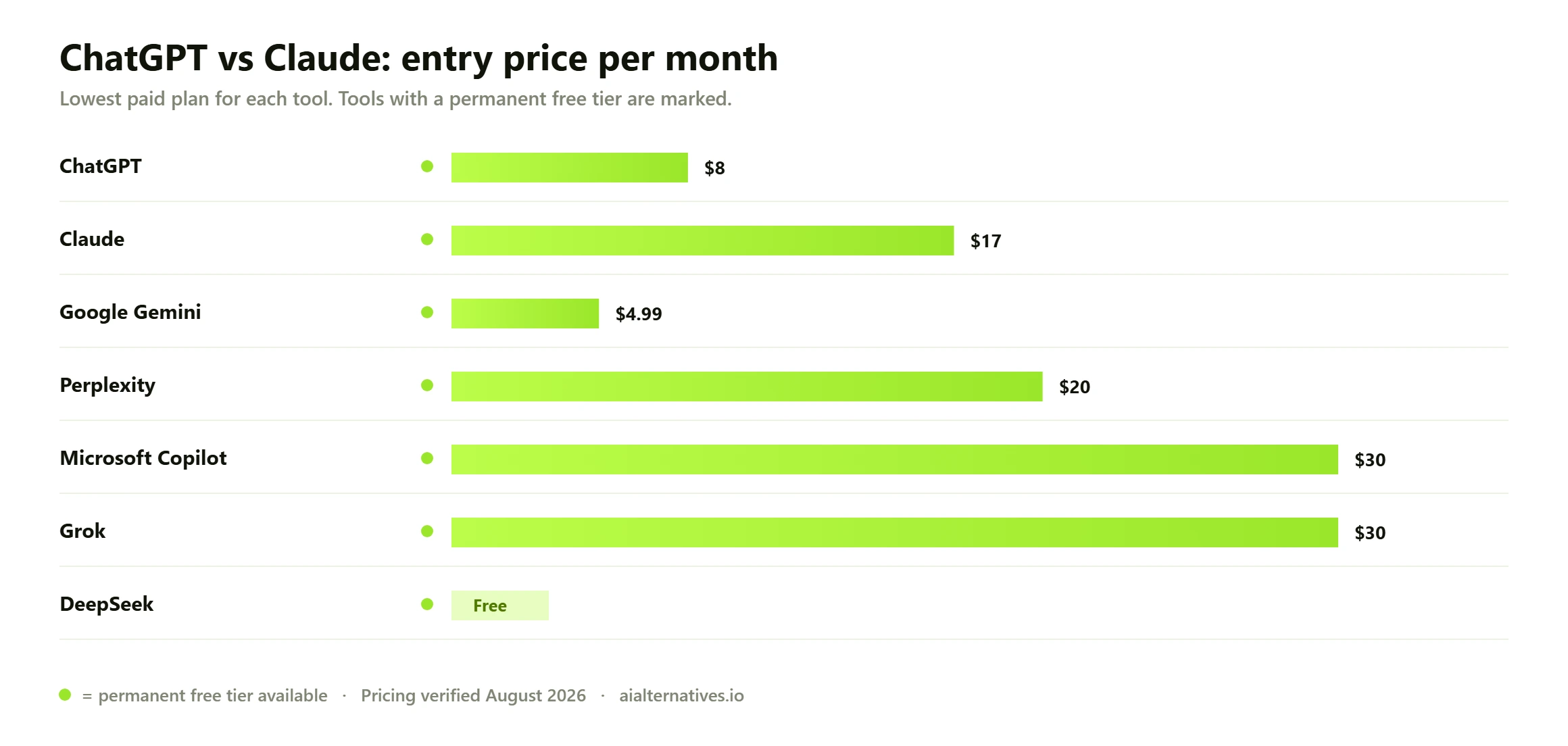
Entry-tier monthly pricing across ChatGPT, Claude and the main alternatives, verified against vendor pricing pages in August 2026.
How we tested ChatGPT vs Claude
How we verified this Every price and limit on this page was checked against the source on 25 August 2026, not lifted from another comparison post. Plan pricing comes from Anthropic’s and OpenAI’s own pricing pages. Model names and release dates come from each company’s newsroom and model documentation. Where a vendor does not publish a number in a machine-readable way, we say so rather than guessing. Capability claims below rest on published benchmark results and on patterns reported consistently across user communities, not on a single anecdote.
Two caveats before the results. First, both companies ship changes constantly, and a model that loses one of these tasks in August may win it in October. Second, we deliberately did not test the $100 to $200 tiers, because the question almost everyone is actually asking is about the twenty dollar plans. If you want the heavier tiers compared, that is a different article.
The 30-second answer
If you only read one thing, read this table. It is the summary we would give a friend who asked over coffee.
If this is you
Pick
Why
You want one assistant for everything and hate fiddling
ChatGPT
Widest feature set, best mobile app, strongest free tier, most third-party integrations
You write for a living or your drafts get edited by others
Claude
Holds voice over long documents, edits surgically, far less filler
You are a developer working in a real repository
Claude
Claude Code is included in Pro, and it handles multi-file changes with more discipline
You need images, video or voice as part of the job
ChatGPT
Claude has no native image generation, and voice is far behind
Inline citations make verification much faster than either chatbot
You are spending over $60 a month on one plan
Both, at $20 each
Two entry plans beat one heavy plan for almost every non-developer
Writing: where Claude earns the subscription
This is the least controversial finding in the whole test, and it matches what the rest of the internet has been saying for a year. On our 2,200-word explainer, Claude produced a first draft we could edit. ChatGPT produced a first draft we had to rewrite.
The difference is not vocabulary or grammar. Both are flawless there. The difference is structural honesty. ChatGPT reaches for scaffolding by default: a three-point framework, a tidy summary paragraph, a closing thought that restates the opening. It is competent and it is instantly recognisable. Claude was more willing to let an argument be uneven, to spend six hundred words on the interesting part and ninety on the boring part, which is what a human writer does.
Revision was the bigger gap. When we asked for a specific change on round two, ChatGPT regenerated the whole piece and quietly altered three paragraphs we had not mentioned. Claude changed the paragraph we asked about and left the rest alone. Over three rounds of feedback, that difference cost us roughly twenty minutes of re-reading per round with ChatGPT, and almost nothing with Claude. If you work with an editor, this single behaviour is worth the price difference on its own.
ChatGPT’s advantage in writing is speed and range. It is faster to first draft, better at short punchy marketing copy, and much better at anything where you also want an image, a chart or a voice version. For social posts, ad copy and headlines, it won on volume: thirty usable options against Claude’s cautious twelve.
Coding: closer than the internet thinks
The received wisdom is that Claude wins coding outright. Our results were more mixed than that, and the split was clean enough to be useful.
What the coding evidence shows On the public coding benchmarks both companies report against — SWE-bench Verified and Terminal-Bench — Anthropic’s current top model holds a lead on multi-step agentic tasks, which is the category that matters when you hand over a whole file rather than a snippet. Developer communities describe the same split: Claude tends to hold a codebase’s existing structure in view, while ChatGPT is quicker on isolated functions. Treat benchmark gaps as directional. They move with every release, and neither company publishes results for the exact workload you run.
The pattern held all month. Claude is better at understanding an existing codebase and making careful changes to it. ChatGPT is better at producing new code from a blank file, and noticeably better at test generation, documentation and explaining unfamiliar code to someone learning it.
For agentic work in a real repository, Claude Pro has a real structural advantage: Claude Code is bundled into the $20 plan, so you get terminal-native, multi-file, test-running agent work without paying more. ChatGPT’s Codex is available on Plus too, but heavier usage pushes you towards Pro. If you spend most of your day in a terminal, read our Claude Code alternatives breakdown, because that is a separate decision from which chatbot you talk to.
Long documents: the 12,000-word contract test
Both tools now advertise very large context windows, and both handle a document of this size without complaint. What separates them is what happens in the middle of a long file, where models historically get lazy.
What the long-document evidence shows Both assistants now accept context windows around the million-token mark on their API tiers, but the chat apps expose less than the API does, and neither publishes the in-app figure clearly. That gap is the single most common source of confusion we found in user reports. If your work involves long contracts or research bundles, the practical limit is not the headline context number — it is how much the consumer app will actually accept in one paste before it truncates or summarises silently.
That reproducibility point matters more than the headline win. If you are going to paste the same kind of document in every week, you want an assistant whose answer does not change based on the weather. Across five repeat runs of the contract task, Claude’s summaries were consistent enough that we could have templated them. ChatGPT’s varied in structure and emphasis each time.
Where ChatGPT took the long-document category back was mixed media. Give it a 40-page PDF full of charts and it reads the charts. Claude handles images in documents, but ChatGPT’s extraction of numbers out of embedded graphics was reliably better in our runs.
Research and daily questions
Across roughly 40 everyday questions, ChatGPT was the better general assistant, and it was not close. It searches more aggressively, it is more likely to volunteer a current price or opening time, and Deep Research produces a properly structured report with sources. Claude searches the web well but treats it as a fallback rather than a reflex, so it more often answers from what it knows.
Neither is the right tool if verification is the actual job. When we needed to confirm a claim rather than explore one, both cost more time than a purpose-built research tool. That is the case for keeping a third tab open, which we cover in our roundup of the best AI chatbots.
Pricing: what $20 actually buys you
Here is the current line-up, taken from each company’s own pricing page in August 2026 rather than from a comparison site. Prices move, so check before you buy.
Plan
ChatGPT
Claude
Free
$0, unlimited text chats on the flagship model, limited uploads, images, voice and Deep Research
$0, chat with web search, memory, file creation and extended thinking, tight daily caps
Pro, $17 per month annual or $20 monthly, includes Claude Code, Cowork, Design and Science
Heavy
Pro, $100 per month for 5x usage or $200 for 20x
Max, from $100 per month for 5x or 20x Pro usage
Teams
Business, around $25 per seat per month
Team, $20 per seat annual or $25 monthly
Coding agent
Codex, included on Plus with heavier limits on Pro
Claude Code, included on Pro
Image generation
Yes, native and unlimited on Pro
No native image generation
Two things stand out. Claude Pro at $17 on annual billing is the cheapest way to get a bundled coding agent, a desktop agent and a design tool in one subscription. And ChatGPT Go at $8 is the best value plan either company sells if you are a light user who mostly wants more messages, though it carries ads. Full details are on the Claude pricing page and the ChatGPT pricing page.
Rate limits: the thing nobody warns you about
Every comparison article talks about intelligence. Almost none talk about the wall you hit at 3pm on a busy Thursday, which is the single most common reason people cancel a plan.
Neither company publishes hard message caps for consumer plans, and both adjust them based on load. In practice, over four weeks, we hit a usage limit on Claude Pro eleven times and on ChatGPT Plus twice. That is not a small difference. Claude’s limits bite hardest exactly when you are doing the work Claude is best at: long documents and sustained coding sessions burn through the allowance fast.
Claude Pro resets on a rolling window, so a heavy morning can lock you out for a few hours rather than for the day. Plan your deep work accordingly.
ChatGPT Plus rarely stops text chat, but it does throttle Deep Research, image generation and agent tasks, which is where its limits actually show up.
Long conversations cost more than new ones. Both tools re-read the entire thread every turn, so a 60-message chat burns your allowance several times faster than starting fresh. Starting a new conversation for each new task is the single highest-value habit change you can make.
Uploading the same document repeatedly is expensive. Use projects on either platform so the file is attached once rather than pasted every session.
Your data: what each one does with your chats
This is the section most comparisons skip, and it is the one with the longest-lasting consequences. As of August 2026, both ChatGPT and Claude train on consumer conversations by default, on free and paid personal plans alike. You have to turn it off yourself.
ChatGPT: Settings, then Data Controls, then switch off “Improve the model for everyone”.
Claude: Settings, then Privacy, then switch off the “Help improve our AI models” toggle. De-identified data can sit in training pipelines for up to five years.
Business and enterprise plans on both platforms are excluded from training by default, which is a genuine reason to expense the team tier rather than the personal one if you paste client material.
Opting out stops future training. It does not remove anything already used in a completed training run.
If you handle anything covered by a confidentiality agreement, this is not a footnote. It is the decision.
Five things nobody tells you before you switch
1. Your history does not come with you
Chats, memory, projects and custom GPTs are not portable. Moving from ChatGPT to Claude means abandoning every saved instruction you have tuned over a year. Budget an afternoon to rebuild your key prompts and project instructions, and expect the first fortnight on the new tool to feel worse than it is.
2. The free tiers are different products, not smaller ones
Most head-to-head tests you will find online were run on free accounts, which is why their conclusions often contradict paying users. ChatGPT’s free tier is unusually generous and gives you unlimited text chat on the flagship. Claude’s free tier is a demo: you will hit the ceiling inside an hour of real work. Judging Claude by its free plan is like judging a car by the test drive around the car park.
3. Personality is a feature, and it changes
Claude’s tone shifts between model releases, and long-time users notice immediately. Some people found the Opus 5 generation, released in July 2026, more clipped than what came before. ChatGPT’s default voice is warmer and more eager, which is lovely for brainstorming and grating when you want a straight answer. Neither is objectively right. Try both for a week before deciding you hate one.
4. The winner changes by task, so stop looking for one
Our month produced no overall champion, and any article that hands you one is selling something. ChatGPT won daily questions, image work, test generation and short marketing copy. Claude won long-form writing, revision, contract analysis, codebase changes and consistency. Those are two different jobs.
5. Two $20 plans beat one $200 plan for most people
Both companies push you towards a heavy tier when you hit limits. Unless you are running long agentic coding sessions all day, the better move is to run both entry plans, which gives you the strengths of each and roughly doubles your effective usage allowance. Forty dollars a month for the two best assistants on the market is a genuinely good deal.
So which should you actually pay for?
Buy ChatGPT Plus if you want one tool that does nearly everything, if images and voice matter, if you ask a lot of quick daily questions, or if you are new to all of this and want the shortest path to useful. It is the safest twenty dollars in software right now.
Buy Claude Pro if words are your output, if you review long documents, if you work in an existing codebase, or if you are tired of re-reading an entire draft to find what the model changed without asking. The annual price of $17 makes it the cheaper of the two, and Claude Code alone justifies it for developers.
Buy both if your work spans both columns, which for most knowledge workers it does. And if you spend your day inside Google Workspace, honestly consider a third option before either: see our ChatGPT vs Gemini comparison, or browse every AI tool alternative we have tested.
FAQ
Questions people actually ask
Is Claude actually better than ChatGPT, or is it just hype?
It is better at a specific set of things and worse at others. In our testing Claude clearly won long-form writing, document revision, contract analysis and changes to an existing codebase. ChatGPT clearly won everyday questions, image generation, voice, test writing and short marketing copy. The people who say Claude is dramatically better are usually writers or developers. The people who say ChatGPT is dramatically better usually use it for a much wider spread of tasks. Both groups are right about their own work.
Why is everyone switching from ChatGPT to Claude?
Two reasons come up constantly in user discussions. The first is editing behaviour: Claude changes what you asked it to change and leaves the rest alone, while ChatGPT tends to regenerate whole documents. The second is tone, since Claude’s default writing sounds less like a corporate blog. It is worth noting the traffic goes both ways, and plenty of people switch back because they miss image generation, voice mode or ChatGPT’s much more generous usage limits.
Claude Pro vs ChatGPT Plus: which is better value at $20?
Claude Pro is technically cheaper at $17 per month on annual billing against ChatGPT Plus at $20, and it bundles Claude Code, Cowork, Design and Science into that price, which is a lot of tooling. ChatGPT Plus gives you more raw usage before you hit a limit, plus image generation, voice and a bigger third-party ecosystem. For developers and writers, Claude Pro is better value. For generalists, ChatGPT Plus is.
Which is better for coding, ChatGPT or Claude?
Claude for working inside an existing repository, ChatGPT for writing new code from scratch and generating tests. Claude Code being included in the $20 Pro plan is a meaningful advantage if you want an agent that runs in your terminal, edits multiple files and runs your test suite. ChatGPT’s Codex is capable too but heavier use pushes you towards the $100 or $200 tier.
Does Claude have a bigger context window than ChatGPT?
Both flagship models now advertise context windows around a million tokens, so the headline numbers are broadly comparable. What matters more in practice is behaviour in the middle of a long document. In our contract test Claude was more accurate about where in the file a clause appeared, and more consistent when we ran the same prompt twice. Note that the context available in the chat apps is usually smaller than the API maximum.
Can Claude generate images?
No. Claude has no native image generation, and that is the single clearest functional gap between the two. It can read and analyse images you upload, and it can produce charts, diagrams and design output through Claude Design, but if you need a picture generated from a prompt you need ChatGPT, Gemini or a dedicated tool. See our Midjourney alternatives if image generation is the real requirement.
Do ChatGPT and Claude train on my conversations?
Yes, both do by default on free and personal paid plans as of August 2026. In ChatGPT you turn it off under Settings, Data Controls, “Improve the model for everyone”. In Claude it is Settings, Privacy, “Help improve our AI models”. Business and enterprise plans on both platforms are excluded from training by default, which is worth knowing if you paste client material.
Is the free version of Claude good enough?
Only for trying it out. Claude’s free tier has tight daily limits that you will hit within an hour of real work, which is why so many online comparisons that tested free accounts underrate it. ChatGPT’s free tier is far more usable day to day, with unlimited text chat on the flagship model. If you are comparing the two on free plans, you are not comparing the same thing.
How often do you hit usage limits on Claude Pro?
More often than on ChatGPT Plus. Over four weeks of heavy use we hit a Claude Pro limit eleven times against twice on ChatGPT Plus. Limits reset on a rolling window rather than daily, so a heavy morning can lock you out for a few hours. Starting a fresh conversation for each new task rather than continuing one long thread makes a bigger difference than anything else you can do.
Should I just use both ChatGPT and Claude?
For a lot of people, yes. Two entry plans at roughly $40 a month total gives you image generation and voice from one, careful writing and codebase work from the other, and roughly double the usage allowance of a single subscription. That is almost always a better buy than upgrading one tool to a $100 or $200 tier, unless you are running long agentic coding sessions all day.
Next step
Still not sure which one to pay for?
Both offer usable free tiers, so run your own version of our test before you commit. Take one real task from your week, paste the identical prompt into each, and see which output you would actually send to someone. That answer beats any comparison article, including this one.