The 10 Best Perplexity Alternatives in 2026 (Free, Paid and Self-Hosted)
You pay Perplexity for one thing: answers you can check. Two independent studies say that promise fails often enough to matter — and, more uncomfortably, that the paid tier is more confidently wrong than the free one.
That is the strongest reason to look elsewhere and no other guide on this term will tell you about it. Below you will find ten alternatives across three groups: hosted answer engines, evidence-grade research tools, and open-source stacks you can run yourself for nothing.
Every price came off the vendor own page in August 2026. We also correct two things almost every competing article gets wrong about Comet and Perplexity Computer — both of which are probably costing you money right now.
Search, reasoning, code and images in one subscription, and Go at $8 undercuts Perplexity Pro by 60%. Its news citations tested worse than Perplexity though, so check links either way.
Free tier: Free tier includes search.
Free / $8 (Go) / $20 per mo
02
Google AI Mode
Free, and already in your search box
AI answers inside the search engine you use anyway, at no cost, grounded in Workspace and YouTube. Shallower than Perplexity once a question needs several steps.
Free tier: Free in Google Search, plus the Gemini free tier.
Web search is on the free tier now, and Claude is far better at turning ten sources into an argument rather than a list. Fewer sources, read properly.
Free tier: Free tier includes web search.
Free / $17 per mo (annual)
04
Kagi Assistant
You can see what you are paying for
The direct answer to not knowing which model answered you: Kagi publishes per-model token accounting. No ads, no tracking, and you can rank domains up or down yourself.
Free tier: 100 free searches plus 100 Assistant interactions, no card.
From $5 per mo ($25 for frontier models)
05
Brave Leo
In your browser, no account
Sits in the browser the way Comet does, but privacy-first and without signing up for anything. The easy swap if you liked Comet and disliked the data trail.
Free tier: Free Leo tier built into Brave.
Free / $14.99 per mo
06
Consensus
Answers from peer-reviewed papers
Grounded in 200M+ papers, so a citation cannot turn out to be a hallucinated blog post. Within its domain, this is the real fix for the accuracy problem.
Free tier: Unlimited paper search plus 10 Pro analyses a month.
Free / $8.99 per mo
07
Elicit
For literature reviews, not questions
Pulls structured data across 138M+ papers and exports to Zotero. Built for systematic reviews rather than quick answers, and priced for institutions.
Free tier: Unlimited search, summaries and chat-with-paper.
Free / $49 per mo
08
Vane (formerly Perplexica)
The closest thing you can self-host
MIT licensed, runs on SearXNG plus any model including local ones through Ollama. This is Perplexity where nothing leaves your network. Note the rename — guides still say Perplexica.
Free tier: Free and open source.
Free (self-hosted)
09
Open WebUI
One private front end for everything
A mature interface with RAG across multiple vector databases and around twenty search backends. The answer if a whole team needs one self-hosted place to work.
Free tier: Free, self-hosted.
Free (self-hosted)
10
Exa and Tavily
Build it into your own product
Search APIs designed for agents rather than people. If what you really want is Perplexity behaviour inside something you are building, this is the layer you need.
Free tier: Tavily: 1,000 API credits a month. Exa: $10 a month in credits.
Free credits / usage-based
Perplexity alternatives compared at a glance10 tools
#
Tool
Best for
Free tier
Price
01
ChatGPT
Stop paying for search twice
Free tier
Free / $8 (Go) / $20 per mo
02
Google AI Mode
Free, and already in your search box
Free tier
Free / from $4.99 per mo
03
Claude
Reasoning over the sources
Free tier
Free / $17 per mo (annual)
04
Kagi Assistant
You can see what you are paying for
Free tier
From $5 per mo ($25 for frontier models)
05
Brave Leo
In your browser, no account
Free tier
Free / $14.99 per mo
06
Consensus
Answers from peer-reviewed papers
Free tier
Free / $8.99 per mo
07
Elicit
For literature reviews, not questions
Free tier
Free / $49 per mo
08
Vane (formerly Perplexica)
The closest thing you can self-host
Free tier
Free (self-hosted)
09
Open WebUI
One private front end for everything
Free tier
Free (self-hosted)
10
Exa and Tavily
Build it into your own product
Free tier
Free credits / usage-based
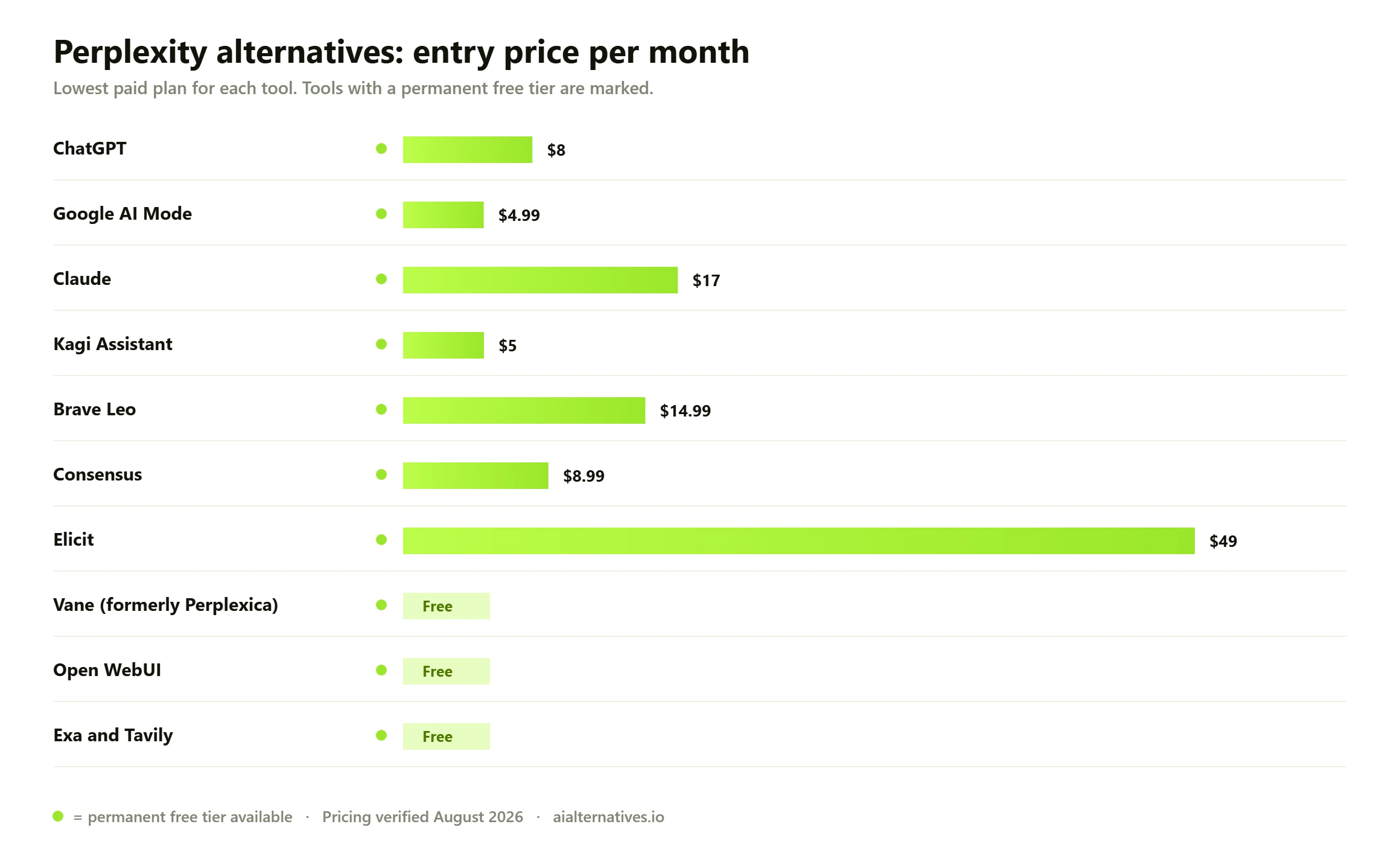
Entry monthly price across every Perplexity alternative we tested. Green dot marks a permanent free tier. Pricing verified August 2026.
Why people are leaving Perplexity in 2026
You are paying for sources. That is the product. So it matters that the two largest independent audits of AI search both found sourcing is where it is weakest.
The Tow Center for Digital Journalism ran 1,600 queries across eight AI search tools and published the results in March 2025. Collectively the engines got more than 60% of queries wrong. Perplexity was the best of a bad set at 37% incorrect — against ChatGPT Search on 67% and Grok 3 on 94%. But here is the finding that should change what you do next: premium tiers, Perplexity Pro included, gave more confidently wrong answers than the free versions. You are not buying accuracy when you upgrade. You are buying certainty.
The EBU and BBC followed in October 2025 with the biggest study of its kind — 22 public broadcasters, 18 countries, over 3,000 responses assessed by working journalists. Roughly 45% had at least one significant issue, about a third had serious sourcing problems, and Perplexity was one of the four assistants tested. Their conclusion was that this is systemic rather than occasional.
None of this means stop using it. It means stop treating the citation as the check. It is the start of the check.
The consent problem
In August 2025 Cloudflare reported that Perplexity used undeclared crawlers to reach sites that had blocked it, on test domains built specifically to be uncrawlable. Cloudflare removed Perplexity from its verified bot programme and shipped blocking rules to every customer, free ones included.
Be fair about the numbers though, because the fairness is the useful part. Cloudflare own crawl-to-refer data put Perplexity at 118:1 against OpenAI 887:1 and Anthropic 50,000:1 — Perplexity sends far more traffic back per page crawled than either. The complaint is about consent, not volume. If you are buying for an organisation, four active publisher lawsuits are still a procurement conversation you may not want to have.
The cheaper competition caught up
The original reason to pay $20 was that ChatGPT could not search properly. It can now, on the free tier, and ChatGPT Go is $8. Claude added web search to its free plan. Google put AI Mode in the search box for nothing. Perplexity moat was a feature gap, and the gap closed.
Two things worth checking before you spend anything
First, Comet is free. It has been a free download worldwide since 2 October 2025. If you have seen it described as a Max perk, that guide is a year out of date.
Second, Perplexity Computer is not Max-only. It launched Max-only on 25 February 2026 and was extended to Pro on 13 March 2026. If someone told you to buy the $200 plan to try it, you were told wrong.
And one nobody mentions at all: the Sonar API retires on 27 September 2026, replaced by the Agent API launched on 13 August. If you have production code on Sonar, that is a deadline sitting a few weeks away.
Perplexity alternatives compared at a glance
Prices read from each vendor own page in August 2026. For reference, Perplexity is Free with three Pro searches a day, Pro at $20 a month or $200 a year, Max at $200 a month, Education Pro at $10, and Enterprise Pro from $40 a seat.
Tool
Best for
Entry price
Free tier
ChatGPT
One tool for everything
$8 (Go) / $20 (Plus)
Yes, search included
Google AI Mode
Free grounded answers
Free / $4.99
Yes, in Search
Claude
Reasoning over sources
$17 per mo (annual)
Yes, web search included
Kagi Assistant
No ads, transparent billing
$5 / $10 / $25 per mo
100 searches + 100 chats
Brave Leo
In-browser privacy
$14.99 per mo
Yes, no account needed
Consensus
Peer-reviewed answers
$8.99 per mo
Yes, unlimited search
Elicit
Systematic reviews
$49 per mo
Yes, unlimited summaries
Vane (Perplexica)
Self-hosted clone
Free
Open source, MIT
Open WebUI
Self-hosted team UI
Free
Open source
Exa / Tavily
Building your own
Usage-based
Free monthly credits
The best hosted alternatives
1. ChatGPT — the one that removes a subscription
Check your bank statement before you read any further. If you pay for both ChatGPT and Perplexity Pro, you are paying twice for search — and since ChatGPT searches competently now, the second $20 is hard to defend. Go at $8 covers everyday search and reasoning; Plus at $20 adds deep research and everything else.
The honest caveat: the Tow Center found ChatGPT Search worse on news citations than Perplexity. Neither is trustworthy unchecked. But if you are checking anyway, you may as well check inside the tool you already pay for. Our ChatGPT alternatives guide covers that subscription in its own right.
2. Kagi — the answer to not knowing what you are buying
The recurring frustration with Perplexity Pro is that you cannot tell which model answered you. Kagi inverts that completely: it publishes per-model token accounting, so your plan spend maps to visible usage. Starter is $5 a month for 300 searches and 300 AI interactions, Professional $10 for unlimited search and standard models, Ultimate $25 for unlimited access to the frontier models.
No ads, no tracking, and you can rank domains up or down in your own results — which, if you have ever wanted to permanently mute a content farm, is worth the money on its own. The trial is 100 searches and 100 Assistant interactions with no card, which is enough to know either way.
3. Claude — fewer sources, read properly
Claude free tier now includes web search, and Pro is $20 a month or $17 annually. It reads fewer sources than Perplexity but does considerably more with them: turning a dozen results into a structured argument is where it separates from every answer engine here. It is not the tool for what happened in the last hour. Our Claude alternatives guide has the wider comparison.
Best for academic and evidence-based research
If accuracy is what brought you here, this section is the actual fix. Both tools below restrict the source pool to peer-reviewed literature, which means a citation cannot be an invented URL — the failure mode simply is not available to them.
Consensus answers from over 200 million papers, with a free tier that includes unlimited paper search plus ten Pro analyses a month, and Premium at $8.99. For anyone making evidence-based claims, that is the cheapest meaningful upgrade in this entire guide.
Elicit is a different animal: structured extraction across 138 million papers, built for systematic reviews, with Zotero import. Free covers unlimited search, summaries and chat-with-paper; Pro is $49 a month, which prices it for institutions rather than individuals.
Open-source, self-hosted Perplexity alternatives
This is the biggest gap in every competing guide, including the one that ranks first for the open-source version of this search. Three stacks are worth an evening of your time.
Vane (formerly Perplexica) — the closest one-to-one clone, MIT licensed, with Speed, Balanced and Quality modes. It needs SearXNG with JSON enabled plus a model provider; point it at Ollama and it runs entirely offline. Note the rename, because guides still calling it Perplexica have not been updated.
Morphic — Apache 2.0, actively maintained, and its Docker Compose bundles PostgreSQL and SearXNG so there is no external search API to pay for. The easiest clean start if you want to modify it.
Open WebUI + Tavily or SearXNG — the most polished interface, RAG across multiple vector databases, hybrid search with reranking, around twenty search backends. One thing to check before you commit: it is no longer plain BSD-3, and the current licence adds a branding-preservation clause that matters if you plan to white-label it.
Underneath all three sits SearXNG, a metasearch engine covering hundreds of sources with no tracking or profiling. Self-host it or use a public instance.
Be realistic about the running cost. Free means free of subscription, not free of effort: Docker, a model provider, and either API keys or a GPU. Budget an evening for setup, and know that output quality tracks whichever model you point it at — the stack is not doing the thinking.
Perplexity Computer alternatives
Computer is Perplexity agentic worker — it breaks a goal into tasks, spawns sub-agents and runs them in cloud sandboxes with a real browser and filesystem. Available to Pro and Max since March 2026.
The credible alternatives are Claude Cowork, ChatGPT Work (free on the desktop app), Manus for long-running cloud tasks, and OpenClaw if you want an MIT-licensed agent you host yourself. Compare them on where execution happens and what has to be approved before an agent acts — not on feature lists. That is what decides whether you can put real work through one without watching it constantly.
For developers: building your own
If what you actually want is Perplexity behaviour inside your own product, do not subscribe to anything. Buy the layer underneath.
Tavily — search built for LLMs, 1,000 free API credits a month, and it drops into LangChain or LlamaIndex in minutes.
Exa — semantic search for agents, $20 on signup and $10 a month in recurring credits, no card required.
Perplexity own Agent API — if you like the results, the low preset runs around $0.05 a query. Just migrate off Sonar before 27 September 2026.
How to choose
You already pay for ChatGPT or Claude — cancel Perplexity for a month and see whether you miss it. Most people do not.
Accuracy is the whole problem — Consensus for anything evidence-based, and keep verifying links whatever tool you use.
You want to see what you are paying for — Kagi, for the per-model accounting.
Nothing may leave your network — Vane or Morphic on SearXNG with a local model.
You liked Comet — Brave Leo, and remember Comet itself is free.
You are building a product — Tavily or Exa, not a consumer subscription.
Is switching worth it?
Stay if your day is fast, sourced lookups and you do not already pay for a general assistant. It is still the tightest product in this category, and the free Comet browser is a genuine perk.
Switch if you are paying twice for search you already have, if you need citations that survive scrutiny rather than links that look right, if your organisation is uneasy about the crawler and litigation history, or if you would rather run the whole thing yourself for the price of an evening.
One last bit of arithmetic to sit with. Perplexity Pro is $200 a year. Consensus Premium is $108. Kagi Professional is $120. Self-hosted Vane is $0 plus whatever your model costs. Unless you specifically need Perplexity speed, that money buys you more somewhere else.
Questions
Perplexity alternatives FAQs
The questions you are actually asking on Google and Quora — answered with what we verified this month.
For fast cited web answers, Perplexity is still tighter. But the gap closed in 2026: ChatGPT Go is $8 against Pro $20, and ChatGPT now searches on the free tier. On citation accuracy the Tow Center found Perplexity wrong on 37% of news queries and ChatGPT Search wrong on 67% — so Perplexity leads on sourcing, ChatGPT on price and breadth.
02 Is there a free alternative to Perplexity Pro?
Yes, several, none needing a card. Claude free tier now includes web search, Google AI Mode is free inside Search, Kagi gives you 100 free searches plus 100 Assistant interactions, and Brave Leo is free in-browser. The PayPal and Airtel free-Pro giveaways have both expired, so ignore any guide still recommending them.
03 Can I self-host a Perplexity alternative?
Yes, and it is more approachable than you might expect. Vane, formerly Perplexica, is MIT licensed and pairs SearXNG with any model including local ones via Ollama, so nothing leaves your network. Morphic bundles SearXNG and PostgreSQL in its Docker setup. Open WebUI is the most polished if a team will use it.
04 Are Perplexity’s citations accurate?
Not reliably, and this is the thing worth knowing before you renew. The Tow Center 1,600-query study found Perplexity wrong on 37% of news citations, and the EBU and BBC study of over 3,000 responses found roughly 45% had at least one significant issue. Both found paid tiers were more confidently wrong rather than more correct.
05 What is Perplexity Computer and do I need Max for it?
Computer is Perplexity agentic worker, launched 25 February 2026, running multi-step tasks in cloud sandboxes with a browser and filesystem. It launched Max-only but has been available to Pro subscribers since 13 March 2026 — so if an article told you to buy the $200 plan to try it, you were overcharged.
06 Is Perplexity Comet free?
Yes. Comet has been a free download worldwide since 2 October 2025. Max subscribers get extras such as the Email Assistant and background agents, but the browser itself costs you nothing and you do not need a paid plan to use it.
07 Why are publishers suing Perplexity?
There are four active suits: Dow Jones and the New York Post, Encyclopaedia Britannica and Merriam-Webster, and The New York Times in New York, plus Nikkei and Asahi in Tokyo. The claims cover reproduction of content and, in two cases, inaccurate output attributed to the publisher. All are unresolved, so treat them as context rather than verdict.
08 Is the Sonar API being discontinued?
Yes, and this one has a deadline. Perplexity is retiring Sonar on 27 September 2026 and replacing it with the Agent API, launched 13 August 2026, where the old tiers map to effort presets. If you have anything in production on Sonar, that migration is due within weeks.
Updated monthly · No paid placements
Still deciding?
See Perplexity tested head to head against ChatGPT search, or browse every AI tool alternative we publish.